Table of Contents >> Show >> Hide
- Understanding the Burning Rope Problem
- The Short Answer: How to Measure Exactly 45 Minutes
- Why Lighting Both Ends Creates a 30-Minute Timer
- Why Rope B Gives You the Remaining 15 Minutes
- The Full Timeline
- Why the Obvious Answers Fail
- The Real Lesson Behind the Riddle
- A Simple Analogy: The Uneven Road Trip
- Why This Puzzle Feels So Good Once You Solve It
- Common Mistakes Solvers Make
- Can This Method Measure Other Times?
- How to Explain the Burning Rope Problem to Someone Else
- Experience Notes: What This Riddle Teaches About Real Problem Solving
- Conclusion
- SEO Tags
Some riddles arrive wearing a tiny magician’s cape. They look simple, wave one suspicious little detail in your face, and suddenly your brain is pacing the room like it forgot where it parked. The Burning Rope Problem is one of those classic logic puzzles: easy to understand, oddly difficult to solve, and just dramatic enough to make you imagine a detective, a dungeon, and a very questionable fire-safety plan.
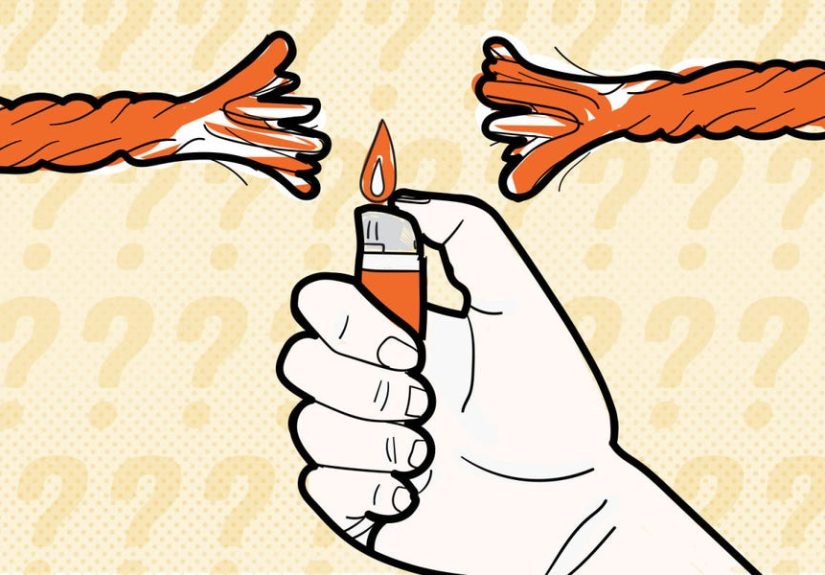
The setup is beautifully minimal. You have two ropes. Each rope takes exactly one hour to burn from end to end. The catch? The ropes do not burn at a steady rate. One section might burn quickly, another section might crawl along like it is waiting for coffee. You also have a way to light the ropes. The challenge is this: how can you measure exactly 45 minutes?
Before we begin, a practical note: this is a reasoning puzzle, not a weekend experiment. Please do not test it with real fire, real rope, or real eyebrows. The magic here belongs safely on the page.
Understanding the Burning Rope Problem
The Burning Rope Problem is a famous brain teaser in recreational mathematics and interview-style logic puzzles. Its charm comes from one sneaky limitation: because the ropes burn unevenly, you cannot use physical length as a timer. Half the rope does not necessarily represent half an hour. A quarter of the rope does not necessarily represent 15 minutes. The rope may be polite enough to finish in one hour, but it refuses to be predictable along the way.
This detail eliminates the most obvious answer. Many people begin by thinking, “Just mark three-fourths of the rope and burn to that point.” Unfortunately, that does not work. If one part of the rope burns faster than another, then 75 percent of the length tells you almost nothing about 75 percent of the time. The puzzle is not about measuring distance; it is about controlling burn events.
The key insight is that while each rope burns unpredictably from section to section, the entire rope still has a known total burn time: one hour. That total time is reliable. The trick is to use the endpoints of the ropes as timing tools.
The Short Answer: How to Measure Exactly 45 Minutes
Here is the solution in its cleanest form:
- At the same moment, light Rope A at both ends.
- At that same moment, light Rope B at one end.
- When Rope A finishes burning, exactly 30 minutes have passed.
- At that instant, light the other end of Rope B.
- When Rope B finishes burning, exactly 45 minutes have passed in total.
That is the whole answer. It sounds almost too neat, which is why the puzzle is so satisfying. The solution does not require measuring the rope, cutting the rope, folding the rope, guessing, or asking the rope to please behave like a normal ruler.
Why Lighting Both Ends Creates a 30-Minute Timer
Let’s unpack the logic, because this is where the puzzle stops being a party trick and starts becoming a lesson in problem-solving.
Each rope takes one hour to burn completely when lit from one end. If you light both ends of one rope at the same time, two flames move toward each other. The rope does not need to burn evenly for this to work. The two flames may move at different apparent speeds depending on the rope’s changing density, coating, or thickness, but together they consume the entire rope in half the total one-ended burn time.
So Rope A, lit at both ends, becomes a 30-minute timer. It burns completely after exactly half an hour. This does not happen because the rope has a uniform middle point. It happens because the rope’s total “burning capacity” is being consumed from two directions at once.
Why Rope B Gives You the Remaining 15 Minutes
While Rope A is burning from both ends, Rope B is also burning, but only from one end. After 30 minutes, Rope B has not necessarily burned through half its length. It may have burned through a tiny-looking section or a huge-looking section. That does not matter.
What matters is time. Since Rope B would take 60 minutes to burn completely from one end, and it has already burned for 30 minutes, it has exactly 30 minutes of burn time remaining if left burning from only one end.
Now comes the clever move. When Rope A burns out at the 30-minute mark, you light the other end of Rope B. Rope B now has 30 minutes of burn time remaining, but it is burning from both ends. That remaining burn time is cut in half. Therefore, Rope B burns out 15 minutes later.
Add the pieces together: 30 minutes from Rope A, plus 15 more minutes from the remaining Rope B. Total: 45 minutes.
The Full Timeline
Minute 0: Start the puzzle
Light both ends of Rope A. At the exact same time, light one end of Rope B. The clock has started, even though no clock exists. Very rude of the puzzle, but here we are.
Minute 30: Rope A is gone
Rope A has burned from both ends, so it is completely consumed after 30 minutes. Rope B has been burning from one end for the same 30 minutes. It now has 30 minutes of burn time left.
Minute 30: Light the other end of Rope B
At the moment Rope A disappears, light the unlit end of Rope B. The remaining burn time on Rope B is now attacked from two directions.
Minute 45: Rope B is gone
Rope B’s remaining 30 minutes of one-ended burn time has been reduced to 15 minutes by burning from both ends. When Rope B is completely burned, exactly 45 minutes have passed.
Why the Obvious Answers Fail
“Can’t we just burn three-fourths of a rope?”
No. This is the trap. If the rope burned uniformly, three-fourths of the length would represent 45 minutes. But the problem clearly says the burn rate is inconsistent. The first inch might take 20 minutes, while the next several inches might vanish quickly. Measuring the length is useless.
“Can’t we fold the rope?”
Folding the rope creates equal physical sections, not equal burn-time sections. If one folded half contains denser or slower-burning material, it may take far longer to burn than the other half. The puzzle does not give you a magical fold that divides time evenly.
“Can’t we cut the rope?”
Cutting would not solve the problem unless you already knew how long each piece would take to burn. Since the burn rate varies along the rope, a short piece could burn longer than a longer piece. The rope is basically saying, “Good luck judging me by appearances.”
The Real Lesson Behind the Riddle
The Burning Rope Problem teaches a powerful thinking skill: focus on what is guaranteed, not what looks convenient. The guaranteed fact is not that the rope’s length corresponds to time. The guaranteed fact is that each complete rope burns in exactly one hour from one end.
Strong puzzle solving often depends on separating assumptions from facts. Many solvers assume equal length means equal time because that works in everyday measurements. But the riddle deliberately breaks that assumption. It asks you to build a solution only from the facts that remain reliable.
This is why the puzzle appears in logic discussions, math enrichment activities, and interview-style problem sets. It rewards flexible thinking. The answer is not hidden in advanced mathematics; it is hidden behind an everyday habit of thinking too literally.
A Simple Analogy: The Uneven Road Trip
Imagine two delivery drivers each have a route that always takes one hour. One route includes traffic lights, highways, potholes, and one terrifying roundabout. The drivers do not travel at a constant speed, but each route reliably takes one hour from start to finish.
If you asked, “How far has the driver gone after 30 minutes?” the answer might be unpredictable. Maybe the driver covered most of the distance quickly, or maybe traffic held them back. But if you create a system where two drivers start from opposite ends of the same route, the whole route is covered faster because both ends are being handled simultaneously.
That is the same kind of thinking behind the rope solution. You are not measuring distance. You are coordinating events.
Why This Puzzle Feels So Good Once You Solve It
The best riddles are not just hard; they are fair. The Burning Rope Problem gives you all the information you need. It even hints at the solution by mentioning two ropes and allowing you to light ends. The challenge is noticing that “both ends” is not a decorative phrase. It is the door handle.
Once you see the answer, the puzzle feels obvious. That is the hallmark of a great brain teaser. It creates a mental click. You do not just memorize the solution; you remember the shift in perspective.
Common Mistakes Solvers Make
Mistake 1: Treating rope length as time
The biggest mistake is assuming physical length maps directly to minutes. The puzzle removes that possibility on purpose.
Mistake 2: Looking for hidden tools
Some people try to invent extra tools: knives, rulers, knots, clocks, water, sand, or a suspiciously helpful stopwatch. But the classic version only needs the two ropes and the ability to light their ends.
Mistake 3: Ignoring simultaneous action
Timing matters. Rope A and Rope B must be lit at the same starting moment. The solution depends on creating two countdowns at once.
Mistake 4: Thinking uneven burning ruins the solution
Uneven burning ruins length-based solutions, but it does not ruin endpoint-based timing. That is the central twist.
Can This Method Measure Other Times?
Yes, variations of rope-burning puzzles can measure other intervals, depending on the number of ropes, their total burn times, and the rules about when ends may be lit. With two one-hour ropes, the classic trick produces 30 minutes and then 45 minutes. More complex versions explore other measurable times, sometimes using several ropes or ropes with different burn durations.
The broader idea belongs to a family of puzzles about “fusible” time intervals. In plain English, these are times you can create by lighting one or both ends of ropes according to specific rules. You do not need that terminology to enjoy the riddle, but it shows that this puzzle is more than a one-off trick. It is part of a surprisingly deep little corner of recreational math.
How to Explain the Burning Rope Problem to Someone Else
If you want to explain this puzzle clearly, avoid starting with the answer. Let the listener wrestle with the unreliable burn rate first. That frustration is part of the fun. Then guide them with one question: “What happens if a rope burns from both ends?”
Once they realize that one rope can create a 30-minute timer, the second half of the solution becomes easier. Ask, “What should the second rope be doing during those first 30 minutes?” That question often leads them to the key step: burn Rope B from one end while Rope A is timing the first half hour.
Finally, when Rope A finishes, ask what remains of Rope B. The answer is not half its length. The answer is 30 minutes of burn time. That distinction is the whole puzzle.
Experience Notes: What This Riddle Teaches About Real Problem Solving
The Burning Rope Problem is memorable because it mirrors real-life decision-making more than people expect. In daily life, we often face problems where the most visible measurement is not the most useful one. We see rope length and want to measure it. We see a long to-do list and assume the longest task will take the most time. We see a thick book and assume it must be harder than a thin one. Then reality walks in wearing muddy shoes and says, “Not always.”
One experience many puzzle lovers share is the sudden embarrassment of the solution. You stare at the problem for several minutes, convinced there must be a complicated trick. Maybe you imagine calculating burn rates, dividing rope segments, or inventing a mathematical formula worthy of a dramatic chalkboard scene. Then the answer turns out to be: light one rope at both ends. It is simple, but not simplistic. That is what makes it elegant.
This riddle also teaches patience with constraints. A beginner might complain that the rope burns unevenly, as if that makes the puzzle unfair. But the uneven burn rate is not an obstacle added to annoy you; it is the feature that defines the puzzle. Without it, the problem would be too easy. You would simply measure three-fourths of the rope. The constraint forces creativity.
In writing, business, studying, or even planning a busy day, the same lesson applies. When a direct path fails, look for a structure that still behaves predictably. The rope’s length is unreliable, but the total burn time is reliable. In a project, your motivation may be unreliable, but your calendar may be reliable. In studying, your mood may vary, but a 25-minute focus session can still create progress. The best solutions often come from finding the stable part of an unstable situation.
Another useful experience from this riddle is learning to respect simultaneous action. Many people try to solve the puzzle one rope at a time. First this, then that. But the solution requires starting two processes together. Rope A measures the first 30 minutes while Rope B quietly prepares the next 15. That is a wonderful metaphor for smart planning. Sometimes the secret is not working harder; it is starting the right second process early.
There is also a communication lesson here. When explaining the answer, saying “lighting both ends makes it burn twice as fast” is helpful but incomplete. The more accurate explanation is that two flames consume the entire remaining burn time from opposite directions. This matters because the rope does not burn evenly. A good explanation does not skip the weird detail; it shows why the weird detail does not break the solution.
Finally, the Burning Rope Problem reminds us that cleverness is often quieter than we expect. It does not always look like a giant leap. Sometimes it looks like noticing the only reliable rule in the room and using it twice. That is why the riddle remains popular: it gives your brain a tiny workout, a tiny surprise, and a tiny ego check, all without requiring calculus. Honestly, for a piece of imaginary rope, that is a pretty impressive résumé.
Conclusion
The solution to Riddle of the Week #6: The Burning Rope Problem is to light one rope at both ends and the second rope at one end at the same time. When the first rope burns out, 30 minutes have passed. Then light the other end of the second rope. Since it has 30 minutes of burn time remaining, burning it from both ends makes it finish in 15 more minutes. Together, that measures exactly 45 minutes.
The puzzle works because it avoids the false assumption that rope length equals time. Instead, it relies on the one fact that stays dependable: each full rope burns in exactly one hour from one end. That makes the Burning Rope Problem a brilliant example of logical thinking, constraint-based problem solving, and the joy of realizing the answer was hiding in plain sight the entire time.