Table of Contents >> Show >> Hide
- What Is C-DAEM?
- Why AI-Guided Artillery Matters
- From Excalibur to AI-Assisted Rounds
- XM1180: The Tank-Hunting Artillery Round
- XM1208: Replacing Cluster Effects More Safely
- Why GPS-Denied Warfare Changes Everything
- Collaborative Target Seeking: When Shells Work as a Team
- The Industrial Base Problem: Smart Shells Still Need Factories
- Ethics, Human Judgment, and AI in Lethal Systems
- What This Means for Future Warfare
- Experience-Based Insights: Lessons From the Smart Artillery Shift
- Conclusion
Artillery used to be the battlefield equivalent of throwing a very angry refrigerator across town and hoping math, weather, and luck all showed up to work that day. Today, the U.S. Army wants something much smarter: 155mm artillery rounds that can fly into a contested battlespace, search for armored targets, and guide themselves toward the right threat even when GPS is jammed or unreliable.
That is the big idea behind the Army’s Cannon-Delivered Area Effects Munition, better known as C-DAEM. The program is not simply about making a shell “smarter” because smart things sound cooler in a press release. It is about solving a hard battlefield problem: how to give cannon artillery the ability to defeat moving tanks, infantry fighting vehicles, self-propelled howitzers, and dispersed enemy formations without relying entirely on old cluster munitions or perfect target coordinates.
The result is a new generation of precision artillery that combines sensors, guidance, advanced seekers, and possibly artificial intelligence-assisted target recognition. In plain English, the Army wants artillery shells that do more than follow a GPS point. It wants rounds that can help find, identify, and attack the right target in a messy battlefield environment. That is a serious leap from “fire and adjust” to “fire and think.” Naturally, the shell is not composing poetry on the way down, but compared with a conventional high-explosive round, it is practically wearing a tiny graduation cap.
What Is C-DAEM?
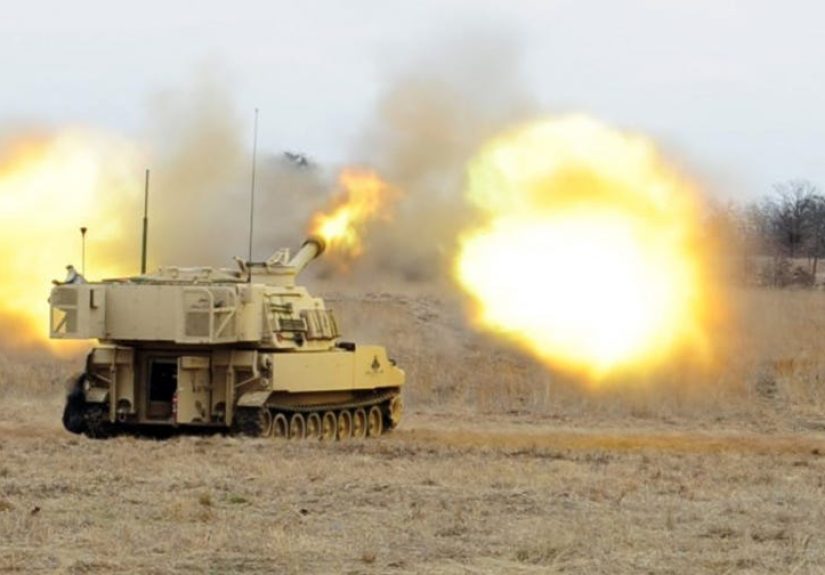
C-DAEM stands for Cannon-Delivered Area Effects Munition. It is a U.S. Army effort to modernize 155mm artillery ammunition for current and future howitzers, including systems such as the M777 and M109 Paladin family. The program is designed to replace or supplement older Dual-Purpose Improved Conventional Munitions, known as DPICM, which scattered smaller submunitions over an area.
DPICM was effective because it covered a wide area and could damage vehicles, equipment, and personnel. The problem was the dud rate. Some submunitions failed to explode, leaving dangerous unexploded ordnance on the battlefield long after the fighting stopped. That created risks for civilians, friendly forces, and anyone unlucky enough to walk through the wrong field years later.
C-DAEM aims to preserve the battlefield usefulness of area effects while reducing unexploded ordnance risk and improving precision. The Army’s solution includes multiple munition paths, most notably XM1208 and XM1180. The XM1208 is intended as a DPICM replacement for area personnel and light-materiel targets, while XM1180 C-DAEM Armor is focused on defeating moved and moving armored vehicles at extended ranges.
Why AI-Guided Artillery Matters
The modern battlefield is crowded, fast, and electronically hostile. Enemy vehicles move, hide, decoy, jam, and shoot back. GPS can be degraded. Drones may spot targets for only seconds. Counter-battery radars can locate artillery quickly, forcing gun crews to fire and move before enemy rounds arrive. In that environment, a shell that can only hit a fixed coordinate is useful, but a shell that can search around a target area and make final guidance decisions is far more valuable.
AI-guided artillery matters because it may reduce the time between detection and destruction. Instead of requiring flawless coordinates, the round can be given a target type and approximate location. After launch, onboard sensors and guidance systems can search the expected area, recognize a target signature, and complete the engagement. This does not mean the shell becomes a tiny battlefield general. Human commanders and operators still define the mission, target area, and rules of engagement. But the munition may perform more of the final sensing and guidance work after it leaves the cannon.
That is especially important against moving armor. A tank that was at one grid coordinate 30 seconds ago may not be there when the shell arrives. Traditional artillery can compensate by firing more rounds, but that burns ammunition and increases collateral risk. A guided munition with onboard target recognition can be more efficient, more precise, and more relevant against a mobile enemy.
From Excalibur to AI-Assisted Rounds
The Army did not jump from dumb shells to artificial intelligence overnight. The journey has been gradual. The M982 Excalibur brought precision-guided 155mm artillery into the modern era by using GPS and inertial navigation to deliver accurate long-range fire. Excalibur proved that cannon artillery could hit with missile-like precision while still being fired from conventional artillery tubes.
Then came the Precision Guidance Kit, or PGK, which allowed existing 155mm shells to be upgraded with a GPS-guided fuze package. PGK does not turn every round into a miracle machine, but it improves accuracy and makes conventional ammunition more useful. Think of it as giving an old shell a pair of glasses and a better sense of direction.
C-DAEM is the next step. Instead of merely guiding toward a coordinate, the goal is to give the projectile more awareness in the terminal phase. The XM1180 C-DAEM Armor projectile has been described as a 155mm guided artillery round designed to defeat moving and moved vehicles, including armored and mechanized targets. It is being developed for GPS-contested environments and for counter-fire or maneuver-support missions where the target may not politely remain parked.
XM1180: The Tank-Hunting Artillery Round
The XM1180 is the most attention-grabbing part of C-DAEM because it aims to give Army artillery units a precision anti-armor capability from long range. In public Army descriptions, the XM1180 is designed to provide extended-range lethality against moving and moved vehicles. In simpler terms, it is intended to let artillery crews attack tanks and armored vehicles without needing a direct line of sight.
That capability matters because tanks are hard targets. A conventional artillery shell can damage a tank if it lands very close, but heavy armor is built to survive fragments, blast, and bad days in general. A dedicated anti-armor round needs to do more than explode nearby. It must find the vehicle, approach from a useful angle, and deliver a defeat mechanism effective against armor.
The Army has also discussed target identification and seeker handover in connection with XM1180 testing. That phrase may sound like something from a robotics dissertation, but it means the projectile has to transition from broader flight guidance to a terminal seeker that can locate the target and guide the final attack. That is the critical “smart” part: the shell must not only travel far; it must arrive with enough awareness to finish the job.
XM1208: Replacing Cluster Effects More Safely
While XM1180 is aimed at armor, XM1208 addresses the wider need to replace DPICM-style area effects. According to public program information, the XM1208 is a 155mm projectile carrying advanced submunitions and designed for current howitzers such as the M109A6/A7 and M777A2. Its role is to engage area personnel targets and limit an enemy force’s freedom of movement.
This is a delicate balance. Militaries want area effects because battlefields are not neat spreadsheets. Enemy troops, light vehicles, sensors, and weapons can spread out. A single point-detonating shell may miss the useful target set. But the old answerscatter many bomblets and accept the risk of leftoversis increasingly unacceptable from both operational and humanitarian perspectives.
Modern area-effect munitions therefore try to combine coverage with reliability. The goal is to reduce the chance of unexploded ordnance while maintaining the ability to suppress, disrupt, or destroy dispersed threats. That is a major reason C-DAEM exists: the Army wants battlefield effectiveness without dragging yesterday’s UXO problems into tomorrow’s wars.
Why GPS-Denied Warfare Changes Everything
For years, precision weapons leaned heavily on GPS. That made sense. GPS is powerful, mature, and widely integrated into U.S. weapons, navigation, and command systems. But adversaries noticed. Electronic warfare has become a central part of modern combat, and GPS jamming is no longer a theoretical headache reserved for PowerPoint slides with too many arrows.
In a GPS-denied or GPS-degraded environment, a munition must use other methods to find its way. That can include inertial navigation, onboard sensors, seekers, terrain-related information, external cueing, or combinations of guidance methods. For artillery, the challenge is brutal: a 155mm shell experiences enormous launch forces, spins, flies fast, and has limited internal space for electronics. Building a smart round is not like putting a smartphone in a metal tube and yelling “good luck.” The electronics must survive launch, operate quickly, and make reliable decisions in seconds.
That is why AI-assisted target recognition is attractive. Machine learning can help classify sensor inputs, distinguish target shapes, and support faster decision-making in the terminal phase. The better the round can recognize what it is seeing, the less it depends on perfect GPS coordinates. In future conflicts, that may be the difference between a clean hit and an expensive crater with self-esteem issues.
Collaborative Target Seeking: When Shells Work as a Team
One of the more futuristic ideas connected to advanced artillery is collaborative target seeking. Instead of each round acting alone, multiple munitions could potentially share information or coordinate search patterns to improve target detection and engagement. This concept is still complex and developing, but it reflects where precision fires are heading.
Imagine several shells fired into a target area where enemy armored vehicles are moving, hiding, or dispersing. If each round searches independently, some may duplicate effort while others miss the best target. If rounds can collaborate, they may divide the search area, avoid redundancy, and improve the odds that the most important targets are engaged. That is the battlefield version of group work, except nobody can complain that one shell did all the work while the others just edited the title slide.
Collaborative weapons also raise important questions. Communication links can be jammed. Algorithms can make mistakes. Rules of engagement must remain clear. Commanders need confidence that the weapon will behave within intended limits. For the Army, the promise is huge, but so is the responsibility to test these systems under realistic conditions.
The Industrial Base Problem: Smart Shells Still Need Factories
AI-guided artillery sounds like a software story, but it is also a factory story. The United States has been expanding 155mm ammunition production because recent wars have shown just how quickly artillery stockpiles can disappear. Ukraine’s defense against Russia, in particular, reminded the world that high-tech warfare still consumes old-fashioned steel, explosives, propellant, fuzes, and logistics capacity at astonishing rates.
The Army has publicly pushed toward a goal of producing 100,000 155mm shots per month. That matters because a brilliant guided round is not useful if it exists only as a briefing chart and three test articles in a desert. Precision munitions require reliable supply chains for electronics, energetics, metal parts, sensors, and testing infrastructure. Smart weapons are only as strong as the industrial base behind them.
This is where C-DAEM becomes more than a laboratory experiment. If the Army wants guided artillery at scale, it must solve production cost, reliability, component availability, and compatibility with existing guns. A munition that works only in perfect test conditions or costs too much to fire regularly will struggle to shape real operations.
Ethics, Human Judgment, and AI in Lethal Systems
Whenever artificial intelligence enters a weapon system, the conversation immediately becomes seriousand it should. The Department of Defense has updated policies for autonomy in weapon systems, emphasizing that commanders and operators must exercise appropriate human judgment over the use of force. That principle is central to how the U.S. military frames AI-enabled weapons.
For artillery rounds like C-DAEM, the ethical question is not simply “Can the shell recognize a target?” It is “Can the entire targeting process remain lawful, controlled, accountable, and reliable?” A human may approve the target type, location, timing, and engagement authority, but the munition may perform final target detection in flight. That creates a need for rigorous testing, clear constraints, reliable fail-safes, and honest performance data.
Supporters argue that smarter artillery can reduce collateral damage by attacking more precisely and reducing the number of rounds needed. Critics worry about misidentification, automation bias, and the risk that speed will outrun human judgment. Both views deserve attention. A shell that can make final guidance decisions must be tested not just against clean targets on sunny test ranges, but against clutter, decoys, smoke, weather, civilian objects, and electronic interference.
What This Means for Future Warfare
If C-DAEM and similar systems mature, artillery could regain some of the battlefield influence that long-range missiles and drones have recently enjoyed. Cannon artillery has advantages: guns can fire repeatedly, rounds are smaller than missiles, and howitzers are already widely fielded. A 155mm round that can reach farther, survive GPS jamming, and attack moving armor would give brigade combat teams a powerful tool.
It could also complicate enemy behavior. Armored units would have to worry not only about drones, mines, anti-tank missiles, and loitering munitions, but also about artillery shells searching from above. Movement, concealment, dispersion, and electronic warfare would become even more important. The battlefield would get faster and less forgiving.
However, smart artillery will not replace everything. It will not make logistics easy, remove the need for trained observers, or magically solve targeting in dense urban environments. It will be one piece of a larger kill chain that includes sensors, command systems, human judgment, electronic warfare, counter-battery protection, and ammunition supply. The shell may be smart, but the system around it has to be smarter.
Experience-Based Insights: Lessons From the Smart Artillery Shift
Looking at the Army’s move toward AI-guided artillery, one practical lesson stands out: precision is not just about accuracy; it is about trust. Soldiers need to trust that a munition will behave as expected under pressure. Commanders need to trust that it will hit the intended target type. Policymakers need to trust that it fits legal and ethical rules. Taxpayers need to trust that it is not just an expensive science fair project with camouflage paint.
Past experience with precision weapons shows that battlefield conditions quickly expose weaknesses. A weapon that performs beautifully in controlled testing may face jamming, weather, dust, damaged sensors, poor target data, or unexpected enemy tactics. The more a weapon relies on advanced software and sensors, the more important realistic testing becomes. For C-DAEM, success will depend on whether the Army can prove reliability across ugly, imperfect scenariosthe kind real wars specialize in producing.
Another lesson is that “smart” weapons do not remove the need for smart people. Fire direction centers, forward observers, intelligence analysts, artillery crews, and commanders still matter. AI can accelerate parts of the targeting process, but humans define intent, judge proportionality, and decide whether an engagement is appropriate. The best future artillery units will likely be those that combine advanced munitions with disciplined training, fast data flow, and clear decision-making.
There is also an ammunition economy lesson. Precision rounds are expensive, but missing is expensive too. Firing many unguided rounds to achieve one effect consumes logistics, exposes crews, wears out tubes, and increases risk to civilians. A guided round that costs more per shot may still be cheaper per successful effect if it reduces the number of rounds required. That is the math the Army must keep testing, because budgets do not care how cool a seeker looks in a brochure.
Finally, the C-DAEM story shows that artillery is not becoming obsolete. It is evolving. For years, some observers treated tube artillery as old-school firepower in a world of drones and missiles. But the wars of the 2020s have reminded everyone that artillery remains central to large-scale combat. The difference is that tomorrow’s artillery may be networked, sensor-driven, GPS-resilient, and AI-assisted. In other words, the King of Battle is not retiring. He is getting a software updateand hopefully reading the user manual.
Conclusion
The U.S. Army’s work on AI-guided artillery rounds reflects a major shift in how land forces think about precision fires. C-DAEM, XM1180, and XM1208 are not just new shells; they are part of a broader effort to make 155mm artillery more accurate, more lethal, more responsible, and more useful in GPS-contested warfare. The promise is clear: fewer wasted rounds, better performance against moving armor, reduced dependence on cluster munitions, and more options for commanders facing fast-moving threats.
The challenge is equally clear. AI-assisted munitions must be reliable, lawful, affordable, scalable, and tested against the chaos of real combat. The Army is trying to build artillery rounds that can sense and guide themselves, but the future of this technology will depend on more than clever algorithms. It will depend on factories, doctrine, training, human judgment, and the ability to keep control over weapons that are becoming faster and smarter.
If the program succeeds, the next generation of artillery may not simply land where it is told. It may search, decide within strict mission limits, and strike moving threats with a level of precision once reserved for missiles. That does not make war simple, clean, or easy. But it does show where military technology is going: toward weapons that combine old firepower with new intelligence. The cannon is still roaring. Now, apparently, it is also thinking.