Table of Contents >> Show >> Hide
- What Is the Volume of a Cylinder?
- Why There Are 3 Ways to Calculate the Volume of a Cylinder
- Method 1: Calculate Cylinder Volume Using Radius and Height
- Method 2: Calculate Cylinder Volume Using Diameter and Height
- Method 3: Calculate Cylinder Volume Using Circumference and Height
- Quick Comparison of the 3 Methods
- Tips for Solving Cylinder Volume Problems Correctly
- Real-World Examples of Cylinder Volume
- Sample Practice Problems
- Final Thoughts on How to Calculate the Volume of a Cylinder
- Experiences and Lessons People Commonly Have When Learning Cylinder Volume
- SEO Tags
Note: This article is formatted as HTML body content for direct web publishing.
Some math problems look friendly. Others show up wearing fake glasses and pretending to be complicated. Cylinder volume is one of the friendly ones. Once you understand the core idea, you can solve it in several different ways without breaking a sweat or launching a dramatic search for a missing calculator.
If you are trying to find the volume of a cylinder, the big concept is simple: volume tells you how much space is inside a three-dimensional object. For a cylinder, that means the amount of space inside shapes like soup cans, water tanks, candles, pipes, batteries, and even some swimming pools. In everyday life, this matters when you want to know capacity, storage space, liquid measurement, or material needed for a project.
The good news is that the cylinder volume formula is not a one-trick pony. You can calculate it with the radius and height, with the diameter and height, or with the circumference and height. These are really three different paths to the same answer. Think of it as taking different roads to the same pizza place. The destination is still delicious.
What Is the Volume of a Cylinder?
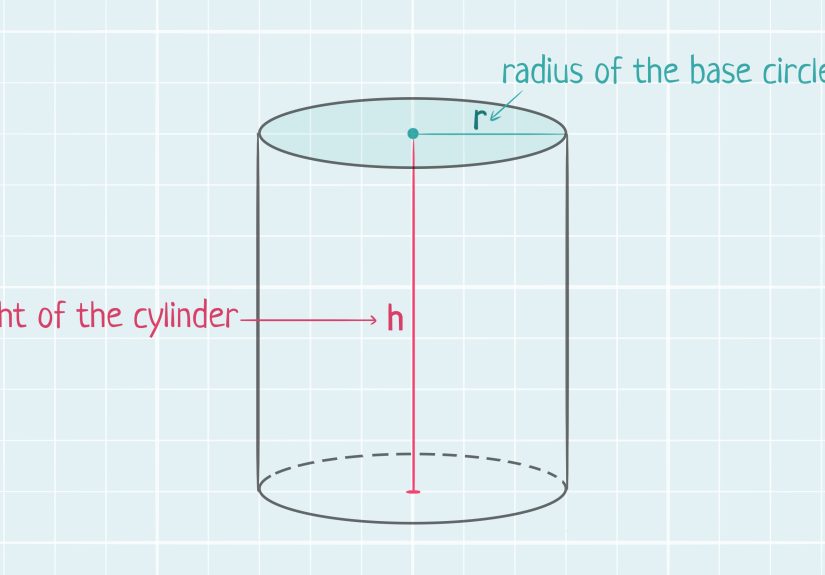
A cylinder is a three-dimensional shape with two matching circular bases and one curved side connecting them. To calculate its volume, you first find the area of the circular base, then multiply that by the height. That is why the basic structure looks like this:
Volume = Area of the base × Height
Because the base of a cylinder is a circle, the area of the base is:
A = πr2
So the standard formula becomes:
V = πr2h
In this formula, V means volume, r means radius, and h means height. The final answer is written in cubic units, such as cubic inches, cubic feet, or cubic centimeters. That “cubic” part matters. If your answer says inches instead of cubic inches, the math police will not arrest you, but your teacher may raise an eyebrow.
Why There Are 3 Ways to Calculate the Volume of a Cylinder
Many students memorize V = πr²h and then freeze the second a problem gives a diameter instead of a radius. Others see circumference and suddenly act like the problem has betrayed them personally. But all three methods work because diameter and circumference can both be converted into radius. Since radius is the key ingredient in the base area, you can always work backward to get the volume.
Here are the three most useful methods:
- Use radius and height
- Use diameter and height
- Use circumference and height
Method 1: Calculate Cylinder Volume Using Radius and Height
The Formula
This is the classic method and the most direct one:
V = πr2h
How It Works
You square the radius, multiply by π, and then multiply by the height. That gives you the space inside the cylinder. This method is fastest when the problem already gives you the radius.
Example
Suppose a cylinder has a radius of 4 inches and a height of 10 inches.
Step 1: Write the formula.
V = πr²h
Step 2: Substitute the values.
V = π(4)²(10)
Step 3: Square the radius.
V = π(16)(10)
Step 4: Multiply.
V = 160π
Decimal form:
V ≈ 502.65 in³
So the volume of the cylinder is 160π cubic inches, or about 502.65 cubic inches.
When to Use This Method
Use this method when the radius is given directly. It is the cleanest approach, the least messy, and the one most math books introduce first. It is also great for mental setup because you can immediately see the relationship between the size of the base and the height.
Common Mistake to Avoid
Do not square the whole formula by accident. Only the radius gets squared. The formula is πr²h, not (πrh)². That tiny difference causes giant headaches.
Method 2: Calculate Cylinder Volume Using Diameter and Height
The Formula
If the problem gives you the diameter, convert it to radius first:
r = d ÷ 2
Then plug it into the regular formula:
V = π(d ÷ 2)2h
You can also simplify that into:
V = (πd2h) ÷ 4
How It Works
The diameter is the full distance across the circle, while the radius is only half of that. Since the basic formula uses radius, you must divide the diameter by 2 before doing anything else. This is the step students forget most often, which is why diameter questions love to cause surprise chaos.
Example
Suppose a cylinder has a diameter of 8 centimeters and a height of 12 centimeters.
Step 1: Find the radius.
r = 8 ÷ 2 = 4 cm
Step 2: Use the volume formula.
V = πr²h
Step 3: Substitute the values.
V = π(4)²(12)
Step 4: Simplify.
V = π(16)(12) = 192π
Decimal form:
V ≈ 603.19 cm³
So the volume is 192π cubic centimeters, or about 603.19 cubic centimeters.
When to Use This Method
This method is perfect when you are measuring real objects like jars, pipes, cans, and drums. In real life, diameter is often easier to measure than radius because you can measure straight across the top.
Shortcut Tip
If you do enough of these problems, the shortcut formula V = πd²h ÷ 4 can save time. But only use it if you are comfortable with it. If not, dividing by 2 first is usually clearer and safer.
Method 3: Calculate Cylinder Volume Using Circumference and Height
The Formula
Sometimes a problem gives you the circumference of the base instead of the radius or diameter. That is not a disaster. It is just math wearing a different hat.
Start with the circle formula:
C = 2πr
Solve for the radius:
r = C ÷ 2π
Then plug that into the volume formula:
V = π(C ÷ 2π)2h
This simplifies to:
V = C2h ÷ 4π
How It Works
This method is useful when the distance around the circular base is easier to measure than the distance across it. For example, if you wrap a tape measure or string around a cylinder, you may get the circumference first. From there, you can still find the volume.
Example
Suppose a cylinder has a circumference of 10π centimeters and a height of 12 centimeters.
Step 1: Find the radius.
r = C ÷ 2π = 10π ÷ 2π = 5 cm
Step 2: Use the volume formula.
V = πr²h
Step 3: Substitute the values.
V = π(5)²(12)
Step 4: Simplify.
V = π(25)(12) = 300π
Decimal form:
V ≈ 942.48 cm³
So the volume is 300π cubic centimeters, or about 942.48 cubic centimeters.
When to Use This Method
Use this approach when the problem gives the circumference directly or when you can easily wrap a measuring tape around the object. It is especially handy in practical situations where the top of the cylinder is not easy to measure straight across.
Quick Comparison of the 3 Methods
All three methods lead to the same result. The only difference is the information you start with.
- Radius + height: fastest and most direct
- Diameter + height: common in measurements of real objects
- Circumference + height: useful when you measure around the object
So no, you do not need three totally different math brains. You just need one formula and a little flexibility.
Tips for Solving Cylinder Volume Problems Correctly
1. Check Which Measurement You Were Given
Always identify whether the number is a radius, diameter, or circumference. This sounds obvious, but math errors love to begin with “I thought that was the radius.”
2. Watch the Units
If the measurements are in inches, the answer will be in cubic inches. If the measurements are in centimeters, the answer will be in cubic centimeters. Volume always uses cubic units.
3. Decide Whether to Leave the Answer in Terms of π
Many classroom problems accept an exact answer like 90π. Others ask for a decimal approximation. Read the directions carefully. One teacher wants elegance. Another wants a rounded number. Both are valid. Both can grade your paper.
4. Do Not Round Too Early
Keep π in your calculator until the final step whenever possible. Rounding too soon can make your final answer less accurate.
5. Remember That Radius Is Squared
This is a huge deal. If the radius doubles while the height stays the same, the base area becomes four times larger, so the volume also becomes four times larger. That is why changing the radius can affect the volume much more dramatically than many students expect.
Real-World Examples of Cylinder Volume
The volume of a cylinder shows up all over daily life. Here are a few common examples:
- Soup cans and food containers: used to estimate how much they hold
- Water tanks: used to calculate storage capacity
- Pipes and tubes: used to estimate internal space or liquid flow capacity
- Candles: used to compare sizes and wax amounts
- Round planters: used to estimate how much soil is needed
- Swimming pools: used to estimate how much water is required
Once you know how to calculate cylinder volume, you are not just doing school math. You are solving practical measurement problems that show up in science, engineering, construction, cooking, and DIY projects.
Sample Practice Problems
Problem 1
A cylinder has a radius of 3 feet and a height of 9 feet. Find the volume.
V = π(3)²(9) = 81π ≈ 254.47 ft³
Problem 2
A cylinder has a diameter of 14 centimeters and a height of 20 centimeters. Find the volume.
r = 14 ÷ 2 = 7
V = π(7)²(20) = 980π ≈ 3078.76 cm³
Problem 3
A cylinder has a circumference of 12π inches and a height of 7 inches. Find the volume.
r = 12π ÷ 2π = 6
V = π(6)²(7) = 252π ≈ 791.68 in³
These examples show why knowing multiple approaches is so useful. The data may change, but the logic stays steady.
Final Thoughts on How to Calculate the Volume of a Cylinder
If you remember only one thing, remember this: the volume of a cylinder comes from finding the area of the circular base and multiplying it by the height. Everything else is just a way of getting the radius when the problem chooses to be slightly dramatic.
So whether you are given the radius, the diameter, or the circumference, you can still solve the problem with confidence. Use the method that matches the information you have, keep your units organized, and do not forget to square the radius. That little exponent is doing more work than it gets credit for.
Once this concept clicks, cylinder volume stops feeling like a formula to memorize and starts feeling like a pattern you actually understand. And that is where math gets much less scary and a lot more useful.
Experiences and Lessons People Commonly Have When Learning Cylinder Volume
One of the most interesting things about learning how to calculate the volume of a cylinder is that people usually do not struggle with the idea of volume itself. They struggle with the setup. In classrooms, students often understand that a cylinder is basically a stack of circles, but the confusion begins the moment a worksheet switches from radius to diameter. Suddenly, a perfectly manageable problem becomes a tiny soap opera. A lot of learners say the same thing afterward: “I knew the formula, but I used the wrong number.” That experience is incredibly common, and it teaches an important lesson. In geometry, identifying the measurement correctly is often half the job.
Another common experience happens in science labs and simple home projects. Someone measures a can, battery, or pipe and realizes that real-world objects do not always come labeled with a neat little “r.” In real life, you might measure across the top and get the diameter, or wrap a string around the object and get the circumference. This is where the three methods become genuinely useful. People often feel more confident with the topic once they see that the formula is flexible. Instead of thinking, “I do not have the radius, so I am stuck,” they start thinking, “I can convert what I have into what I need.” That shift in mindset is a big win.
There is also a practical experience that shows up during tests: rounding trouble. Many students get almost everything right and then round too early, which causes the final answer to drift off course. After making that mistake once or twice, most people become much more careful about keeping π in the calculation until the end. It is one of those small habits that makes math feel smoother. Not more exciting, exactly, but definitely less annoying.
People working on DIY projects often run into cylinder volume in surprisingly normal situations. A gardener may estimate how much soil a round planter needs. A homeowner may figure out the capacity of a rain barrel. Someone buying concrete for a cylindrical post hole may want to avoid guessing and hoping for the best. In those moments, cylinder volume stops being a textbook topic and becomes a money-saving skill. Nobody enjoys buying too little material and making a second trip to the store. Nobody enjoys buying far too much and staring at the leftovers like a monument to poor planning.
Teachers also notice that students remember the concept better when it is tied to familiar objects. A soda can, candle, soup can, and swimming pool all make the idea more concrete. Once learners connect the formula to real objects, the concept usually sticks. The experience becomes less about memorizing symbols and more about understanding space, capacity, and measurement.
In the end, the experience of learning cylinder volume is usually a story of moving from confusion to clarity. At first, the formula looks like something to survive. Later, it becomes something useful, logical, and even a little satisfying. That is especially true when a student solves a problem using radius, then solves another using diameter, and finally handles one with circumference without panicking. That is the moment the topic clicks. And once it clicks, it tends to stay with you.