Table of Contents >> Show >> Hide
- Quick Snapshot: What “Floating Bungalow” Actually Means
- Context Matters: Venice Walk Streets and the Disappearing Bungalow
- Architect Visit: Approaching the House Like a Neighbor Would
- The Front Outdoor Room: A Friendly Line Between Public and Private
- Ground Floor: Loft-Like Openness That “Slips Under” the Cloud
- The Party Logic: A Built-In DJ Booth and “Festivity” as a Design Feature
- Color as Navigation: When a Staircase Becomes a Highlighter
- Upper Floor: Private Rooms Wrapped in a Minimal, Protective Shell
- The Floating Trick: Materials, Shadow, and Nighttime Magic
- Design Lessons You Can Steal Without Needing a Venice Address
- Why This House Still Matters in LA’s Architecture Conversation
- Conclusion: A House That Floats, but Also Connects
- Extra Field Notes: The Experience of an “Architect Visit” to a Floating Bungalow in LA
If you’ve ever walked a Venice, Los Angeles “walk street,” you know the vibe: compact cottages, neighbors close enough to borrow
a lemon (and also hear you argue about where the recycling goes), and a front-yard culture that feels more like a shared porch
than private territory. Now imagine a brand-new house that wants to honor that old bungalow spirit… while also quietly admitting,
“Yeah, I need more space than a 1920s cottage can give me.”
That’s where Bestor Architecture’s Floating Bungalow comes inan LA residence that pulls off a clever visual trick:
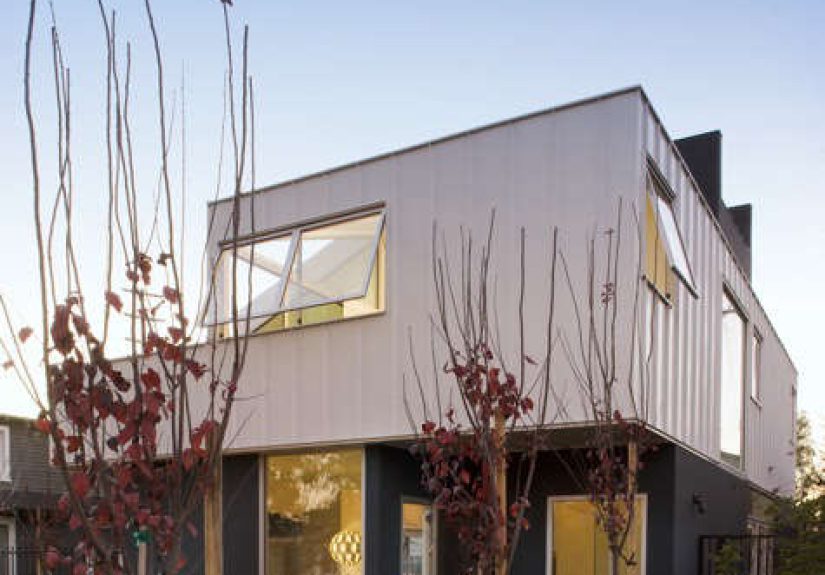
it looks like a bungalow got lifted into the air, turning into a white “cloud” hovering over an open, party-friendly ground floor.
It’s modernism with a wink, craftsmanship with a tan line, and just enough theatricality to make the neighborhood do a double-take.
Quick Snapshot: What “Floating Bungalow” Actually Means
- Where: Venice, Los Angeles (a pedestrian-friendly walk-street setting)
- Who: Bestor Architecture (Barbara Bestor, FAIA)
- Big idea: Reinterpret the traditional Venice bungalow by “lifting” the private rooms above a transparent, loft-like public level
- Signature moves: A white metal upper volume (“cloud”), charcoal exterior that visually dissolves at night, and an indoor-outdoor ground floor that behaves like a neighborhood living room
Context Matters: Venice Walk Streets and the Disappearing Bungalow
Venice has long been defined by small-scale bungalows and an outdoor life that’s less “backyard fortress” and more “porch diplomacy.”
But when bigger, boxier houses arrive, the neighborhood’s proportionsand social rhythmcan get bulldozed even when nothing is literally demolished.
Bestor’s concept responds to that tension by treating the bungalow not as a style to copy-and-paste, but as a cultural artifact worth translating.
A Tribute That Doesn’t Pretend Square Footage Isn’t a Thing
The Floating Bungalow’s central strategy is almost disarmingly straightforward: keep the public life generous and open at grade,
then tuck the private life above. Instead of spreading the house outward and crowding the lot, the design stacks the program.
The result is a home that nods to the modest bungalow scale of the street while still delivering a modern, expanded layout.
The “Cloud” Metaphor (Yes, It’s a MetaphorBut It’s Also Metal)
Bestor describes the upper floor as a white metal cloud that shrouds private areas. This isn’t fluffy sentimentalityit’s a
crisp architectural object: abstracted, lifted, and intentionally dreamlike. The gesture reads like a ghost of the old bungalow
floating above a contemporary life below.
Architect Visit: Approaching the House Like a Neighbor Would
Start at the walk street, because that’s the point. Unlike a typical “garage-forward” suburban experience, this house meets you in
pedestrian mode. The front of the property becomes an outdoor roomporch-like, open, and intentionally social. In a neighborhood where
people actually walk, the house behaves like it understands the assignment.
The Front Outdoor Room: A Friendly Line Between Public and Private
The street-facing zone functions as a welcoming extension of the neighborhoodcomplete with a fire pit vibe that practically invites
conversation. This is a subtle but powerful move: it preserves the walk-street tradition where front yards are social spaces, not decorative buffers.
If the goal is to build something new without acting like the neighborhood is just scenery, this is how you do it.
Ground Floor: Loft-Like Openness That “Slips Under” the Cloud
Under the hovering upper volume, the ground floor is defined by transparencypublic rooms that visually connect to outdoor spaces.
The plan reads as permeable and relaxed, with indoor-outdoor openings that let Southern California weather do what it does best:
turn architecture into lifestyle marketing (but, in this case, honestly).
The effect is a kind of architectural sleight of hand. By keeping the lower level visually open, the upper “bungalow” feels lighter.
Your eye doesn’t read a bulky two-story mass; it reads an airy base with something hovering above it.
The Party Logic: A Built-In DJ Booth and “Festivity” as a Design Feature
Here’s where the house stops being purely poetic and starts being extremely Venice: the design includes a built-in DJ booth.
That’s not just a quirky detailit’s an argument that homes can be serious about joy. A lot of modern houses are designed like nobody
ever laughs, dances, or plays music louder than a polite apology. This one isn’t shy about being fun.
The interiors lean into a creative, slightly industrial energyconcrete floors and bold, graphic color moments that make the spaces feel
alive rather than museum-quiet. In other words: the house can do “restraint,” but it can also do “we might host tonight.”
Color as Navigation: When a Staircase Becomes a Highlighter
In many homes, stairs are just circulation. Here, color helps turn movement into experience. A vivid stairwell becomes a spatial cue
a moment that says, “Yes, you are transitioning to the private cloud zone above.” It’s practical (wayfinding) and emotional (delight) at once.
Upper Floor: Private Rooms Wrapped in a Minimal, Protective Shell
Upstairs, the mood shifts. The “cloud” houses bedrooms and private spaces, creating separation from the public openness below.
This stacking strategy makes a lot of sense on dense urban lots: you keep the ground floor engaged with outdoor life while giving
the upper level privacy, quiet, and a little remove from the street.
The Floating Trick: Materials, Shadow, and Nighttime Magic
Charcoal Exterior That Dematerializes at Sunset
One of the most underrated moves is the charcoal exterior treatment that fades into darkness as the day ends. As the upper volume
visually recedes, the warm glow of the ground floor becomes the focal point. The house doesn’t just sit there; it performs across the day.
In the evening, it can feel like the bungalow is truly hoveringless like a stacked box, more like an illuminated public layer supporting a shadowy cloud.
Window Placement as Optical Engineering
Strategically placed windows help break down the mass and enhance the “floating” effect. Instead of punching holes randomly, openings
are composed to control sightlines and shadow. The result is a two-story home that reads lighter than it should, especially from the street.
Japanese Restraint Meets SoCal Creative Energy
A big part of the Floating Bungalow’s appeal is its dual personality: it can be restrained and finely crafted, then suddenly burst into
color and industrial texture. Think of it like mixing a clean, precise baseline with a playful remix. This balance keeps the house from
tipping into either extremeneither sterile minimalism nor chaotic “look at me” eclecticism.
Design Lessons You Can Steal Without Needing a Venice Address
1) Respect the Vernacular Without Cosplaying It
The Floating Bungalow doesn’t pretend it’s an old bungalow. It acknowledges the bungalow’s role in the neighborhood and then proposes
a contemporary answer: preserve the street’s human scale and social logic while updating the form for modern living.
That’s a more honest kind of contextual design than copying a roof pitch and calling it a day.
2) Put Public Life Where the Neighborhood Can Feel It
In walk-street communities, the ground plane matters. This project treats the front of the house as a social interface, not a defensive wall.
It’s a reminder that “privacy” and “community” don’t have to be enemiesyou can design a gradient between them.
3) Make the House Flexible Enough for Real Life
A loft-like lower floor, indoor-outdoor openings, movable furnishings, and a dedicated music zone all point to the same principle:
the home is designed for multiple modesquiet mornings, casual workdays, and bigger gatherings. A house that only works for one
Instagram-perfect moment is basically a set. This one feels like it’s meant to be lived in.
4) Use Color Like a Tool, Not a Costume
Bold color here isn’t random decoration; it’s a way to organize experience, energize certain zones, and reflect the personality of place.
In Los Angeleswhere light is intense and culture is layeredcolor can be architectural, not just cosmetic.
Why This House Still Matters in LA’s Architecture Conversation
Los Angeles has a long tradition of experimenting with domestic architecturehouses that act like prototypes for how people might live
in a changing city. The Floating Bungalow fits that lineage by asking a very LA question: how do you densify, modernize, and expand
without erasing the neighborhood’s soul?
It’s also part of a broader Bestor signature: architecture that engages the city through spatial arrangements, graphics, and colorwork
that treats “everyday life” as worthy of strange beauty, not just efficient shelter.
Recognition and Cultural Footprint
Over the years, the Floating Bungalow has shown up in major design and architecture conversationsfeatured in prominent design media,
included in discussions of contemporary Los Angeles architecture, and recognized within professional circles. That kind of staying power
usually isn’t about trends; it’s about the clarity of the idea and how well it was executed.
Conclusion: A House That Floats, but Also Connects
The Floating Bungalow is memorable because it’s more than a cool visual trick. It’s a carefully argued response to Venice’s walk-street
culture: keep the neighborhood-facing life open and generous, lift privacy above, and use material and shadow to make a larger house
feel lighter and more respectful.
In a city where “new construction” can sometimes feel like a blunt instrument, Bestor Architecture offers a sharper toolone that cuts
with precision, leaves room for joy, and still makes time for the neighbors out front. Not bad for a house that’s technically not floating
at all. (Architecture: 1. Physics: 0.)
Extra Field Notes: The Experience of an “Architect Visit” to a Floating Bungalow in LA
Picture this as a design-minded walkthroughless “I toured it yesterday” and more “here’s how it tends to feel when you study a place like this,
step by step, with your senses turned on.” If you’ve ever visited a house with a strong concept, you know the moment: you arrive and the idea hits
you before you even touch the door handle.
On a Venice walk street, the approach is quiet in a very specific way. You’re not bracing for traffic; you’re watching for dogs, bikes, and people
carrying coffee like it’s a sacred object. That changes your body language. You slow down. You notice details. And then you see it:
the upper volumelight, white, hoveringlike someone lifted a simplified bungalow silhouette into the sky and left it there on purpose.
The first reaction is usually a grin, because the building is doing a visual joke without being silly.
Standing near the front outdoor room, you can feel how the house negotiates with the neighborhood instead of ignoring it. A lot of modern homes
“protect” themselves from the street with fences and blank walls. Here, the front zone reads like an invitationan outdoor living room that suggests
the house is aware of the social ecosystem around it. If there’s a fire pit, you immediately understand the architecture’s intent:
this isn’t a display home; it’s a social tool. You can almost hear the future conversations: neighbors pausing, guests arriving, someone inevitably
saying, “Okay, waithow is the top part doing that?”
Once you’re inside (or even just peering through the openness), the lower level tends to feel like a loft that’s been tuned for indoor-outdoor life.
Light moves across surfaces differently when openings are generous and views are layered. You catch glimpses through to the backyard; you sense that
the house wants airflow, not just air conditioning. And because the “cloud” is above you, the ceiling line and shadow conditions can make the space
feel simultaneously protected and openlike a covered patio that happens to include your kitchen and living room.
The most memorable “experience” moments are often small. A saturated stairwell color that makes moving upstairs feel like entering a new chapter.
A bold interior elementlike a built-in DJ booththat tells you this house was designed for actual personality, not generic resale neutrality.
You start noticing how the concept is reinforced in multiple ways: stacking public and private, shaping views, using material contrast, and creating
a rhythm of openness below and retreat above.
If you catch the house near sunset, the whole idea levels up. Darker exterior tones recede, and the lower level’s warm interior glow becomes the
visual anchor. Suddenly, the “floating” reads less like a metaphor and more like an effect you can measure with your eyes.
It’s the kind of moment that makes architecture students (and design nerds, and honestly any curious human) start taking photos and saying,
“Oh… that’s why they did it.” And that’s the best kind of architect visit: you leave not just impressed, but with a clear understanding of how
concept, detail, and daily life can align in one coherent, surprisingly fun home.