Table of Contents >> Show >> Hide
- A Tiny Paris Flat With Big Ideas
- Why the Name “Blue Streak” Fits So Well
- The Genius of the Multifunctional Plywood Spine
- Historic Bones, Modern Attitude
- How Blue Streak Makes a 270-Square-Foot Home Feel Larger
- Design Lessons for Anyone Living Small
- Why This Paris Apartment Still Feels Fresh
- Experiences Inspired by Blue Streak: What a Flat Like This Feels Like
- Conclusion
Some apartments whisper. This one struts in wearing cobalt eyeliner.
Blue Streak, the famously compact Paris flat redesigned by interior designer Marianne Evennou, proves that a very small home does not have to behave like a very small home. In roughly 270 square feet, this pied-à-terre in the Marais manages to feel stylish, practical, playful, and just a little bit theatrical. That is no small feat. In homes this size, the line between “charming” and “I accidentally sat on the kitchen” can be dangerously thin.
What makes this postage stamp-sized flat so memorable is not simply that it is tiny. Paris is full of tiny apartments. The real headline is that Blue Streak treats limited square footage as a design brief, not a punishment. Instead of trying to disguise the apartment’s constraints, the design turns them into personality. Color becomes architecture. Storage becomes furniture. Circulation becomes ritual. And the whole place feels less like a compromise and more like an extremely clever mic drop.
That is why this apartment continues to resonate with designers, urban dwellers, and anyone who has ever looked at a studio floor plan and laughed nervously. It is a master class in how to make a small apartment in Paris feel both rooted in history and confidently modern.
A Tiny Paris Flat With Big Ideas
The apartment sits in central Paris, near the Marché des Enfants Rouges in the Marais, and it was designed as a usable, elegant pied-à-terre for a Swiss art-collecting family. That context matters. This was never meant to be a novelty project or a minimalist dare. It had to work for real people, real routines, and real belongings. In other words, this was not a design exercise for someone who owns one espresso cup and a single black turtleneck. It had to function like a true home base.
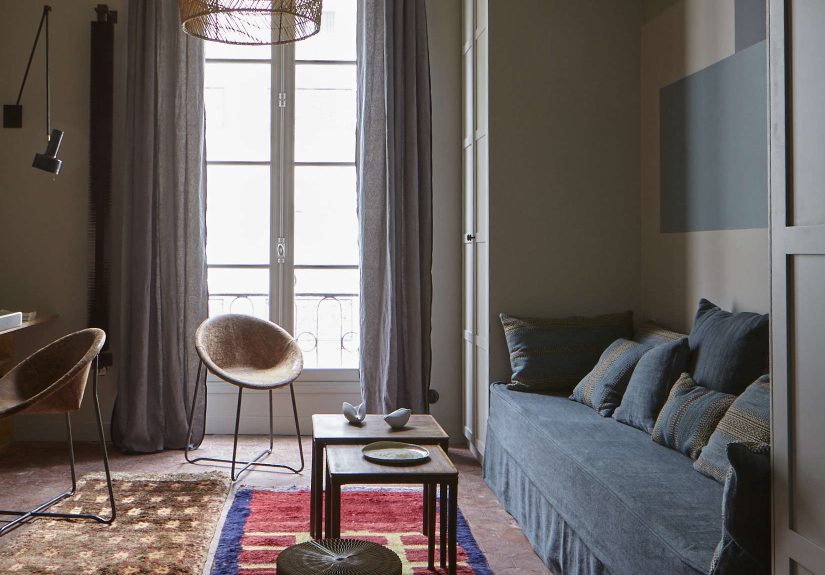
Evennou approached the challenge with her signature sense of color and mood. She preserved the apartment’s original 18th-century floor tiles in the living room, then layered in unapologetically contemporary moves: a dark blue entry, a warm sand-toned main room, graphic wall treatment, rust accents, and a custom plywood structure that does the work of several separate pieces of furniture without creating visual chaos.
The result is a space that understands a truth many large homes ignore: good design is not about how much room you have. It is about how intelligently every inch behaves. Blue Streak behaves like an overachiever.
Why the Name “Blue Streak” Fits So Well
The name is not just catchy. It reflects the apartment’s visual logic. Blue appears in ways that guide the eye, define zones, and sharpen the tiny floor plan. The entry is bold and dark, almost like a visual intake of breath before the softer, sand-colored main room opens up. Deeper blue reappears in the petite kitchen, where color helps the compact work zone feel intentional instead of squeezed in as an afterthought.
This is one of the smartest lessons in the whole apartment: in a tiny home, color is not merely decorative. It can become a planning tool. Strong hues can frame circulation, create a sense of destination, and separate functions without adding walls. That is especially useful in studio apartments, where too many physical dividers can make a room feel like a maze designed by a stressed-out raccoon.
Design publications in the U.S. often recommend pale palettes for small homes, and that advice has merit. But Blue Streak shows the more interesting truth: small spaces do not always need to be timid. Bold color can absolutely work when it is controlled, layered, and balanced by openness, light, and clean lines.
The Genius of the Multifunctional Plywood Spine
If the apartment has a hero, it is the long, low plywood element running through the main room. This custom piece is not just furniture. It is infrastructure. It serves as storage, a mini office, a stairway to the lofted sleeping area, and part of the seating logic of the room. In larger homes, these functions might be split among four or five objects. Here, one carefully designed intervention does the job of an entire cast.
This is what inventive small-space design looks like in practice. Not gimmicks. Not fold-down circus tricks performed twice and then abandoned forever. Just one coherent element working very, very hard.
American design guidance on small apartments often stresses multifunctional furniture, hidden storage, and vertical thinking, and this flat nails all three. The stair becomes access and storage. The landing becomes a desk or console. The loft frees the floor for living. Nothing feels accidental. That is the difference between “small but cute” and “small but brilliant.”
Why it works
The plywood structure succeeds because it respects visual calm. Rather than stuffing the apartment with tiny furniture pieces, the design consolidates tasks into one strong volume. That keeps the room legible. Your eye understands the space quickly, and that sense of clarity makes the apartment feel larger than the math suggests.
What other homeowners can steal
You do not need a Paris designer and a custom loft to borrow the principle. Any small apartment benefits when furniture does double or triple duty. A bench with drawers, a wall-mounted desk, an entry cabinet that stores shoes and bags, a bed platform with integrated storage, or a bookshelf that also zones a room all follow the same logic. The point is not to cram in more stuff. The point is to make each piece earn its rent.
Historic Bones, Modern Attitude
One of the apartment’s most appealing qualities is the tension between old and new. Evennou kept the original living-room floor with its authentic 18th-century tiles, then contrasted that history with graphic color blocking and modern interventions. That move gives the apartment emotional depth. Without the old elements, the design might have felt merely clever. Without the new ones, it could have felt quaint. Together, they create something much richer.
This balancing act is especially important in Paris, where apartments often carry architectural memory in the form of old flooring, odd proportions, tall windows, or inherited quirks. The best renovations do not erase those traces. They edit around them. Blue Streak understands that history is not dead weight; it is atmosphere.
The mural-like graphic treatment in the living area pushes that idea further. It acts almost like built-in art, giving the room visual structure without requiring extra objects. In a tiny apartment, fewer freestanding items usually mean less clutter and more breathing room. That is why the mural feels so effective. It adds personality while preserving precious floor space. It is artwork that does not demand its own address.
How Blue Streak Makes a 270-Square-Foot Home Feel Larger
Small-space design is often discussed in vague, mystical terms, as if a mirror and a prayer will solve everything. This apartment is more practical than that. It feels larger for concrete reasons.
1. It preserves negative space
One of the biggest mistakes in tiny homes is overfurnishing. Blue Streak resists that urge. By leaving visual breathing room around the main interventions, the apartment avoids the boxed-in feeling that happens when every corner is stuffed with storage. Empty space is doing active work here. It lets the eye rest, and that makes the home feel calmer and more generous.
2. It uses vertical volume
The lofted sleeping area lifts one of the apartment’s biggest functions off the floor. That single move dramatically improves usability. Vertical space is free real estate in many small homes, yet it is often underused. In Blue Streak, height becomes a strategy, not just a measurement.
3. It zones without cluttering
The entry, living area, kitchen, and sleeping zone each have their own identity, but the apartment does not rely on bulky dividers. Color, built-ins, and layout do the zoning work. That keeps the space open while still allowing each area to feel purposeful.
4. It keeps the palette intentional
Although blue plays the starring role, the apartment is not visually chaotic. Warm sand, rust, wood, and historic tile tones create balance. This is crucial. Bold color in small spaces works best when it is part of a disciplined palette, not a random paint-store panic attack.
Design Lessons for Anyone Living Small
You do not need to live in Paris to learn from this apartment. You just need a floor plan that occasionally insults you.
Make built-ins do the heavy lifting
Custom or semi-custom storage often outperforms a parade of small furniture pieces. In tight homes, built-ins can combine storage, seating, work surfaces, and circulation in a cleaner way than off-the-shelf items ever will.
Let color create structure
Thoughtful color placement can define areas and mood without erecting barriers. Use strong shades to frame entries, kitchens, alcoves, or feature walls, then support them with a more restrained overall palette.
Respect the apartment’s personality
If your home has original flooring, unusual moldings, quirky windows, or odd little niches, treat them as assets. The most interesting small spaces rarely look generic. They look specific.
Do not over-explain the room
Not every function needs its own separate object. The more a small apartment can consolidate, the more relaxed it feels. A room full of solutions can quickly become a room full of evidence.
Why This Paris Apartment Still Feels Fresh
Many micro-apartment projects go viral because they are shocking. A bed comes out of the ceiling. A wall spins. A table appears from nowhere like a magician with a home-improvement budget. Those projects are fun to look at, but they do not always feel livable. Blue Streak endures because it is not trying to win a talent show.
Instead, it offers a grounded vision of compact luxury: a place with beauty, storage, history, warmth, and enough wit to make daily life feel designed rather than managed. The apartment is polished, but not sterile. Bold, but not noisy. Efficient, but not joyless. That balance is hard to achieve at any size. At 270 square feet, it borders on outrageous.
It also speaks to a broader shift in how urban living is imagined. Small apartments are no longer automatically viewed as temporary, inferior, or stripped-down. With the right design, they can be sophisticated, expressive, and deeply comfortable. Blue Streak makes that argument persuasively, and in very good color.
Experiences Inspired by Blue Streak: What a Flat Like This Feels Like
To understand why this apartment lingers in the imagination, it helps to think beyond the floor plan and into the experience of using it. A place like Blue Streak changes how ordinary routines feel. You would notice it the second you stepped through the dark blue entryway. The color would create a moment of compression, a tiny dramatic pause, before the apartment opened into the warmer main room. In a larger home, that transition might barely register. Here, it becomes part of the pleasure.
Morning would likely feel highly choreographed in the best possible way. You would climb down from the loft, maybe slightly more gracefully on some days than others, and the apartment would ask you to be intentional. There is no room for sleepy chaos in a flat this compact. Every movement matters. Where you place your bag matters. Where you leave your book matters. Even where you stand to drink your coffee matters. Oddly enough, that kind of spatial awareness can make daily life feel more elegant, not more restricted.
There is also a special satisfaction in a small apartment that works smarter than expected. Sitting at a landing that doubles as a desk or reaching into storage tucked neatly into a stair would create a small daily thrill. It is the home equivalent of discovering your coat has a secret pocket. You know it is practical, but it still feels a little glamorous.
Then there is the mood. A tiny apartment can feel apologetic if it is underdesigned, as though it is forever explaining why it is so small. Blue Streak does the opposite. It has confidence. That confidence changes the emotional experience of the space. You are not in a “small unit.” You are in a sharp, artistic, considered interior that just happens to be compact. That distinction matters more than square footage ever could.
For guests, the experience would be even more memorable. People tend to enter tiny spaces expecting compromise. What surprises them is delight. The preserved floor tiles would ground the apartment in Parisian history. The graphic mural would give them something to talk about immediately. The blue kitchen would feel like a jewel box tucked into the back of the room. The whole place would deliver that rare reaction all designers secretly want: not “How do you fit here?” but “Wait, this is actually amazing.”
And perhaps that is the deepest appeal of Blue Streak. It suggests that compact living does not have to feel like living with less. It can feel like living with more precision, more style, and more awareness of what actually improves everyday life. In a world full of oversized everything, there is something refreshing about a home that edits itself so beautifully. It does not try to be huge. It just tries to be excellent. Mission accomplished.
Conclusion
Blue Streak: An Inventive, Postage Stamp-Sized Flat in the Center of Paris is memorable because it solves a practical problem with genuine imagination. Marianne Evennou transformed a tiny Paris apartment into a home that feels layered, useful, and unmistakably stylish. By combining preserved historic details, bold blue accents, multifunctional built-ins, and careful control of visual space, the flat delivers a lesson that extends far beyond Paris: small homes do not need less personality. They need better ideas.
For readers interested in Paris apartment design, micro-apartment living, small-space storage, or simply how to make a compact home feel more human, Blue Streak remains an inspiring example. It is proof that square footage is a fact, not a verdict.