Table of Contents >> Show >> Hide
- The Real Story Behind Lauren Sánchez’s “Something Blue”
- Why the Blue Veins Comment Took Off
- A Wedding Built for Headlines
- The Internet’s Favorite Hobby: Turning Symbolism Into Memes
- Why People Could Not Look Away
- Fashion, Branding, and the Power of a Tiny Detail
- Visible Hand Veins Are Not the Scandal Some Made Them Out to Be
- Why the Comparisons Became So Hilariousand So Harsh
- What This Buzz Says About Modern Celebrity Weddings
- Experience-Based Reflections: Why This Topic Feels So Familiar
- Conclusion
Celebrity weddings are supposed to have flowers, dresses, dramatic entrances, and at least one auntie somewhere whispering, “That cake better be good.” But when Lauren Sánchez married Jeff Bezos in Venice, the internet did what the internet does best: it ignored the sensible parts, zoomed in like a detective with unlimited coffee, and turned one tiny phrase“something blue”into a full-blown pop-culture scavenger hunt.
The phrase became even more clickable after Sánchez revealed that her “something blue” was connected to her Blue Origin spaceflight. Romantic? Yes. On-brand? Extremely. Subtle? Not exactly. Then came the comments. Some social media users joked about whether the “blue” was actually the visible veins on her hands in wedding photos. Others made comparisons ranging from space-themed puns to classic celebrity snark. The result was a strange but very modern mix of fashion coverage, billionaire wedding fascination, body-commentary debates, and meme culture wearing a tuxedo.
This article looks at why Lauren Sánchez’s “something blue” sparked so much buzz, how the blue-veins-on-her-hands comments became part of the conversation, and what this viral moment says about celebrity weddings in the age of screenshots, zoom buttons, and comment sections that behave like they skipped breakfast.
The Real Story Behind Lauren Sánchez’s “Something Blue”
In traditional wedding folklore, a bride may wear or carry “something old, something new, something borrowed, and something blue.” It is an old bridal rhyme linked to luck, continuity, loyalty, and love. Most people interpret “something blue” as a ribbon, a garter, a piece of jewelry, or maybe a tiny stitched detail hidden inside the dress. Lauren Sánchez, however, took the concept to a different altitudeliterally.
Her “something blue” was widely reported as a private keepsake tied to her Blue Origin spaceflight. In April 2025, Sánchez joined an all-female crew aboard Blue Origin’s New Shepard mission NS-31, alongside Katy Perry, Gayle King, Aisha Bowe, Amanda Nguyễn, and Kerianne Flynn. The suborbital trip lasted around 11 minutes and became one of the most talked-about celebrity space moments of the year. So when Sánchez later hinted that her wedding “something blue” had gone to space with her, the symbolism was obvious: romance, personal transformation, and Jeff Bezos’s rocket company all packed into one very expensive wedding detail.
It was clever branding, whether intentional or not. “Something blue” became “something Blue Origin,” and that wordplay basically wrote the headline itself. In a wedding already watched by fashion editors, celebrity fans, critics, and Venice residents annoyed by the chaos, this tiny detail became another reason for people to talk.
Why the Blue Veins Comment Took Off
The viral phrase “blue veins on her hands” came from social media users reacting to photos of Sánchez in her wedding looks. In several images, her hands were visible, and some commenters noticed prominent blue veins. Instead of moving on like emotionally stable adults, the internet built a small comedy festival around it.
Visible hand veins are common and can appear for many normal reasons, including age, genetics, body composition, lighting, skin texture, temperature, and even the way a hand is positioned. They are not automatically unusual, and they are not a diagnosis. But online, nuance often arrives late, parks badly, and forgets to pay the meter.
The joke worked because it collided with the “something blue” tradition. Sánchez said she had a mysterious blue keepsake; commenters jokingly pointed to the blue veins in photos. It was less about medical curiosity and more about internet wordplay. Still, the reaction also showed how quickly celebrity coverage can slide from fashion analysis into body scrutiny. A gown can take 900 hours to make, but a comment section can reduce the whole event to one zoomed-in hand in nine seconds flat.
A Wedding Built for Headlines
Lauren Sánchez and Jeff Bezos’s Venice wedding was not exactly a backyard ceremony with folding chairs and someone’s cousin running the playlist. It was a multi-day event in one of the world’s most photographed cities, attended by famous faces from entertainment, fashion, business, and politics. Guests were spotted traveling by boat, photographers followed every arrival, and fashion outlets studied each outfit like it might contain state secrets.
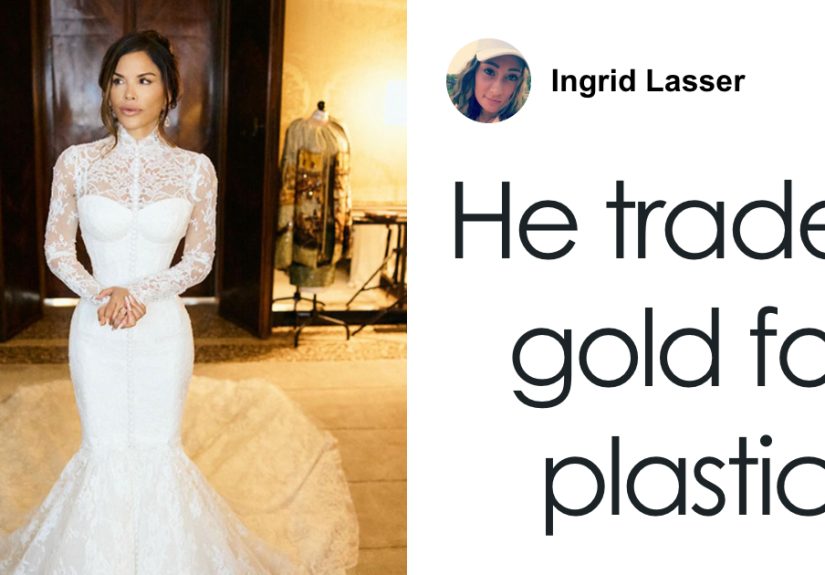
Sánchez’s wedding dress added even more fuel to the coverage. She wore a long-sleeved Dolce & Gabbana lace gown with a high neckline, fitted silhouette, and old-Hollywood drama. The dress was reported to require hundreds of hours of atelier work, and Sánchez described wanting something that captured a moment in her life rather than simply a modern bridal look.
That is where the story became more interesting than “rich people had a fancy wedding.” Sánchez framed the dress and the day as part of a personal evolution. She had recently gone to space. She had spoken about therapy, change, confidence, and feeling seen. Whether readers found that moving, too glossy, or a little too public-relations-perfect, it gave the wedding a narrative. And the internet loves nothing more than a narrative it can decorate with jokes.
The Internet’s Favorite Hobby: Turning Symbolism Into Memes
Once a celebrity reveals a meaningful detail, social media immediately asks: “Yes, but can we make this weird?” The answer is almost always yes.
Lauren Sánchez’s “something blue” had all the ingredients for a viral moment. It involved a famous bride, a billionaire groom, a wedding tradition everyone understands, a space-company pun, and photos detailed enough for online sleuths to inspect. The jokes practically assembled themselves. Some people made Blue Origin references. Some focused on the visible veins. Some compared the wedding imagery to sci-fi, old Hollywood, reality TV, or luxury-brand theater. Others simply asked why everyone was talking about a hand when Venice was right there looking like a Renaissance painting with boat traffic.
Humor is part of celebrity culture, but it can be a slippery gondola ride. Playful jokes about branding and wedding symbolism are fair game. Personal attacks about someone’s body, aging, or appearance are less charming. A good rule: if the joke works without treating a person’s body like public property, it is probably better. If the joke requires zooming into someone’s skin texture like a forensic lab, maybe let it float away down the canal.
Why People Could Not Look Away
Part of the fascination comes from the scale of the wedding. When two extremely public figures marry in Venice, people expect spectacle. Bezos is one of the most recognizable billionaires in the world. Sánchez is a former journalist, helicopter pilot, children’s book author, philanthropist, and now a major figure in the Bezos public orbit. Their relationship has long attracted attention, and their wedding became a cultural event whether people admired it, criticized it, or watched only to complain that they were watching.
The other factor was timing. Sánchez’s Blue Origin flight happened just months before the wedding. That mission was praised by some as an inspirational all-female spaceflight and criticized by others as an expensive celebrity publicity moment. By tying “something blue” to that flight, Sánchez connected the wedding to a debate that had already been simmering. Suddenly, a bridal detail was not just a bridal detail. It was about space tourism, wealth, image-making, femininity, empowerment, branding, and whether a rocket trip should count as romantic luggage.
Fashion, Branding, and the Power of a Tiny Detail
In celebrity fashion, small details do big work. A veil can reference family history. A necklace can revive a vintage trend. A pair of earrings can become a headline. Sánchez’s “something blue” was powerful because it was hidden, mysterious, and connected to a major public moment. That gave writers and fans room to speculate without having the full answer.
Her bridal styling also leaned into contrast. The Dolce & Gabbana lace gown was traditional, modest by red-carpet standards, and deeply bridal. The spaceflight keepsake, on the other hand, sounded futuristic and personal. It blended old-world ceremony with space-age symbolism. In simple SEO terms, that is content gold. In human terms, it is also a reminder that people use weddings to tell stories about who they believe they are becoming.
The funny part is that the internet sometimes refuses the official story and invents its own. Sánchez offered an elegant mystery: a blue keepsake from space. Commenters replied with: “What about the blue veins?” It was cheeky, slightly rude, and extremely online. It also shows how audiences now participate in celebrity storytelling. They do not just consume the image; they annotate it, remix it, roast it, and send it back wearing sunglasses.
Visible Hand Veins Are Not the Scandal Some Made Them Out to Be
Let’s pause for one reasonable paragraph, because the comment section clearly did not. Visible veins on hands are common. Hands naturally have less soft tissue than many other areas of the body, and veins may appear more noticeable with age, lower body fat, warm weather, exercise, lighting, or simply genetics. In high-resolution celebrity photos, every shadow and vein can look more dramatic than it would in real life.
That matters because celebrity culture often turns normal human features into “talking points.” A wrinkle becomes a headline. A hand becomes a debate. A shadow becomes a conspiracy. It is exhausting, and honestly, the zoom button may need a vacation.
The better takeaway is not “What is wrong with her hands?” It is “Why are we trained to inspect famous women this closely?” Sánchez’s wedding was packed with actual topics worth discussing: fashion craftsmanship, wealth display, Venice protests, celebrity guest culture, space tourism, and the blending of personal milestones with corporate symbolism. Compared with all that, visible veins are not the main event. They are just hands being hands.
Why the Comparisons Became So Hilariousand So Harsh
The hilarious comparisons spread because they were short, visual, and easy to understand. A successful viral joke usually needs three ingredients: a recognizable subject, a simple twist, and a punchline that can be repeated. “Something blue” plus visible blue veins created an instant setup. Add the Blue Origin connection, and suddenly every pun felt like it had a rocket booster.
But the harshness also came from public discomfort with extreme wealth. Many people were already critical of the wedding because it took place in Venice, a city dealing with overtourism, high living costs, and local frustration over luxury events. Some protesters framed the celebration as a symbol of inequality. In that environment, jokes about the bride were not just about appearance; they were part of a broader backlash against the spectacle.
That does not make every comment fair. It explains the temperature of the room. When a wedding looks larger than life, the reaction also becomes larger than life. The internet does not whisper at billionaire weddings. It brings a megaphone, a meme folder, and absolutely no chill.
What This Buzz Says About Modern Celebrity Weddings
Modern celebrity weddings are no longer private ceremonies that later appear in a glossy magazine. They are live cultural events, even when technically private. Paparazzi photos circulate instantly. Guest lists become social maps. Fashion credits become brand strategy. TikTok, Instagram, Facebook, X, Reddit, and entertainment sites each create their own version of the story.
Lauren Sánchez’s “something blue” is a perfect example of how one detail can travel across platforms. Fashion readers saw tradition and couture. Space watchers saw Blue Origin. Critics saw billionaire branding. Meme-makers saw a punchline. Body-commentary watchers saw another example of how women’s appearances are picked apart. SEO editors saw a headline with enough hooks to power a small newsroom.
In the end, the “blue veins” jokes may fade, but the structure of the story will repeat. A celebrity shares a symbolic detail. The public zooms in. The internet makes jokes. Then everyone argues about whether the jokes went too far. Rinse, repeat, add designer gown.
Experience-Based Reflections: Why This Topic Feels So Familiar
Anyone who has ever been in a wedding photo understands the danger of the unexpected detail. You spend weeks planning the outfit, hair, lighting, flowers, shoes, seating chart, and emotional stability of relatives. Then the final photo arrives and everyone notices one thing you never planned: a weird sleeve crease, a smudge on a glass, a flower girl making a face, or your hand looking like it just completed a dramatic side quest.
That is why the Lauren Sánchez “something blue” moment feels oddly relatable, even though most of us have not married a billionaire in Venice after going to space. The scale is different, but the experience is familiar. Big life moments rarely stay under our control once other people start looking at them. A bride may intend one meaning, while viewers create another. Sánchez’s intended meaning was sentimental and cosmic. The internet’s version was comedic and anatomical. That gap between intention and interpretation is where viral culture lives.
Think about family weddings. There is always one photo where someone’s hand looks strange, someone blinked, someone’s dress caught the wind, or Uncle Mike appears in the background chewing like he is trying to defeat the buffet. Nobody planned it, but that becomes the photo everyone remembers. In celebrity culture, the same thing happens, except millions of strangers become Uncle Mike.
The lesson for readers is not to avoid photos or obsess over flaws. It is the opposite. Human details are part of the story. Hands have veins. Faces move. Dresses wrinkle. People age. Lighting behaves like a prankster. The more polished a public image becomes, the more aggressively audiences hunt for the one detail that proves the person is still human.
There is also an experience many social media users know well: the strange thrill of joining a joke before thinking about the person inside it. Online humor moves fast. A funny comment appears, people laugh, and suddenly the joke becomes the dominant frame. But after the laugh, it is worth asking whether the joke punches up at fame, wealth, and brandingor down at ordinary human features. Joking about a billionaire wedding’s space-company symbolism? Fair enough. Mocking visible veins as if skin must pass a luxury inspection? That gets old quickly.
For content creators, this story is a useful case study. The best angle is not simply “people mocked Lauren Sánchez.” That is too flat. The stronger angle is the collision of wedding tradition, Blue Origin branding, celebrity image-making, and internet body scrutiny. That gives the topic depth. It lets readers enjoy the absurdity without turning the article into a pile-on.
For readers, the moment is a reminder to laugh, but laugh wisely. The internet will always find “something blue,” even when it has to zoom in to find it. But maybe the better joke is not that a woman’s hands looked human. The better joke is that in a wedding featuring Venice, couture, billionaires, space travel, celebrity guests, and a mystery keepsake, the comment section still managed to become a dermatology panel with Wi-Fi.
Editor’s note: This article is based on publicly reported information about Lauren Sánchez, Jeff Bezos, their Venice wedding, Sánchez’s Blue Origin spaceflight, and social media reactions. It avoids medical claims and treats appearance-related commentary as part of a broader discussion about celebrity culture, online humor, and public scrutiny.
Conclusion
Lauren Sánchez’s “something blue” became a viral talking point because it blended romance, tradition, luxury, space travel, and internet mischief into one irresistible headline. The real keepsake reportedly connected to her Blue Origin journey gave the wedding a futuristic twist, while the “blue veins on her hands” jokes showed how quickly social media can turn symbolism into satire.
At its best, the buzz was funny because it played with language and celebrity branding. At its worst, it drifted into unnecessary body commentary. The more interesting story is not whether Sánchez’s hands looked a certain way, but why audiences were so eager to decode, mock, and remix every detail of a wedding built for maximum public attention.
In the end, the “something blue” mystery did exactly what celebrity wedding details are designed to do: it kept people talking. And in the age of viral culture, that may be the most powerful accessory of all.