Table of Contents >> Show >> Hide
- Why Dry Milano Still Feels Different
- Milan Is the Perfect City for a Place Like This
- The Room: Retro, Bare, and a Little Theatrical
- The Food Program: Pizza With Discipline and Personality
- The Bar Program: Not a Side Hustle, a Co-Star
- Recognition Matters, but Atmosphere Matters More
- Decadent and Decayed, in the Best Sense
- An Evening at Dry Milano: The Experience That Stays With You
- Conclusion
Some restaurants pair wine with dinner. Dry Milano looked at that old rule, loosened its collar, and decided pizza deserved a more glamorous companion. Since opening in 2013 on Via Solferino, Dry has built its identity around a concept that still feels just rebellious enough to be irresistible: serious pizza, serious cocktails, one table, zero apologies. In a city that can make even a coffee break feel like a styling exercise, that idea lands with the confidence of a perfectly tailored jacket.
That confidence matters in Milan. This is not a city that falls in love easily with gimmicks. Milan rewards precision, taste, and restraint. It likes beauty, but not sloppy beauty. It likes innovation, but preferably served with good lighting and excellent shoes. Dry Milano works because it understands the city it lives in. It is playful without being silly, polished without feeling corporate, and original without shouting, “Look at me, I’m innovative!” across the room like an insecure startup founder at a networking event.
The title Decadent and Decayed sounds dramatic, but that is exactly the point. Dry is not “decayed” in any literal sense. It is better understood as beautifully worn-in, a place where elegance is sharpened by roughness, where exposed structure, moody lighting, and vintage cues give the room a seductive edge. It feels like a stylish after-hours conversation between old Milan and modern hospitality. Nothing is collapsing. Everything is curated. But it is curated in a way that allows a little shadow, a little friction, and a little romance.
Why Dry Milano Still Feels Different
On paper, pizza and cocktails should not be this exciting. The idea sounds almost suspiciously simple. Yet simplicity is often where the smartest hospitality concepts hide. Dry’s success comes from treating the pairing not as a novelty but as a philosophy. The pizza is not an accessory to the bar program, and the drinks are not decorative sidekicks to the food. Both sides of the experience are built to carry equal weight.
That balance is rare. Plenty of places make great pizza. Plenty of bars make memorable drinks. Much fewer make the two seem as if they were always meant to share the same spotlight. Dry’s achievement lies in making the pairing feel natural rather than forced. It gives the meal rhythm. A bite of warm, airy dough followed by a sip that cuts, lifts, or deepens the flavor creates a conversation at the table. Dinner stops being a sequence and becomes a composition.
That idea also helped Dry stand out early. More than a decade ago, it was already being noticed as an envelope-pushing pizza-and-cocktail destination, long before food-and-drink “pairing concepts” became common branding wallpaper. Today, what once felt mischievous now feels influential. Dry does not merely fit into Milan’s dining scene; it helped expand what that scene could look like.
Milan Is the Perfect City for a Place Like This
Dry Milano would not mean the same thing in just any city. Its magic depends on Milan, a place where aperitivo is not simply a pre-dinner drink but a civic ritual. Milanese drinking culture has long balanced elegance and informality. People gather, talk, snack, linger, and move through the evening with practiced ease. It is social, stylish, and often wonderfully unhurried. In that setting, Dry’s format makes perfect sense. It takes the local instinct for pre-dinner pleasure and stretches it into a full evening.
Milan is also a city of reinvention. It carries old culinary traditions from Lombardy while absorbing global ideas with unusual ease. That tension between heritage and experimentation runs through the city’s best restaurants and bars. You can feel it in the contrast between historic aperitivo institutions and newer cocktail programs, between classic saffron risotto and modern pizza laboratories, between marble glamour and industrial rawness. Dry sits right inside that tension and makes it look effortless.
That is why the place feels so Milanese even when it seems to break the rules. It is rooted in Italian hospitality, but it is not trapped by nostalgia. It respects classics, but it is not interested in museum behavior. Milan likes places that know where they came from and still dare to evolve. Dry understands that assignment better than most.
The Room: Retro, Bare, and a Little Theatrical
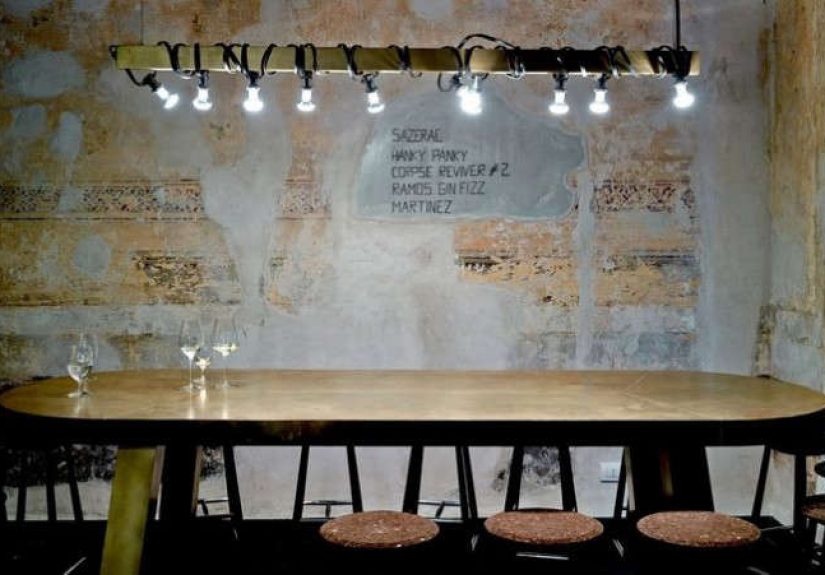
Part of Dry’s allure is visual. The official description emphasizes a warm atmosphere with retro character and an intentionally spare environment. Design coverage has highlighted the exposed structure, brass-finished tables, incandescent lighting, and references to 1970s Italian dining traditions. That combination gives the room a clever contradiction: it feels both polished and stripped back, glamorous and slightly rough around the edges.
This is where the “decayed” half of the title earns its keep. Dry understands that perfect surfaces can be boring. A little darkness, a little grit, a little tension between shine and shadow can make a room feel more human. The interior avoids that overdesigned problem many modern restaurants suffer from, where everything is so carefully polished it starts to resemble a luxury waiting room. Dry has texture. It has mood. It has the kind of confidence that does not need to wink at you every three minutes.
And because this is Milan, the crowd becomes part of the architecture. Design people, food obsessives, neighborhood regulars, visitors who did their homework, and the occasional sharply dressed person who looks like they stepped out of a fragrance ad all contribute to the atmosphere. At Dry, the room is never just a backdrop. It is part of the performance, though thankfully not in a way that requires you to dress like a minor royal.
The Food Program: Pizza With Discipline and Personality
Dry’s culinary side is led by Lorenzo Sirabella, a Neapolitan-born pizzaiolo whose background connects him to serious baking traditions. That matters because Dry’s pizza has never been content to ride on bar-world coolness alone. The dough, toppings, and structure of the menu reveal a kitchen that takes its craft seriously.
The current menu shows the range clearly. There are classic anchors like the Margherita and Margherita DOP, but also variations that push the format forward: smoked versions, more layered interpretations, and a “Sunday” take that plays with ragù, stracciatella, pesto, and Parmigiano chips. Elsewhere, pizzas move into richer and more adventurous territory, with ingredients such as yellow and red Piennolo tomatoes, anchovies, smoked cheeses, eggplant, chutneys, cashews, pork belly, shrimp, and regional accents that keep the menu from becoming predictable.
What makes this compelling is not extravagance for its own sake. The menu is structured with the logic of a place that wants to surprise you without losing control. There are stuffed focacce, starters, salads, desserts, and enough variety to make the meal feel layered rather than repetitive. Dry knows that pizza can be casual, but it also knows that casual does not have to mean careless.
The result is food that feels modern without drifting into abstraction. You can still recognize the emotional center of what you are eating. It is pizza, not a thesis statement. It just happens to be pizza with better posture.
The Bar Program: Not a Side Hustle, a Co-Star
On the beverage side, Dry’s identity is shaped by bar manager Edris Al Malat. His role is important because Dry only works if the drinks can stand shoulder to shoulder with the food. Based on the official menu and brand language, the bar program is designed not merely to impress on its own terms but to enhance the bite in front of you. That is a different mindset from the usual dinner-drinks setup.
The menu includes recognizable classics as well as more playful and seasonal expressions. Even at a glance, the tone is clear: the bar is interested in pleasure, texture, and balance, not just spectacle. This is not the kind of place that needs smoke, foam, or a lecture about foraged moss to justify itself. The intelligence is subtler than that. It shows up in pairability, in clarity of flavor, and in the confidence to let a drink do its job without staging a Broadway audition.
That approach fits Milan beautifully. The city’s cocktail culture has long been shaped by aperitivo traditions, bitter flavors, and a taste for drinks that feel social rather than merely strong. Dry belongs to the newer wave of places that embrace craft while still respecting the rhythm of Italian drinking culture. It understands that a bar can be stylish without becoming sterile, and inventive without becoming exhausting.
Recognition Matters, but Atmosphere Matters More
Dry Milano’s reputation is not just neighborhood gossip with good lighting. In 2025, it placed No. 7 in Italy and No. 15 in the world on 50 Top Pizza, and it also received the organization’s Best Cocktail List award. Those recognitions confirm what guests have been noticing for years: Dry is not coasting on concept alone. The quality is real, and it travels well beyond Milan.
Still, awards only explain part of the appeal. Plenty of decorated places feel emotionally flat. Dry does not. What lingers is the way everything seems aligned: the city, the room, the dough, the drinks, the hour of the evening, the crowd noise, the little flashes of brass, the sense that dinner is happening in a place with a point of view. That is harder to rank, but it is the part people remember.
It also helps that Dry lives in a city increasingly recognized for more than traditional sightseeing. Milan has become harder to dismiss as merely the serious sibling of Rome, Venice, or Florence. Its food scene is richer, its cocktail culture sharper, and its design energy more visible than ever. Dry captures all of that in one address. It is pizza, yes. It is cocktails, yes. But it is also Milan behaving exactly like itself: chic, clever, restless, and just a little bit dangerous in the best possible way.
Decadent and Decayed, in the Best Sense
So what makes Dry Milano feel “decadent and decayed”? Decadent is easy. There is indulgence here, but the grown-up kind: attention to ingredients, seductive lighting, layered flavors, a room that flatters the evening, and a meal built around pleasure instead of efficiency. Decayed is trickier, but more interesting. It is the refusal of sterile perfection. It is the moody edge, the visual roughness, the sense that this beauty has lived a little. Dry is elegant, but it is not fragile. It wants you to relax, spill into conversation, and stay longer than you planned.
That combination is exactly why the bar remains compelling. Many trendy places feel exciting for six months and tired by month seven. Dry has held attention because it is not merely chasing relevance. It has a strong central idea and enough craft behind it to keep that idea alive. In a world full of concepts, that still counts for a lot.
An Evening at Dry Milano: The Experience That Stays With You
What people remember most about Dry Milano is not a single menu item or one especially photogenic corner of the room. It is the feeling of arriving there at the right hour, when Milan begins its nightly transformation from busy, purposeful city to stage set for appetite. Outside, the streets still carry the residue of work, traffic, fashion, errands, and ambition. Inside, the mood shifts. The light softens. Glass catches brass. Conversations gather momentum. The room starts humming before it ever gets loud.
The first impression is rarely flashy. Dry does not greet guests like a theme park. It is more seductive than that. You notice the confidence of the room slowly: the balance between bare surfaces and warm materials, the glow of the lighting, the subtle theatricality of a space that knows exactly how it wants to be seen. There is a kind of urban intimacy to it. Even when the place is busy, it never feels random. It feels edited.
Then the rhythm of the evening takes over. A table settles in. Someone leans forward to study the menu with the seriousness of a curator. Someone else pretends they are “just browsing,” which is usually the universal sign that they are about to become emotionally attached to at least three things at once. Plates begin to land. Glasses follow. The whole experience moves in short, satisfying beats: a first sip, a first slice, a pause, a laugh, a second taste that suddenly explains the first one better.
That is when Dry shows why it works so well as an experience and not just a concept. The food and drink do not compete for attention. They create pacing. A classic pizza can reset the palate after a richer course. A brighter drink can sharpen the edges of a creamy topping. A deeper, moodier choice can slow the table down and pull the conversation into evening mode. Even for guests who choose zero-proof options or keep the focus more on the food, the same logic remains: contrast, lift, richness, restraint.
And then there is the social atmosphere, which is very much part of the appeal. Dry does not feel like a place people visit only to document that they were there. It feels like a place they come to inhabit for a while. Friends stretch out the night. Couples settle into their own little orbit. Visitors try to decode the room and inevitably end up enjoying it instead. The best hospitality spaces make you feel briefly smarter, calmer, and better dressed than you really are. Dry has that trick down cold.
Hours later, what tends to linger is not excess but composition. The evening feels assembled with care: the moody room, the contrast of elegance and roughness, the precision of the menu, the sense that Milan itself has been condensed into a few square feet of table space. You leave with the memory of warmth, edge, and style all working together. That is the real luxury of Dry Milano. It does not simply feed you. It gives the night a plot.
Conclusion
Dry Milano endures because it understands that hospitality is part flavor, part atmosphere, and part timing. It is a pizza destination, a cocktail bar, and a design statement, but none of those labels quite capture the whole picture. What makes it memorable is the way it turns those elements into one coherent experience. In a city built on image, ritual, and reinvention, Dry feels both perfectly native and refreshingly distinct.
For adult travelers interested in Milan’s food and bar culture, it remains one of the clearest expressions of what the city does best: elegance without stiffness, experimentation without chaos, and pleasure without apology. Decadent? Absolutely. Decayed? Only in that beautifully metaphorical way that makes a place feel less manufactured and more alive. And in Milan, that may be the highest compliment of all.