Table of Contents >> Show >> Hide
- What Is a Function in Math?
- The Main Rule: Each Input Must Have Exactly One Output
- Step-by-Step: How to Tell if a Table is a Function
- Common Mistake: Thinking Repeated Outputs Are Not Allowed
- Function vs. Relation: What Is the Difference?
- How Ordered Pairs Connect to Function Tables
- What About Word Tables?
- How to Tell if a Table Is Not a Function
- Quick Checklist for Function Tables
- Practice Examples with Answers
- Can a Table Be a Function Without a Pattern?
- Domain and Range in Function Tables
- Real-Life Examples of Function Tables
- Why the Direction Matters
- Experience-Based Tips for Learning Function Tables
- Conclusion
Trying to tell whether a table is a function can feel like math is handing you a tiny spreadsheet and whispering, “Good luck.” The good news? This topic is much easier than it looks. You do not need fancy graphing skills, a calculator that costs more than your backpack, or a secret handshake from the algebra club. You only need one golden rule: each input can have exactly one output.
That rule is the heart of every function table. If one input value points to one output value, you probably have a function. If the same input points to two different outputs, the table is not a function. Simple? Yes. Sneaky sometimes? Also yes.
In this guide, you will learn how to tell if a table is a function or not, how to check input-output pairs, what repeated numbers really mean, and how to avoid the most common mistakes students make. We will use clear examples, practical rules, and a few friendly warnings so your next function table does not ambush you during homework.
What Is a Function in Math?
A function is a relationship between inputs and outputs where every input has one and only one output. Think of a function as a machine. You put something in, the machine follows a rule, and one result comes out. If you put in the same input again, the same output should come out again. If the machine gives two different answers for the same input, congratulations, your machine is confusedand in math, that means it is not a function.
For example, suppose a table shows the rule multiply by 3. If the input is 4, the output must be 12. The input 4 cannot also produce 9, 15, and a coupon for free pizza. One input, one output. That is the deal.
Input and Output Meaning
In a function table, the input is usually the first column. It is often labeled x. The output is usually the second column. It is often labeled y or f(x). The input is the value you start with, and the output is the value connected to it.
Here is a simple function table:
| Input (x) | Output (y) |
|---|---|
| 1 | 5 |
| 2 | 10 |
| 3 | 15 |
| 4 | 20 |
This table is a function because each input appears once and leads to one output. The pattern happens to be “multiply by 5,” but here is something important: you do not always need to know the pattern to decide whether a table is a function. You only need to check whether any input has more than one output.
The Main Rule: Each Input Must Have Exactly One Output
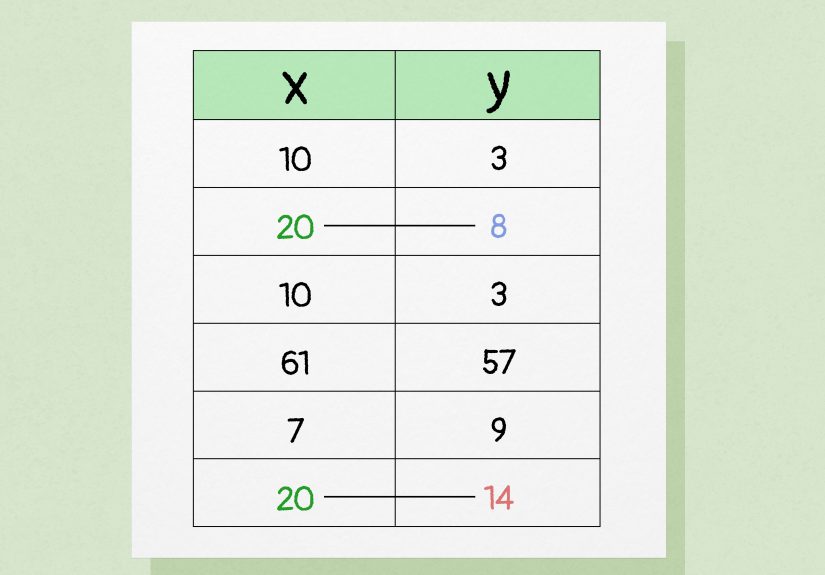
The fastest way to determine if a table is a function is to scan the input column. Look for repeated input values. If an input repeats, compare its outputs. If the repeated input has the same output every time, it can still be a function. If the repeated input has different outputs, it is not a function.
Here is a table that is a function:
| Input (x) | Output (y) |
|---|---|
| -2 | 4 |
| -1 | 1 |
| 0 | 0 |
| 1 | 1 |
| 2 | 4 |
Notice that the outputs repeat. Both -2 and 2 have an output of 4. Both -1 and 1 have an output of 1. That is allowed. A function does not require every output to be unique. It only requires every input to have exactly one output.
Now look at this table:
| Input (x) | Output (y) |
|---|---|
| 3 | 7 |
| 4 | 8 |
| 3 | 10 |
| 5 | 11 |
This table is not a function because the input 3 appears twice with two different outputs: 7 and 10. The input 3 is trying to live two math lives at once. Functions do not allow that.
Step-by-Step: How to Tell if a Table is a Function
Step 1: Identify the Input Column
Start by finding the input values. In most school problems, the input column is on the left and labeled x, input, domain, or independent variable. The output column is usually on the right and labeled y, output, range, dependent variable, or f(x).
Do not skip this step. Some tables may switch the order or use words instead of x and y. For example, a table might show “hours studied” and “test score.” If the question asks whether test score is a function of hours studied, then hours studied is the input and test score is the output.
Step 2: Check for Repeated Inputs
Next, scan the input column. If every input is different, the table represents a function. You are done. Go enjoy a snack.
If an input appears more than once, do not panic. Repeated inputs are not automatically bad. You just need to check what output each repeated input has.
Step 3: Compare the Outputs for Repeated Inputs
If the same input repeats with the same output, the table can still be a function. For example:
| Input (x) | Output (y) |
|---|---|
| 6 | 12 |
| 6 | 12 |
| 7 | 14 |
This still behaves like a function because input 6 gives output 12 both times. The table is repetitive, but it is not contradictory.
Now compare this table:
| Input (x) | Output (y) |
|---|---|
| 6 | 12 |
| 6 | 18 |
| 7 | 14 |
This is not a function because input 6 has two different outputs: 12 and 18.
Step 4: Write a Clear Answer
When explaining your answer, use the function rule in words. A strong answer sounds like this:
“Yes, the table represents a function because each input value is paired with exactly one output value.”
Or:
“No, the table does not represent a function because the input 6 is paired with two different outputs, 12 and 18.”
This kind of explanation shows that you understand the rule, not just that you guessed correctly.
Common Mistake: Thinking Repeated Outputs Are Not Allowed
One of the biggest mistakes students make is thinking repeated outputs mean a table is not a function. That is not true. Outputs can repeat. Inputs are the ones that must be controlled.
Consider this table:
| Input (x) | Output (y) |
|---|---|
| 1 | 9 |
| 2 | 9 |
| 3 | 9 |
| 4 | 9 |
This table is a function. Every input has exactly one output, even though all the outputs are 9. This could represent a real situation. For example, maybe every student paid a $9 field trip fee. Different students, same cost. That is perfectly fine.
Function vs. Relation: What Is the Difference?
A relation is any set of ordered pairs. A function is a special kind of relation where every input has exactly one output. So every function is a relation, but not every relation is a function.
Think of “relation” as the big category and “function” as the stricter club inside it. A relation can be messy. A function has rules. A relation might say:
{(2, 5), (2, 8), (3, 9)}
That relation is not a function because input 2 has two outputs. But this relation:
{(2, 5), (3, 8), (4, 11)}
is a function because every input is used once and has only one output.
How Ordered Pairs Connect to Function Tables
A function table is really just a neat way to organize ordered pairs. Each row gives one pair: (input, output). If the table has x-values and y-values, each row creates an ordered pair in the form (x, y).
For example:
| x | y |
|---|---|
| 0 | 2 |
| 1 | 5 |
| 2 | 8 |
This table can be written as {(0, 2), (1, 5), (2, 8)}. Since none of the x-values repeat with different y-values, it represents a function.
What About Word Tables?
Not every function table uses numbers. Some use words, categories, names, months, or real-life data. The same rule still works.
| Student | Birth Month |
|---|---|
| Ava | March |
| Ben | July |
| Chris | March |
If the input is student and the output is birth month, this is a function. Each student has one birth month. Two students can share the same month, and that is allowed.
But if the input is birth month and the output is student, then March would point to both Ava and Chris. In that direction, it is not a function. This is why identifying the input matters so much.
How to Tell if a Table Is Not a Function
A table is not a function when at least one input is matched with more than one different output. You do not need several problems in the table. One contradiction is enough.
Here is an example:
| Input | Output |
|---|---|
| -1 | 3 |
| 0 | 4 |
| -1 | 5 |
| 2 | 8 |
The input -1 appears twice. First it gives output 3, then it gives output 5. Since one input has two different outputs, the table is not a function.
Quick Checklist for Function Tables
Use this quick checklist whenever you are stuck:
- Find the input column.
- Look for repeated input values.
- If no input repeats, the table is a function.
- If an input repeats, check whether the output is the same.
- If a repeated input has different outputs, the table is not a function.
- Do not reject a table just because outputs repeat.
Practice Examples with Answers
Example 1
| x | y |
|---|---|
| 1 | 4 |
| 2 | 5 |
| 3 | 6 |
Answer: This table is a function because each input appears once and has exactly one output.
Example 2
| x | y |
|---|---|
| 2 | 8 |
| 3 | 8 |
| 4 | 8 |
Answer: This table is a function. The output 8 repeats, but repeated outputs are allowed.
Example 3
| x | y |
|---|---|
| 5 | 1 |
| 5 | 2 |
| 6 | 3 |
Answer: This table is not a function because input 5 is paired with two different outputs, 1 and 2.
Can a Table Be a Function Without a Pattern?
Yes. This is an important point. A table does not need an obvious pattern to be a function. Students often look for a rule like “add 4” or “multiply by 2,” but the function test is not about whether the pattern is easy to spot. It is about whether each input has exactly one output.
For example:
| Input | Output |
|---|---|
| 1 | 17 |
| 2 | -4 |
| 3 | 22 |
| 4 | 0 |
This table may not show a simple pattern, but it is still a function because each input has exactly one output.
Domain and Range in Function Tables
The domain is the set of input values. The range is the set of output values. In a table, the domain usually comes from the x-column, and the range usually comes from the y-column.
For this table:
| x | y |
|---|---|
| -3 | 9 |
| -2 | 4 |
| -1 | 1 |
| 0 | 0 |
The domain is {-3, -2, -1, 0}. The range is {9, 4, 1, 0}. Knowing domain and range helps you describe the table, but remember: the function test focuses on the domain values. If a domain value is connected to two different range values, the relation is not a function.
Real-Life Examples of Function Tables
Function tables show up in everyday life more often than you might think. A price table can be a function if each number of items has one total cost. A distance table can be a function if each amount of time has one distance traveled. A temperature conversion table can be a function if each Celsius temperature has one Fahrenheit temperature.
For example, if a parking garage charges $3 per hour, the number of hours parked can be the input, and the total cost can be the output. If you park for 2 hours, the cost is $6. If you park for 3 hours, the cost is $9. Each input gives one output, so the table represents a function.
But suppose a messy table says that 2 hours costs both $6 and $10 under the same conditions. That would not represent a function unless there is another input being ignored, such as weekend pricing, a special event fee, or valet service. In math, tables must be clear about what counts as the input.
Why the Direction Matters
Sometimes a relationship is a function in one direction but not in the other. For example, a person’s age is a function of the person. Each person has one age at a specific moment. But a person is not a function of age because many people can have the same age.
The same idea applies to tables. If the input column changes, your answer might change. Always read the problem carefully. If it asks whether y is a function of x, then x is the input. If it asks whether x is a function of y, then y is the input. Tiny wording, big difference.
Experience-Based Tips for Learning Function Tables
After working with many students on function tables, one thing becomes clear: most wrong answers come from rushing. Students often glance at the table, see a repeated number, and immediately decide “not a function.” That shortcut works only when the repeated number is in the input column and has different outputs. If the repeated number is in the output column, it usually does not matter.
A useful habit is to cover the output column with your hand for a moment and inspect only the inputs. Ask, “Do any of these input values appear more than once?” If the answer is no, the table is a function. If the answer is yes, then uncover the outputs and compare only the rows with repeated inputs. This method keeps your brain from getting distracted by repeated y-values.
Another helpful experience-based trick is to read the table like a sentence. For example, if a row says input 4 and output 12, say, “When x is 4, y is 12.” If another row says input 4 and output 15, say, “When x is 4, y is 15.” Hearing both sentences makes the problem obvious. The same input cannot produce two different outputs in a function.
Students also improve when they stop treating tables as random boxes of numbers. Each row tells a mini-story. In a table about hours and money earned, each row might mean, “After 3 hours, the worker earned $45.” If another row says, “After 3 hours, the worker earned $60,” something is missing or inconsistent. Maybe the hourly rate changed, or maybe the table is simply not a function. Context can help you understand why the function rule fails.
When preparing for a quiz, make your own tables. Create three function tables and three non-function tables. Then mix them up and test yourself later. The best non-function examples usually include one repeated input with different outputs. The best function examples often include repeated outputs, because that trains you not to panic when you see the same y-value twice.
Teachers often encourage students to explain answers in complete sentences, and this is worth practicing. A correct answer without an explanation may not earn full credit. Instead of writing “yes” or “no,” write the reason: “Yes, because every input has exactly one output,” or “No, because the input 2 has two different outputs.” That one sentence can turn a shaky answer into a confident one.
Finally, remember that function tables are not just an algebra topic to survive. They are the foundation for graphs, equations, patterns, and real-world modeling. Once you understand how inputs and outputs behave in a table, graphing functions and interpreting equations becomes much easier. The table is not the enemy. It is more like the instruction manualsmall, organized, and occasionally annoying, but extremely useful once you know how to read it.
Conclusion
To tell if a table is a function or not, focus on the input values. A table represents a function when each input is paired with exactly one output. Repeated outputs are allowed. Repeated inputs are allowed only if they repeat with the same output. If one input has two different outputs, the table is not a function.
The easiest method is simple: identify the input column, look for repeated inputs, compare their outputs, and explain your answer clearly. With practice, function tables become less mysterious and much more predictable. And honestly, any math topic that can be solved by checking one column deserves a little appreciation.
: