Table of Contents >> Show >> Hide
- What Solar Flares Actually Are
- The New Model: A Magnetic Cage Decides the Outcome
- So, How Strong Could Solar Flares Get?
- Why Stronger Solar Flares Matter on Earth
- Forecasting Is Getting Better, Even If the Sun Refuses to Be Easy
- Solar Maximum Makes This Conversation More Than Academic
- What the New Model Changes in the Bigger Scientific Picture
- Experiences from a Flare-Heavy Sun: What This Looks Like in Real Life
- Final Thoughts
- SEO Tags
The sun is many things: a life-giving star, a cosmic furnace, and occasionally a giant orange drama queen with magnetic mood swings. Most days, it behaves well enough that we can complain about ordinary weather instead of stellar weather. But every so often, the sun releases a solar flare so intense that scientists, satellite operators, radio users, and anyone who relies on modern technology collectively mutter, “Well, that’s not ideal.”
That is why a new model of solar eruptions matters. Rather than treating every flare as a random tantrum from a glowing ball of plasma, the model points to something more organized: a battle between a twisted magnetic structure trying to erupt and a surrounding magnetic “cage” trying to hold it in. In plain English, the sun appears to have both a gas pedal and a seat belt. When the seat belt is strong, a flare may stay confined. When it is weak or breaks, the eruption can grow more violent and sometimes launch a coronal mass ejection, or CME, into space.
This idea does more than make solar physics sound like an action movie. It helps explain why some solar flares stay relatively contained while others become powerful, disruptive space-weather events. It also helps answer a question that sounds simple but is annoyingly difficult: how strong could solar flares get? The short answer is that the upper limit is probably set not by one magic number, but by how much magnetic energy the sun can store, twist, and then unleash before the surrounding field either restrains the eruption or gives way.
That may not be the neat Hollywood-style answer of “exactly X42 and then the universe explodes,” but it is far more useful. It means scientists are getting better at understanding the conditions that make truly extreme flares possible. And in the era of satellites, GPS, aviation, power grids, and a civilization that cries when Wi-Fi blinks, that is a very big deal.
What Solar Flares Actually Are
A solar flare is a sudden burst of radiation caused by the rapid release of magnetic energy in the sun’s atmosphere. These eruptions usually happen near sunspots, where magnetic fields are especially strong, tangled, and unstable. Think of it like stretching, twisting, and knotting a giant collection of invisible rubber bands until they snap into a new arrangement. That snap is called magnetic reconnection, and it can release enormous energy in a very short time.
Solar flares are classified by their X-ray brightness. The scale runs from A, B, C, M, to X, with each step representing a tenfold jump in energy output. X-class flares are the heavyweights. They are the ones that can trigger strong radio blackouts, disrupt navigation signals, and create conditions that ripple through Earth’s upper atmosphere. And despite the fact that “X” sounds like the final boss level, the scale is open-ended. An X2 flare is twice as strong as X1. An X10 is ten times stronger than X1. The most powerful flare measured in the modern era, during the storms of 2003, was so intense that it overloaded the instruments trying to measure it and had to be estimated at around X28.
That little detail is both scientifically fascinating and mildly rude. The sun basically hit the detector so hard the detector gave up.
The New Model: A Magnetic Cage Decides the Outcome
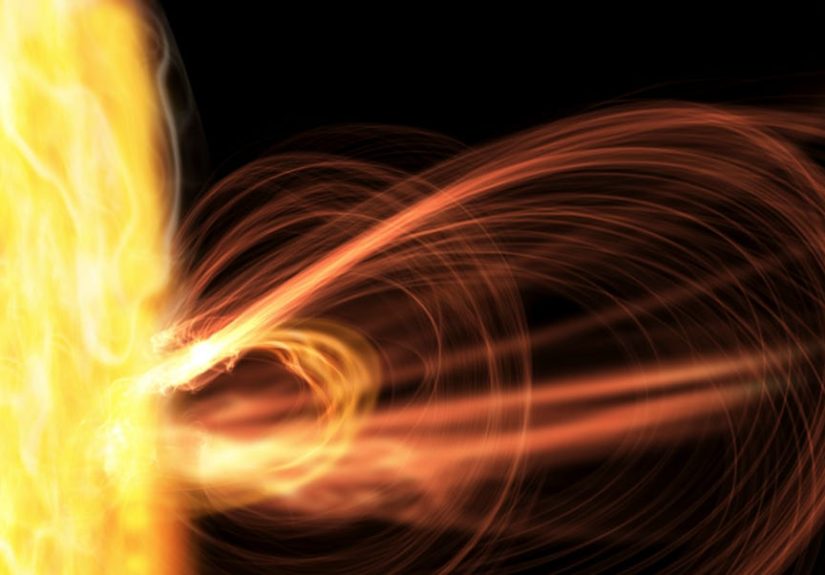
The model at the center of this discussion focuses on the magnetic environment around an eruption. Researchers found that a twisted magnetic flux rope can build up in the corona, the sun’s outer atmosphere, while stronger magnetic fields arching above it act like a cage. The fate of the eruption depends on the tug-of-war between those two structures.
When the Cage Wins
If the overlying magnetic field is strong enough, it can confine the outburst. In that case, the flare may still be bright and energetic, but the eruption does not fully break free into space. Scientists call this a confined flare. It is still a real flare, still a powerful event, and still something worth paying attention to. But it may not hurl a giant cloud of solar plasma into the solar system.
When the Rope Breaks Out
If the magnetic cage weakens rapidly with height, or if the flux rope becomes unstable enough to punch through it, the event can become eruptive. That is when a flare may be accompanied by a CME, a huge expulsion of magnetized plasma that can travel across space and interact with Earth’s magnetic field. That is the version of solar bad behavior that keeps space-weather forecasters especially busy.
Why This Matters
The beauty of the model is that it provides a physical explanation for flare strength and type using the same underlying idea. It suggests that the sun does not produce eruptions in a simple all-or-nothing way. Instead, the surrounding magnetic landscape helps determine whether energy is bottled up, partially released, or launched into space with much more dramatic consequences.
In other words, a solar flare is not just about how angry the sun is. It is also about whether the cosmic lid stays on the pot.
So, How Strong Could Solar Flares Get?
This is where the new model becomes especially interesting. The X-class scale has no hard ceiling. Scientists already know the sun can exceed X9, and it has done so dramatically. But a flare’s practical upper limit depends on how much magnetic energy an active region can store and how the surrounding coronal field is arranged. The model implies that extreme flare strength is linked to both the internal pressure of the flux rope and the confining power of the magnetic cage above it.
That means the question is not merely, “Can the sun make a huge flare?” It clearly can. The better question is, “Under what magnetic conditions can the sun make a huge flare that also escapes, grows, and produces major space-weather consequences?”
This is an important distinction because brightness alone is not the whole story. A powerful flare can happen without a major Earth-directed CME. Meanwhile, a flare that successfully breaks through the magnetic cage can become part of a much more dangerous sequence of events. The model helps scientists separate the drama on the sun from the risk to Earth, which is useful because one of those is visually beautiful and the other can wreck your day in several expensive ways.
Could the sun produce a truly monstrous event again? History suggests yes. The Carrington Event of 1859 remains the benchmark for extreme space weather, and scientists continue to use it as a reference point for what a worst-case solar storm might look like. More recent events, such as the storms of 2003 and the intense activity in May 2024, remind us that the sun does not need to reach mythical levels to cause real-world problems. It just needs the right active region, the right magnetic configuration, and terrible timing for whatever technology happens to be in the line of fire.
Why Stronger Solar Flares Matter on Earth
Solar flares affect Earth mainly through radiation, especially X-rays and extreme ultraviolet light. Because that radiation travels at the speed of light, the effects can begin almost immediately after the flare is observed. The upper atmosphere becomes more ionized, which can interfere with high-frequency radio communication on the sunlit side of Earth. That matters for aviation, emergency communications, military operations, and anyone who still enjoys the very underrated magic trick of talking to someone far away.
Then there is the CME problem. If an eruptive flare is accompanied by a fast CME aimed at Earth, the effects can escalate. Geomagnetic storms can stress power systems, disturb satellite operations, degrade GPS accuracy, increase drag on spacecraft in low Earth orbit, and create dazzling auroras in places that are not used to seeing them. Auroras are the pretty part of the story. The part where a farmer’s GPS-guided tractor goes cross-eyed or a satellite operator starts sweating through a conference call is less poetic.
The new magnetic-cage model helps because it gives scientists a better shot at distinguishing between flares that are merely intense and flares that may become broader space-weather threats. That is exactly the kind of nuance operational forecasting needs.
Forecasting Is Getting Better, Even If the Sun Refuses to Be Easy
For a long time, solar-flare prediction has been a bit like trying to predict which popcorn kernel will explode next, except the popcorn is magnetic plasma and the consequences involve national infrastructure. Progress has been real, but stubbornly incremental.
NASA has already highlighted models that successfully predicted several of the largest flares from a previous solar cycle using data from the Solar Dynamics Observatory. NOAA-backed research has also used transformer-based machine learning to estimate whether an active region will produce flares within the next 24 hours. More recently, NASA and IBM described an AI model called Surya that can improve short-term flare forecasting even further by learning from large archives of solar imagery and data.
Meanwhile, researchers are finally making better measurements of the sun’s coronal magnetic field, which has long been one of the hardest things to observe directly. That matters because if the magnetic cage is the bouncer deciding whether a flare escapes the club, scientists need to know how strong that bouncer is and where it is standing.
Put all of this together, and the future of space-weather prediction looks more promising than it did a decade ago. We are moving from broad probability guesses toward more physically informed models. We are not at the stage of saying, “Tuesday at 3:14 p.m., the sun will attempt a dramatic exit,” but we are getting better at identifying risky active regions and understanding the magnetic setups that favor extreme eruptions.
Solar Maximum Makes This Conversation More Than Academic
The timing also matters. NASA and NOAA announced that the sun reached the maximum phase of its current 11-year solar cycle in October 2024. During solar maximum, sunspots become more common, magnetic complexity increases, and the odds of powerful flares go up. That does not mean every day becomes a cosmic emergency, but it does mean the sun is operating in its more energetic mode.
Recent years have already delivered a reminder. In May 2024, the sun produced a burst of major activity that included multiple X-class flares and one of the most intense geomagnetic storms in decades. The event painted the skies with auroras far from the poles, but it also caused real operational headaches involving communications, satellites, and navigation systems. The lesson was simple: even when the world does not end, strong solar activity can still be disruptive, expensive, and technically complicated.
That is exactly why models like the magnetic-cage framework matter. They are not just elegant physics. They are part of a growing toolkit for understanding which active regions are all bark, which ones are all bite, and which ones are capable of flinging a magnetized plasma tantrum across the solar system.
What the New Model Changes in the Bigger Scientific Picture
One of the biggest contributions of this model is conceptual clarity. Older discussions often treated solar flares and coronal mass ejections as related but somewhat separate phenomena. The new approach strengthens the idea that they are connected outcomes shaped by the same magnetic architecture. The flare is not one event and the CME another random add-on. They can be different expressions of the same deeper magnetic struggle.
That matters because it shifts research from cataloging outcomes to understanding conditions. Scientists want to know not only what happened, but why one active region produced a confined X-class flare while another launched an Earth-directed CME. The magnetic-cage model offers a unifying way to think about that difference.
It also helps scientists talk more realistically about flare limits. The upper bound is not simply a number on the X-ray scale. It is a function of available magnetic energy, the geometry of the field, the stability of the flux rope, and whether the surrounding structure restrains or releases the eruption. That is a far richer and more useful answer than “the sun gets rowdy sometimes.” Although, to be fair, that answer still has emotional truth.
Experiences from a Flare-Heavy Sun: What This Looks Like in Real Life
To make all of this feel less abstract, it helps to think about the human experience around strong solar activity. Not in a sci-fi, everybody-hide-in-a-bunker way, but in the very real, very modern sense of systems acting weird all at once.
Imagine a satellite operations team on a week when the sun is especially active. Their job is already a juggling act of orbital mechanics, communications windows, and hardware limitations. Then a strong flare erupts. Within minutes, radiation has altered the ionosphere enough to complicate communications. If a CME is involved, the team also has to think ahead to atmospheric expansion, increased drag on satellites in low Earth orbit, and the possibility of charging events that can stress onboard electronics. Nothing may fail dramatically, but everyone suddenly becomes much less relaxed.
Now shift to aviation. High-frequency radio communication matters for certain long-distance and polar routes. During stronger flare events, those signals can degrade on the sunlit side of Earth. Airlines and flight planners may need reroutes, timing changes, or backup procedures. Passengers usually do not get a cheerful announcement saying, “Ladies and gentlemen, the star at the center of our solar system is being difficult today.” They just experience delays or route changes while someone behind the scenes deals with the consequences.
On the ground, GPS users can feel the effects too. Most people think of solar flares as an astronomy problem, but space weather can ripple down into positioning and timing systems that agriculture, shipping, surveying, logistics, and emergency response depend on. During major solar disturbances, even small errors become costly if your entire workflow assumes satellite timing is rock solid.
Then there are radio operators and power-grid planners, two groups that never need to be told the sun matters. Radio enthusiasts often notice strange conditions almost immediately when flare activity spikes. Power operators, meanwhile, worry less about the beauty of auroras and more about geomagnetically induced currents, transformer stress, and whether the grid can ride out disturbances without cascading trouble. Their experience of a solar storm is not wonder. It is spreadsheets, monitoring dashboards, and caffeine.
And yet there is another side to these events. During the big storm of May 2024, people across unusually low latitudes stepped outside and saw auroras where they almost never appear. Social media filled with photos, surprise, and the universal human reaction of pointing at the sky and saying, “Wait, what?” That contrast is part of the story of strong solar flares. The same event can be a scientific treasure, an operational headache, and a once-in-a-lifetime public spectacle.
That is why research like this resonates beyond astrophysics. It connects the hidden magnetic architecture of the sun to everyday human systems. A better model does not stop solar flares, obviously. We are not putting a lid on the sun anytime soon. But it does help us prepare, forecast, adapt, and understand when the next major outburst arrives. And if the sun insists on staging another enormous magnetic performance, it would be nice to have more than guesswork and crossed fingers.
Final Thoughts
The new model does not claim that solar flares are simple. They are not. The sun remains a turbulent, magnetically tangled engine with enough energy to humble both instruments and egos. But the magnetic-cage idea gives researchers a stronger framework for understanding what controls flare strength, why some eruptions stay trapped, and why others break free with greater consequences.
That is a major step forward. It means flare strength is no longer just a scoreboard number after the fact. It is increasingly something scientists can analyze through magnetic structure, physical constraints, and forecastable conditions. For everyone on Earth who relies on satellites, navigation, communications, or electric power, that is good news. For the sun, it is probably just Tuesday.