Table of Contents >> Show >> Hide
- What Happened at Stonehenge (and Why It Felt So Shocking)
- Why Stonehenge Isn’t “Just Rocks” (and Never Has Been)
- The Cleanup: Fast, Careful, and Still Not “No Big Deal”
- Legal Fallout: Arrests, Charges, and the Long Tail of a Viral Protest
- So… Did This Help the Climate Cause or Hurt It?
- What Heritage Managers Can Learn From the Orange Day
- If You Witness Something Like This: A Safer Way to Help
- FAQ: The Questions People Keep Asking
- of “Being There” Experiences: What the Orange Moment Felt Like Up Close
- Conclusion: Stonehenge Didn’t Need a “Glow-Up”But We Do Need a Conversation
Stonehenge has survived thousands of years of wind, rain, and human curiosity. It has endured wars, weather, and more than a few questionable souvenir choices. But on a bright June afternoon, the ancient stone circle found itself starring in a modern drama: a burst of orange “paint” across the stones, a small crowd shouting “Stop!” and a couple of bystanders rushing in as if they were auditioning for the role of Unofficial Guardian of World Heritage.
The moment went viral fastbecause of course it did. Few things travel at the speed of the internet like an iconic landmark in trouble. But the story is more complicated (and honestly more revealing) than the headline. This wasn’t a random act of vandalism. It was a calculated protestdesigned for maximum visibilitycolliding head-on with a place many people treat as sacred, historic, and untouchable.
What Happened at Stonehenge (and Why It Felt So Shocking)
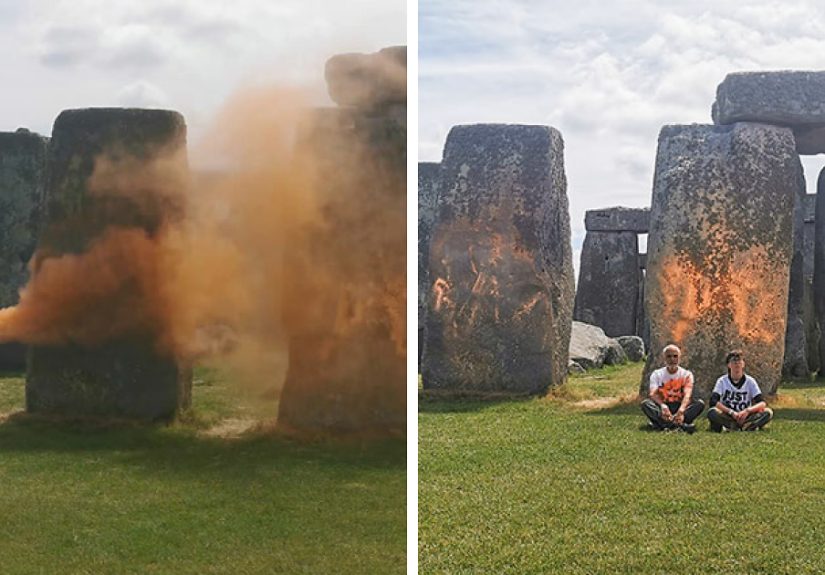
In the middle of the day, two activists ran up to the stones and sprayed an orange substance across parts of the monument. People nearby immediately reactedsome yelling, some filming, and at least a couple stepping forward to try to stop them. Within minutes, police arrested suspects on suspicion of damaging the ancient monument.
If you watched only the first few seconds of video, you might have thought: “Spray paint. Permanent. Disaster.” That assumption is exactly why the footage hit like a punch. Stonehenge isn’t just any tourist stop. It’s a symbolone of the most recognizable prehistoric sites on Earthso seeing it streaked in bright orange in broad daylight set off instant alarm bells.
The Onlookers Who Tried to Intervene
The bystander reaction became part of the story. Instead of passively recording, some people moved inattempting to physically halt the action or wrestle away the spraying device. That split-second decision is a very human one: you see something you believe is wrong, you want to stop it, and your body moves before your brain finishes the risk assessment.
It also exposes the uncomfortable reality of modern public spaces: the crowd becomes the first line of response, whether that’s fair or safe. Sometimes that means someone steps in heroically. Sometimes it means someone gets hurt. Either way, it’s a reminder that “public heritage” is not abstractit’s a shared responsibility people feel in their bones.
Was It Actually Spray Paint?
The group behind the action, Just Stop Oil, described the substance as “orange powder paint” and claimed it was made from cornstarch (and therefore designed to wash away). That detail matters because it shifts the question from “Did they permanently deface Stonehenge?” to a more layered debate: “Is it acceptable to risk a historic siteeven with a removable substancejust to make a political point?”
The short version: it looked like paint, it behaved like a highly visible coating, and it triggered the same instinctive outrage that permanent damage would. The long version is where the real argument lives.
Why Stonehenge Isn’t “Just Rocks” (and Never Has Been)
Stonehenge is ancientroughly 4,500 to 5,000 years old depending on which phase you’re talking aboutand internationally protected. It’s also a cultural lightning rod: part archaeology, part astronomy, part national identity, part spiritual magnet. People come for history, for mystery, for the Instagram shot, for the solstice sunrise, or for all of the above.
That makes it the worst possible place for anyone to say, “Relax, it’ll wash off.” Because even if a substance is removable, the site is not a whiteboard. It’s fragile, complex, and irreplaceable.
The Quiet Detail Most People Miss: Stonehenge Has Living “Skin”
Here’s the part that tends to get buried under hot takes: Stonehenge isn’t only stone. It hosts rare lichens and delicate surface features. Heritage experts have warned that both the coating and the cleanup process can pose risksespecially if removal requires rubbing, pressure, or repeated handling. Even careful cleaning can erode fragile surfaces or disrupt biological growth that took decades to establish.
In other words, “non-permanent” does not automatically mean “no impact.” When the object is older than written English, the margin for error is tiny.
Why the Timing Wasn’t Random: The Solstice Factor
The protest happened right before the summer solsticea time when crowds traditionally gather at Stonehenge to watch the sunrise align with the stones. Choosing that window is not subtle. It’s strategic: maximum visibility, maximum media coverage, and maximum emotional reaction because the site is about to become a focal point for celebration.
If you’re trying to force a conversation, there are few louder megaphones than “Stonehenge + solstice + bright orange.”
The Cleanup: Fast, Careful, and Still Not “No Big Deal”
Officials reported that specialists moved quickly to remove the orange powder and that the stones appeared visibly undamaged afterward. That was good newsbut it didn’t erase the underlying concern: cleaning is not neutral. Any intervention on an ancient surface can introduce wear, however slight.
There was also misinformation swirling online, including speculation that harsh chemicals were required. Heritage officials and fact-checking reports later emphasized that no chemicals were used and that the removal relied on specialist methods appropriate for the site.
The practical takeaway is simple: the “it washes off” claim is not the full story. The act creates work, risk, and cost. Even when the stones come out looking fine, the site still pays a price in disturbance, scrutiny, and the possibility of long-term effects that won’t show up in a quick photo.
Legal Fallout: Arrests, Charges, and the Long Tail of a Viral Protest
In the immediate aftermath, police arrested suspects on suspicion of damaging the monument. Later, authorities brought charges connected to damaging an ancient protected monument and public nuisance-type offenses (the exact charges depend on the defendant and the jurisdiction’s framework).
And then came the part many headlines skipped: the courtroom aftermath stretched on. In later proceedings, defendants associated with the incident were cleared in court, with reporting noting that the cleanup cost was relatively modest compared with what many people feared when they first saw the orange coating on the stones.
No matter where you land emotionally, that arc illustrates something important about modern protest: the viral moment is short, but the legal and civic debate can last years.
So… Did This Help the Climate Cause or Hurt It?
If your goal is attention, this worked. Stonehenge turned orange and the world looked. If your goal is public persuasion, the answer gets messy.
The “Attention Tax” Problem
Big stunts carry an attention tax: people talk about the stunt itself instead of the policy demand. Many viewers didn’t come away debating fossil fuel phase-outs. They came away debating whether heritage sites should ever be used as protest backdrops. That’s a predictable outcome when your stage is a beloved landmark.
The protest group argued that governments must commit to ending fossil fuel extraction and burning on a set timeline, framing the action as proportionate compared to climate damage. Critics argued it was reckless, alienating, and disrespectful to shared cultural heritage.
Why Heritage Sites Trigger a Different Kind of Anger
A road blockade frustrates commuters. A museum stunt annoys art lovers. But heritage sites like Stonehenge hit a deeper nerve because they feel like communal inheritancesomething we didn’t create, but we’re supposed to protect.
That’s why “it’s washable” didn’t calm people down. The action felt like playing chicken with a cultural heirloom. And the bystanders who rushed in? They weren’t just defending a tourist attraction. They were defending the idea that some things should be off-limits.
What Heritage Managers Can Learn From the Orange Day
As uncomfortable as it is, incidents like this are now part of the risk landscape for famous public sites. A few lessons stand out:
- Speed matters. The quicker the response, the lower the chance of staining, weather-related complications, or copycat escalation.
- Transparency matters. Clear updates about what happened, what was used, and how cleanup works help prevent misinformation spirals.
- Protection isn’t only fences. Staff training, visitor flow design, and coordination with law enforcement often matter as much as physical barriers.
- “No visible damage” isn’t the same as “no impact.” Communicating nuance builds credibilityeven when people are angry.
If You Witness Something Like This: A Safer Way to Help
The instinct to intervene is understandable. But physically confronting someone can escalate fast. If you ever witness vandalism or a dangerous stunt at a public site:
- Alert staff or call emergency services immediately. They can respond with authority and training.
- Keep distance. Protect yourself firstespecially if chemicals, sharp tools, or crowd surges could be involved.
- Document safely. Video can help authorities later, but don’t put yourself in harm’s way to get it.
- Follow directions from officials. Crowds are unpredictable; staff may need space to manage the scene.
The bystanders at Stonehenge acted on impulse. In some cases, impulse prevents greater harm. But safety should never be a guessing game.
FAQ: The Questions People Keep Asking
Was Stonehenge permanently damaged?
Reporting indicated the orange substance was removed and that the stones appeared visibly undamaged afterward. However, experts also noted that both the substance and the cleaning process can pose risks to fragile surfaces and rare lichens.
Why target Stonehenge at all?
Because it guarantees attention. The site is globally iconic, and the timing near the solstice amplifies visibility. That’s the strategic logiceven if it provokes backlash.
Is Stonehenge easy to access up close?
Visitor access has long been managed and restricted compared with the mid-20th century. That’s partly because heavy foot traffic can damage the site. Modern visitation is designed to protect what remains.
of “Being There” Experiences: What the Orange Moment Felt Like Up Close
Experience 1: The “This Can’t Be Real” Freeze. You’re standing there thinking about how old everything ishow these stones have watched entire civilizations rise and falland then your brain tries to process a scene that feels out of place in time. Bright orange? At Stonehenge? In broad daylight? For a second, your body does the classic human thing: you don’t move. You just stare, because your mind insists you must have misunderstood what you’re seeing. That freeze is part shock, part disbelief, and part griefbecause the place suddenly feels vulnerable in a way you didn’t expect.
Experience 2: The Split in the Crowd. Almost instantly, the crowd fractures into roles. Some people become filmmakers. Some become refereesshouting “Stop!” like the world’s angriest sports fans. Some become negotiators, hands up, trying to talk the activists down. A few become protectors, moving forward physically. You can feel the collective tension: everyone wants the scene to end, but nobody agrees on how far a regular visitor should go. And in that confusion, you realize something unsettling: the site’s safety is partly held together by social norms, not just ropes and rules.
Experience 3: The Sound of Urgency. Videos capture the visuals, but being there would be about soundthe quick steps, the hiss or burst of a spraying device, the sudden rise in voices. There’s a specific pitch crowds hit when they’re alarmed but not yet panicking. It’s not screaming; it’s a loud, urgent confusion. Your heart rate follows the noise. Even if the substance is said to be washable, your body reacts like it’s witnessing a permanent violation. That’s the emotional reality: the ancient object feels attacked, so your nervous system treats it as an emergency.
Experience 4: After the Burst, the Weird Calm. One of the most disorienting details reported about similar protest stunts is what happens after: the activists stop moving. They sit. The energy doesn’t match the spectacle. That contrast can feel infuriatinglike someone set off a fire alarm and then calmly sat down to read a book. For onlookers, the adrenaline has nowhere to go. People keep talking, keep gesturing, keep replaying what they just saw. Meanwhile, the scene shifts from “event” to “aftermath,” and you’re left staring at orange-coated stone and wondering how quickly “normal” returns to a place that suddenly felt breakable.
Experience 5: Leaving With Two Feelings at Once. Walking away, many people would carry a strange double reaction: anger at the act and anxiety about the issue that motivated it. You might think, “Don’t touch heritage sitesever,” while also thinking, “Climate change is real and urgent.” That tension is uncomfortable, and it’s exactly what makes these protests polarizing. You don’t leave with a clean moral conclusion; you leave with a messy emotional file labeled “How did we get to a world where this felt like the only way to be heard?” And then, because you’re human, you probably check your phonebecause the world will already be arguing about what you just witnessed.
Conclusion: Stonehenge Didn’t Need a “Glow-Up”But We Do Need a Conversation
The orange day at Stonehenge was a collision of values: climate urgency versus cultural protection, spectacle versus stewardship, protest rights versus shared inheritance. The substance may have been designed to be removable, but the reaction wasn’t. People felt the violation because Stonehenge is a stand-in for permanenceand modern life feels anything but permanent right now.
If you want proof that symbols still matter, you got it. The real challenge is deciding what we’re willing to do with those symbols: protect them, weaponize them, or use them as a reason to finally take the future seriouslywithout turning the past into collateral damage.