Table of Contents >> Show >> Hide
There are some gadgets that disappear politely, like office interns on their last Friday. Then there are gadgets that refuse to leave the building. The BlackBerry keyboard belongs in the second category. BlackBerry phones, as a company-defining consumer phenomenon, are gone. Their legacy services officially hit end-of-life on January 4, 2022. But the keyboard? That little clicky rectangle of thumb-powered ambition? It is very much alive.
And not just alive in the usual “vintage nerds on eBay are keeping the faith” way. It has escaped its original corporate habitat and spread into something more interesting: an open-source ecosystem. Today, the BlackBerry keyboard lives on in Linux handhelds, custom boards, experimental phones, community firmware, alternative mobile operating systems, keyboard cases, and hobbyist projects built by people who look at a dead platform and see compost, not a graveyard.
That is what makes this story worth telling. “The BlackBerry keyboard” is no longer only a product memory. It is now a design language, a hardware donor, a maker obsession, and, increasingly, a symbol of what happens when a beloved interface gets adopted by communities that prefer Git repos over glossy launch events. In other words, the keyboard did not die. It went feral, found some hackers, and started a garden.
From boardroom icon to beautiful fossil
For a long stretch of the smartphone era, the BlackBerry keyboard was more than a keyboard. It was a promise. It said your phone was for doing things. Email, messaging, shortcuts, triage, productivity, and the occasional passive-aggressive reply sent before coffee. The keyboard was BlackBerry’s secret sauce because it made tiny hardware feel purposeful. You were not just pecking at letters. You were operating a machine.
Then the industry moved in the other direction. As touchscreens improved, manufacturers chased larger displays, cleaner slabs, and software keyboards that could adapt faster than physical buttons ever could. BlackBerry itself leaned into that shift during the BlackBerry 10 era, emphasizing a more capable virtual keyboard even while physical-keyboard devices remained in the roadmap. Later handsets like the KEY2 kept the tactile spirit alive, mixing Android with familiar hardware tricks such as backlit keys, app shortcuts, a spacebar fingerprint sensor, and gesture-style scrolling across the keys.
Still, the economics had changed. A physical keyboard takes up space that could otherwise become screen. It adds complexity. It appeals passionately, but not universally. That is a dangerous combination in a market optimized for scale. So the mainstream smartphone world gradually treated physical keyboards like shoulder pads: iconic, memorable, and no longer invited to most launch parties.
And yet, something funny happened on the way to extinction. The more smartphones became smooth glass rectangles, the more some users missed friction. Not literal difficulty. Useful friction. The kind that lets your thumbs know where they are. The kind that makes shortcuts feel embodied instead of buried in software menus. The kind that turns typing from tapping into an act with rhythm.
Why the keyboard never really died
The easiest way to misunderstand the BlackBerry keyboard revival is to call it nostalgia and leave it there. Nostalgia is part of it, sure. So are old thumbs and older opinions. But nostalgia alone does not keep hardware categories alive for years after the market has “moved on.” What keeps them alive is that some people still find them better for specific jobs.
That is why modern keyboard products keep popping up in places where efficiency matters more than fashion. Clicks turned the idea into a case, moving typing off the screen and pitching more usable display space, customizable shortcuts, and a more focused workflow. The product gained traction fast enough to expand from iPhone to Android, and the broader category has only grown weirder and more ambitious since. That is not the behavior of a dead idea. That is the behavior of a stubbornly useful one.
Unihertz has also leaned hard into the “What if BlackBerry, but still alive and caffeinated?” concept, with Titan devices that keep the square-ish screen, thumb keyboard, and shortcut-heavy productivity angle in circulation. Meanwhile, newer experiments like the Clicks Communicator suggest there is now room for communication-first devices that treat the physical keyboard as part of a deliberate lifestyle pitch: less doomscrolling, more messaging, more intention, fewer algorithmic rabbit holes at 1:13 a.m.
That shift matters. The keyboard is no longer trying to win back the whole smartphone industry. It is finding success as a niche tool, a productivity statement, and a modular accessory. Once an interface leaves the burden of pleasing everyone, it often gets more interesting.
Where open source enters the chat, loudly
This is where the story gets genuinely fun. The modern BlackBerry keyboard revival is not only about commercial nostalgia products. It is also about open hardware and open software communities noticing that old BlackBerry keyboard modules are excellent raw material for new devices.
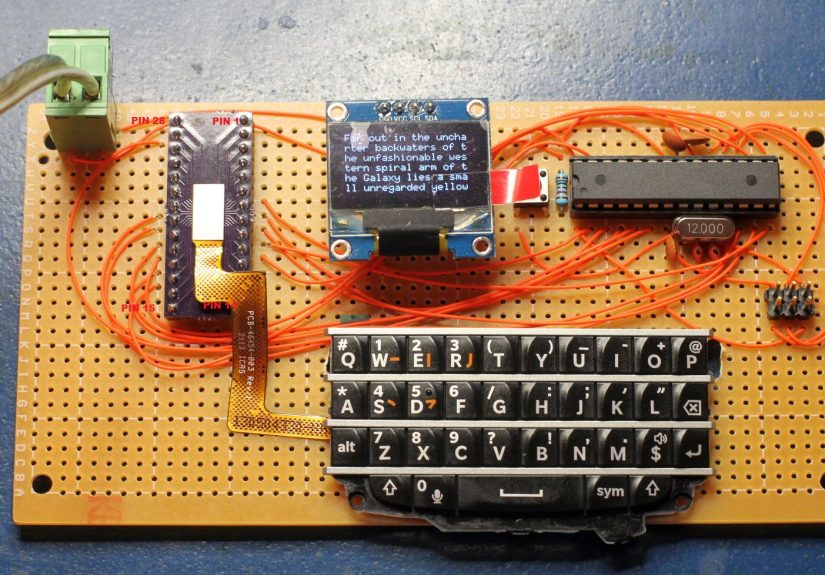
One of the best examples is the Beepy, a palm-sized Linux gadget built around a BlackBerry-style keyboard, a Sharp Memory LCD, a battery, and a Raspberry Pi Zero. In open-hardware circles, the Beepy became more than a cute side project. It became proof that a salvaged or repurposed keyboard could anchor an entire mini-computing ecosystem. Once the design files, firmware ideas, and community knowledge were out in the world, other people began improving, remixing, and extending the concept.
That is the magical part of open-source culture that corporations rarely bottle successfully: one project turns into ten side quests. Reverse-engineering leads to controller boards. Controller boards lead to polished devices. Polished devices lead to clones, forks, fixes, rival boards, better cases, replacement firmware, and a constantly evolving body of community know-how. Nobody has to ask permission from a boardroom to try something weird. They just publish and proceed.
In this environment, the BlackBerry keyboard stopped being a finished product and became a platform component. The emphasis shifted from “Can this beat the iPhone?” to “What else can this become?” That question is far more generous, and frankly a lot more interesting.
The Beepy effect: from keyboard part to hacker habitat
The Beepy story shows exactly how an open-source ecosystem sprouts. First comes reverse-engineering. Then come breakout boards, controller logic, firmware work, and little utility scripts. Then the community notices. People start optimizing text UIs, adapting apps to tiny screens, experimenting with low-power behavior, and building derivatives. Suddenly a single keyboard module has become the center of an ecosystem with tutorials, forks, clones, repair conversations, and design debates.
This is not how mainstream consumer electronics usually behave. Most phones arrive sealed, curated, and allergic to improvisation. The Beepy-style world works the opposite way. Imperfection is not a failure state. It is an invitation. A rough project that ships with open files can become more fertile than a polished closed device because other people can help it grow.
Even the clone drama around Beepy-like devices tells the same story from the opposite angle. Open-source communities thrive when improvements are shared back, documented, and fixable by others. They get weaker when derivatives close up, hide design changes, or treat community labor like free fertilizer for private products. In that sense, the BlackBerry keyboard ecosystem is teaching the same lesson every healthy open-source project teaches sooner or later: openness is not just ideology, it is infrastructure.
PinePhone and the keyboard as a Linux hinge
If Beepy represents the pocket-hacker wing of this movement, the PinePhone keyboard case represents the Linux phone wing. The PinePhone and PinePhone Pro already attract users who want mobile computing to feel more like general computing. Add the official keyboard case and the whole thing starts behaving less like a conventional smartphone and more like a tiny PDA that wandered in from an alternate timeline where tinkering stayed fashionable.
The case is not merely decorative. It attaches through pogo pins, adds a substantial internal battery, supports open firmware, and turns the device into something users can actually type on for longer sessions. That open firmware detail is a big deal. It means the keyboard is not frozen in amber. Community members can alter functionality, refine behavior, and adapt the experience in ways that closed accessories rarely allow.
In other words, the PinePhone keyboard case does what the best open accessories do: it extends hardware while inviting participation. The keyboard is not just an input method. It is another surface where the community can build.
F(x)tec Pro1 X and the operating-system buffet
Then there is the F(x)tec Pro1 X, which feels like it was designed by someone who heard the phrase “choose your platform” and took it personally. The device became notable not only for its landscape slide-out keyboard, but also for its relationship with open and alternative software communities. It shipped with LineageOS out of the box, earned recognition as a FOSS-friendly device, and has remained relevant because projects like Ubuntu Touch continue to support it.
That matters because an ecosystem is never just hardware. It is hardware plus software plus maintainers plus documentation plus users willing to break things on a Sunday and explain the fix by Monday. The Pro1 X works as a symbol of a different mobile future: one where a keyboard phone is not a quirky relic, but a host for multiple operating system identities.
When you can run a phone with a physical keyboard on community-driven Android, or Ubuntu Touch, or other alternative platforms, the keyboard becomes part of a broader freedom story. You are not simply choosing how to type. You are choosing how much control you want over the device itself.
Why this ecosystem keeps sprouting
The short answer is that the BlackBerry keyboard solves a problem people still have. Typing on glass is fine. Typing on real keys is sometimes better. But the bigger answer is that this keyboard also solves a cultural problem. It offers resistance to a phone industry that increasingly treats users as passive consumers of sealed experiences.
A physical keyboard invites intent. Shortcuts become muscle memory. Text entry becomes less visually demanding. Notifications feel less dominant because the device itself seems built for actions, not just content streams. In open-source spaces, that philosophy clicks into place immediately. These communities like hardware that exposes its logic, software that can be modified, and workflows that reward understanding. The BlackBerry keyboard fits right in, like a retired journalist joining a room full of ham radio enthusiasts and instantly becoming mayor.
There is also a repair-and-reuse dimension here that should not be ignored. A discarded BlackBerry keyboard assembly can become the heart of a new project. A dead commercial line becomes donor material for living experiments. That is deeply satisfying in a world full of disposable gadgets. It is also practical. Open ecosystems often grow best around parts that are cheap, available, beloved, and mechanically distinctive. The BlackBerry keyboard checks all four boxes with a smug little click.
The experience of using this world now
Spend time around these projects and a pattern appears almost immediately. Nobody involved talks about the BlackBerry keyboard as if it were merely a collector’s item. They talk about it like a working tool. That changes everything. A collector polishes the past. A builder recruits it.
What makes the experience special is not just the tactile feel, though yes, that still rules. It is the sense that your device is participating with you instead of performing at you. On a touchscreen slab, everything is visually smooth and functionally abstract. On a keyboard device, a tiny act of intention happens every time your thumb presses a key. You do not just touch a possibility on glass. You commit.
That commitment creates a surprising emotional effect. Email feels more manageable. Messaging feels more deliberate. Even command-line experiments on a tiny Linux handheld feel less absurd than they should, because the hardware keeps whispering, “Sure, this is ridiculous, but it is productive ridiculous.” The keyboard makes ambitious nonsense feel respectable.
And that may be the real reason this ecosystem keeps growing. It is not chasing mass-market approval. It is rewarding a specific kind of user delight: the delight of control, texture, clarity, and adaptation. Those are exactly the feelings open-source communities are good at amplifying.
Additional experience section: living with the BlackBerry keyboard mindset
Here is the part nobody tells you when you return to a BlackBerry-style keyboard after years of touchscreen life: your thumbs remember more than your brain does. The first few minutes feel clumsy. You miss keys. You overcorrect. You wonder whether this whole idea belongs in the same museum wing as netbooks and wired earbuds you had to untangle with a prayer. Then, quietly, something shifts. Your hands stop negotiating with the device and start collaborating with it.
That is the experience modern open-source keyboard projects are really selling, even when they pretend they are just offering utility. It feels like re-learning how to drive a stick shift, except the car is a tiny Linux gadget, the road is your message inbox, and the emotional reward is embarrassingly large for something so small. The sensation is tactile, yes, but it is also psychological. You become more aware of what you are doing. Typing stops being background blur.
On a Beepy-like device, that feeling is amplified by constraints. The screen is tiny. The environment is stripped down. There is no giant glossy interface trying to seduce you into a content spiral. You type, navigate, launch, tweak, and continue. It feels less like using an app ecosystem and more like operating a pocket workstation designed by sleep-deprived geniuses who think terminals are cozy. Oddly enough, they may be right.
On something like a PinePhone with a keyboard case, the experience becomes more architectural. You open the hinge, settle the device on a desk, and instantly understand the form factor in your bones. This is not a phone pretending to be a laptop. It is a phone admitting that sometimes a little physical structure goes a long way. Even the act of opening it changes your posture and your intent. You are no longer grazing at the buffet of apps. You are sitting down to do a thing.
The same goes for devices like the Pro1 X or modern BlackBerry-inspired phones. Sliding out a keyboard changes your relationship with time. You are more willing to write longer thoughts. You forgive the smaller screen because the trade-off feels honest. The hardware is telling you exactly what it values. It values input. It values deliberate action. It values the possibility that a phone can still be a tool before it becomes a toy.
What surprised me most about following this space is how communal the experience becomes. In mainstream phone culture, users mainly compare camera samples, benchmark numbers, and whether a new AI button is useful or just decorative. In the BlackBerry keyboard and open-source crowd, people swap firmware tips, discuss keyboard mappings, compare shells, share fixes, document quirks, and celebrate weird little improvements like backlight behavior or power management. It feels less like fandom and more like stewardship.
That is why this ecosystem matters. It turns nostalgia into participation. It turns old parts into new ideas. It turns users into contributors. And in a technology landscape increasingly defined by sealed devices and rented experiences, that feels almost rebellious. Not loud rebellion. Not cinematic rebellion. More like the soft rebellion of a thumb pressing a real key and saying, with satisfying certainty, “I would like my gadget to belong to me again.”
Conclusion
The BlackBerry keyboard survives because it earned the rarest compliment in consumer technology: people missed it for reasons that went beyond sentiment. It was useful, distinctive, and deeply tied to a certain kind of intentional computing. Once the corporate shell around it collapsed, open-source communities, hardware tinkerers, and niche device makers picked up the seeds.
Now those seeds are sprouting everywhere: in Linux handhelds, in keyboard phone revivals, in open firmware accessories, in alternative operating systems, and in tiny communities doing the kind of careful, joyful engineering that giant companies rarely prioritize. The lesson is bigger than one keyboard. When a beloved interface escapes a closed ecosystem and lands in open hands, it can stop being a product and start becoming a species.
The BlackBerry keyboard is no longer just a memory of the mobile past. It is a living branch in the future of open hardware. Not bad for a bunch of tiny buttons that were supposedly finished years ago.