Table of Contents >> Show >> Hide
- What Is the Cube Rule of Food?
- How the Cube Rule Categories Work
- Why the Theory Went Viral
- The Great Hot Dog Schism: Sandwich or Taco?
- Specific Examples That Make the Rule Weirdly Useful
- Where the Cube Rule Works Brilliantly
- Where the Cube Rule Falls Apart
- Experiences People Have With the Cube Rule of Food
- Conclusion
Every generation gets the philosophy it deserves. Some people got Plato. Some got Kant. We got the internet asking, with a straight face and a ketchup stain on its shirt, whether a hot dog is a sandwich. Out of that glorious chaos came The Cube Rule of Food, a playful but surprisingly persuasive system for classifying dishes by one thing alone: where the starch sits.
That is the charm of this so-called unified food identification theory. It ignores ingredient prestige, culinary snobbery, and the emotional fragility of people who do not want to hear that pizza is toast. Instead, it asks a geometric question. If you imagine a food as a cube, where does the starch appear? Bottom only? Top and bottom? Folded around the sides? Fully enclosed? Suddenly, meals become shapes, and lunch becomes a logic puzzle.
Is this formal food science? No. Is it one of the funniest and most strangely useful food classification systems on the modern internet? Absolutely. The Cube Rule works because it strips food down to structure. It treats a dish like architecture you can eat, which means a humble hot dog can start family arguments normally reserved for politics and thermostat settings.
In this article, we will break down how the Cube Rule of Food works, why it became such a pop-culture phenomenon, where it fits surprisingly well, where it totally falls apart, and why the whole thing still says something clever about how people think about food. Spoiler: the rule is ridiculous, but it is not meaningless. That is a dangerous combination online.
What Is the Cube Rule of Food?
The Cube Rule of Food is an internet-born framework that classifies foods by the placement of their “structural starch.” In plain English, structural starch means the bread, crust, tortilla, pastry, dough, rice wrapper, or other carb-based element that physically supports the filling. The filling itself matters less than the edible container.
That idea turns food into geometry. If starch appears only on the bottom, the food is a toast. If it appears on the top and bottom, it is a sandwich. If it wraps around the bottom and two sides, it becomes a taco. Wrap a little more, and you move into sushi, quiche, or calzone territory. The official chart also includes the chaos-tier extras: salad, cake, and nachos.
What makes the rule memorable is that it applies the same logic to wildly different foods. A slice of pizza and a piece of nigiri both fall under toast because the starch is on the bottom. A burrito, if fully enclosed, can become a calzone. A sub sandwich with a connected hinge? According to the Cube Rule, that is not a sandwich at all. It is a taco. Somewhere, a deli owner just felt a disturbance in the force.
How the Cube Rule Categories Work
1. Toast
Toast is the base class: starch only on the bottom. This is the Cube Rule’s favorite way to offend people. Pizza is toast. Nigiri sushi is toast. Pumpkin pie slice is bent toast. The rule does not care whether the topping is tomato sauce, raw fish, or whipped cream. If the support is mostly underneath, congratulations, you are eating a toast.
2. Sandwich
In Cube Rule logic, a sandwich requires starch on the top and bottom, with the sides open. This category includes obvious examples, but it is narrower than many dictionary definitions. A classic two-slice deli sandwich fits beautifully. So does a neatly layered cake with filling between horizontal layers, which is exactly the kind of statement that makes pastry chefs stare into the middle distance.
3. Taco
Taco means starch on the bottom and two opposing sides. This is where the famous hot dog taco debate lives. If the bun is hinged rather than split into two separate pieces, the Cube Rule says the hot dog belongs here. Same goes for an uncut sub. A slice of pie can even count as a taco if you rotate the geometry and accept that the internet clearly had too much free time.
4. Sushi
Sushi, in Cube Rule language, means starch wraps the top, bottom, and two sides, leaving the ends open. This category captures foods like wraps, enchiladas, and certain rolled items. It is not claiming every wrap is literally Japanese sushi in the culinary sense. It is saying the structure matches the same carb-position pattern. In other words, this is geometry wearing a fake mustache.
5. Quiche
Quiche covers foods with starch on the bottom and all four sides, but open on top. Cheesecake, deep-dish pizza, bread-bowl soup, and falafel in pita can slide into this class depending on their form. It is the category for dishes that say, “I am contained, but I still need air.”
6. Calzone
Calzone is the fully enclosed starch class. Burritos, corn dogs, whole pies, dumplings, Pop-Tarts, and unbitten Uncrustables all qualify under the broader logic. It is the Cube Rule’s version of a sealed system, which sounds scientific until you remember a frosted toaster pastry is now sitting at the same conceptual lunch table as an empanada.
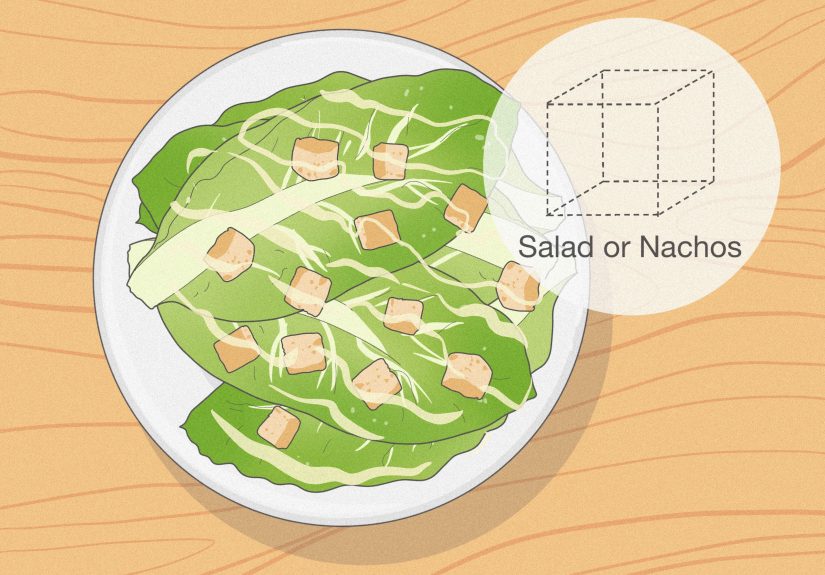
7. Salad, Cake, and Nachos
The rule’s “extended universe” is where things get extra spicy. Foods without structural starch become salad. Steak? Salad. Mashed potatoes? Salad. Soup? Wet salad. Then there is cake, which refers to stacked layers, like lasagna or a Big Mac. Finally, nachos describe foods with supporting bits distributed throughout rather than wrapped around, such as poutine or cereal in milk.
Why the Theory Went Viral
The Cube Rule exploded because it arrived at the exact intersection of internet culture, food obsession, and mock scholarship. It offered a clean chart for an argument people were already having: is a hot dog a sandwich? Once the rule declared the hot dog a taco, the conversation leveled up from semantic squabble to full-blown comedic cosmology.
That leap matters. People love systems, even absurd ones. Give the internet a chart, a debate, and a chance to tell strangers they are wrong about lunch, and you have instant fuel. The Cube Rule looks tidy enough to feel logical, but outrageous enough to be shareable. It is the culinary equivalent of putting glasses on a raccoon and calling it a consultant.
It also helps that the theory reveals something true about classification: people rarely agree on what counts most. Some focus on ingredients. Others focus on shape, tradition, preparation, or cultural identity. The Cube Rule says, “Forget all that. We ride for structure.” Even when people reject the framework, they end up exposing their own hidden rules about food. That is why the joke keeps working.
The Great Hot Dog Schism: Sandwich or Taco?
No food has benefited more from the Cube Rule than the hot dog. Conventional references often treat a hot dog in a split roll as a type of sandwich. That makes perfect sense in ordinary language. Bread plus filling is bread plus filling. But the Cube Rule insists the bun’s hinge changes everything. The connected shape creates bottom support and two sides, which moves the hot dog into taco territory.
This is why the hot dog sandwich debate refuses to die. It is not really about meat tubes. It is about which rulebook wins. The dictionary rule prioritizes usage. Tax agencies care about categories that affect sales tax. Food institutions protect cultural identity. The Cube Rule cares about shape and shape alone.
Once you understand that, the argument becomes less silly and more revealing. A hot dog can be a sandwich in one system and a taco in another because classification is always built on assumptions. The Cube Rule is not wrong because it is funny. It is funny because it exposes how arbitrary some of our “serious” categories already are.
Specific Examples That Make the Rule Weirdly Useful
Pizza Is Toast
This is the ruling that launches a thousand comment sections. Traditional pizza is a flat bread base with toppings placed on top. Structurally, the Cube Rule sees a toast. Harsh? Maybe. But look at a slice of pizza without romance. It is bread on the bottom, stuff on top. The geometry does not care that your favorite pizzeria has a wood-fired oven and a 90-second bake.
Burrito Is Usually a Calzone
A burrito is a wrapped tortilla around a mixed filling. Because it is enclosed on all sides, it often lands in calzone territory. That ruling sounds outrageous until you remember the rule is not comparing cultural origin or flavor profile. It is comparing enclosure. A burrito and a calzone are distant structural cousins, not culinary twins.
Nigiri Is Toast, but Maki Is Sushi
This example is where the theory actually teaches something. “Sushi” in real culinary terms is broader than one shape, but the Cube Rule uses the word for a specific form: starch wrapped around several sides. That means nigiri, with rice underneath fish, behaves like toast, while maki-style rolls align more closely with the rule’s sushi category. The framework is silly, but it does reward close visual thinking.
Deep-Dish Pizza Is Not Regular Pizza
One of the Cube Rule’s funniest strengths is its willingness to split hairs where people normally do not. A New York slice may be toast, but a deep-dish pizza can drift toward quiche because the crust rises up the sides and creates a more container-like structure. The theory is absurdly literal, which is exactly why it can handle these edge cases with such smug confidence.
Where the Cube Rule Works Brilliantly
For all its chaos, the Cube Rule succeeds in a few real ways. First, it gives people a fast, memorable way to compare foods across cuisines without defaulting to ingredient lists. Second, it highlights form, which genuinely matters in eating. Structure affects bite, portability, mess, layering, temperature retention, and how fillings behave. A taco is not just taco-flavored because it tastes like one. It is also taco-shaped in the hand.
Third, the rule makes people notice design. Foods are engineered experiences. The bun on a hot dog, the wrap on a burrito, the crust wall on a pie, the stack of a Big Macthese are structural choices with practical effects. Once you start thinking this way, you stop seeing meals as random and start seeing them as edible architecture. Frankly, that is a much better use of the phrase “open concept.”
Where the Cube Rule Falls Apart
Now for the obvious truth: the Cube Rule is not a complete theory of food. It ignores culture, history, technique, and intention. A taco is not just a folded starch geometry. It is a food with deep culinary roots, regional traditions, and context. The same goes for sushi, pizza, burritos, pies, and sandwiches. Structure matters, but it is not the whole story.
The rule also struggles with fluid foods, messy foods, partially eaten foods, and foods that change shape while you eat them. Is a taco still a taco after it cracks and turns into a plate of sadness? Is an ice cream cone a taco, or does melting turn it into soup with emotional consequences? The framework can answer these questions only by becoming even more ridiculous, which is honestly on-brand.
Still, the theory does not need to be academically perfect to be useful as a thought experiment. Its value lies in how elegantly it simplifies, then how spectacularly that simplification collides with culture. In that collision, the joke becomes insight.
Experiences People Have With the Cube Rule of Food
The funniest thing about the Cube Rule is not the chart itself. It is what happens when real people start using it in real life. The first experience is almost always disbelief. Someone sees “hot dog = taco” and laughs, then immediately starts mentally reorganizing the contents of their fridge. Breakfast becomes a philosophy seminar. A bagel with cream cheese starts looking suspiciously like toast. A breakfast burrito suddenly feels less like a morning hero and more like a sealed carb pod with legal calzone implications.
Then comes the group experience, which is where the rule truly earns its keep. At parties, family dinners, office lunches, game nights, and late-night takeout runs, the Cube Rule turns ordinary eating into a debate sport. One person points at pizza and declares it toast. Another person objects on moral grounds rather than logical ones. Someone brings up deep-dish pizza and the room divides into factions. Before long, people are standing over a counter holding half-eaten food like expert witnesses in the world’s least necessary trial.
There is also a surprisingly nostalgic side to it. The Cube Rule has a way of bringing back the pure, goofy pleasure of arguing about something low stakes. In a world where many conversations feel exhausting, it is refreshing to spend ten minutes fiercely discussing whether lasagna is cake. Nobody needs to win. The fun comes from how seriously everyone pretends to take it. The rule gives adults permission to be gloriously unserious for a moment, which may be its healthiest contribution to society.
Another common experience is that the Cube Rule changes the way people look at menus. Once you learn the categories, you cannot fully unsee them. Wrap sections become sushi-adjacent. Bread bowls become quiche territory. Filled pastries start waving little calzone flags. Even if you do not agree with the rulings, the framework trains your eye to notice structure first. It becomes a tiny form of food literacy, wrapped in a meme and delivered with a wink.
And perhaps the most relatable experience of all is realizing the Cube Rule says more about people than it does about food. The foods that trigger the strongest reactions are usually the ones people feel emotionally loyal to. Folks defend pizza because they love pizza, not because the geometry is airtight. People resist the burrito-calzone idea because it feels culturally wrong, even if the visual comparison makes a weird kind of sense. The rule pokes at identity through lunch, which is an internet superpower if there ever was one.
In that way, the experience of using the Cube Rule is a mix of laughter, mild outrage, curiosity, and a sudden urge to inspect your dinner from all six sides. It is silly, but it is also social. It gets people talking. It makes meals memorable. And every now and then, it leaves someone staring at an Uncrustable like they have just uncovered a classified document.
Conclusion
The Cube Rule of Food: A Unified Food Identification Theory is not a real scientific law, and that is exactly why it works so well. It is a playful system with just enough logic to feel persuasive and just enough chaos to stay funny. By classifying food according to the position of structural starch, it turns lunch into geometry, dinner into debate, and dessert into a potential legal dispute.
More importantly, the Cube Rule reminds us that food categories are not always as natural or obvious as they seem. A sandwich is a definition. A taco is a tradition. A burrito is a structure. A pizza is a cultural treasure that, according to one rude little chart, also happens to be toast. Love it or reject it, the theory forces people to explain what they think food is, and that makes it more than a meme. It becomes a clever lens on the way humans sort, name, defend, and occasionally overthink what they eat.
So the next time someone asks whether a hot dog is a sandwich, you can smile with the confidence of a person who has seen the carb matrix. The better question is not whether the answer is right. It is whether the room is ready for it.