Table of Contents >> Show >> Hide
- Why the First Images Hit So Hard
- The Five First Targets That Announced a New Era
- Why This Was NASA’s Greatest Achievement in Decades
- More Than Pretty Pictures: Webb Changed the Scientific Mood
- The Human Experience of Seeing Webb’s First Images
- 500 More Words on the Experience of Webb’s First Images
- Conclusion
When NASA released the James Webb Space Telescope’s first images in July 2022, it did not feel like an ordinary science update. It felt like civilization had opened a door. One minute the public was hearing about mirror alignment, cryogenic instruments, and a sunshield the size of a tennis court. The next minute, humanity was staring at glittering ancient galaxies, stellar nurseries, a dying star wrapped in dust, and an alien world whose atmosphere had already started spilling secrets. That is not a press cycle. That is a mic drop.
Plenty of NASA missions deserve applause, standing ovations, and maybe a parade with extremely nerdy floats. But the James Webb Space Telescope’s first images made a stronger argument than most for being the agency’s greatest achievement in decades. Not because they were merely beautiful, although they were absurdly beautiful. Not because Webb was expensive, delayed, and difficult, although yes, it definitely collected all three. Webb’s debut mattered because it instantly proved that the telescope could transform astronomy on multiple fronts at once: the early universe, galaxy evolution, star formation, dying stars, and exoplanet atmospheres. In one release, NASA showed that Webb was not just working. It was overachieving.
Why the First Images Hit So Hard
To understand why the first image set landed like a scientific thunderclap, you have to remember the stakes. Webb was designed as the most powerful space observatory ever launched, built to see the cosmos in infrared and look farther back in time than previous observatories could manage with the same clarity. The engineering challenge was so wild it sounded like a dare: launch a folded observatory, send it roughly a million miles from Earth to the Sun-Earth L2 point, unfold it in space, cool its instruments, align 18 gold-coated mirror segments, and then hope the universe would reward your stress with data worth the gray hair.
NASA had been here before with ambitious projects, but Webb was different. This was not just another telescope following Hubble with a slightly shinier résumé. Webb was built to answer giant questions: How did the first galaxies form? How do stars and planetary systems emerge from dust? What do alien atmospheres contain? In other words, the telescope was not here to provide prettier wallpaper for your desktop. It was here to change textbooks.
That is why the first images mattered so much. They were the public proof of concept. The debut package showed that Webb could do scale and subtlety at the same time. It could observe the deepest reaches of cosmic history, but also detect fine details hidden inside dust clouds and even read an atmospheric fingerprint from a distant exoplanet. Hubble gave us iconic views of the universe. Webb showed up and basically said, “That was adorable. Now watch this.”
The Five First Targets That Announced a New Era
1. Webb’s First Deep Field Was the Ultimate Flex
The first released image, centered on galaxy cluster SMACS 0723, was the kind of reveal that makes people stop pretending they understand scale. At first glance, it looked like a dense jewel box of light. But the real magic was what those lights represented: thousands of galaxies, many incredibly ancient, with their light stretched into infrared after traveling for billions of years. Gravitational lensing from the foreground cluster magnified even more distant galaxies behind it, turning the field into both an image and a time machine.
This image mattered because it immediately demonstrated Webb’s power. The telescope was not just producing a prettier deep field than Hubble. It was delivering a deeper, sharper infrared look at the distant universe, revealing faint objects that had either been difficult to study or entirely out of reach. That one frame justified years of anticipation. It told astronomers that the early universe was suddenly much more accessible. It told the public that space is crowded, old, and gloriously indifferent to our deadlines.
2. The Carina Nebula Turned Star Formation Into Theater
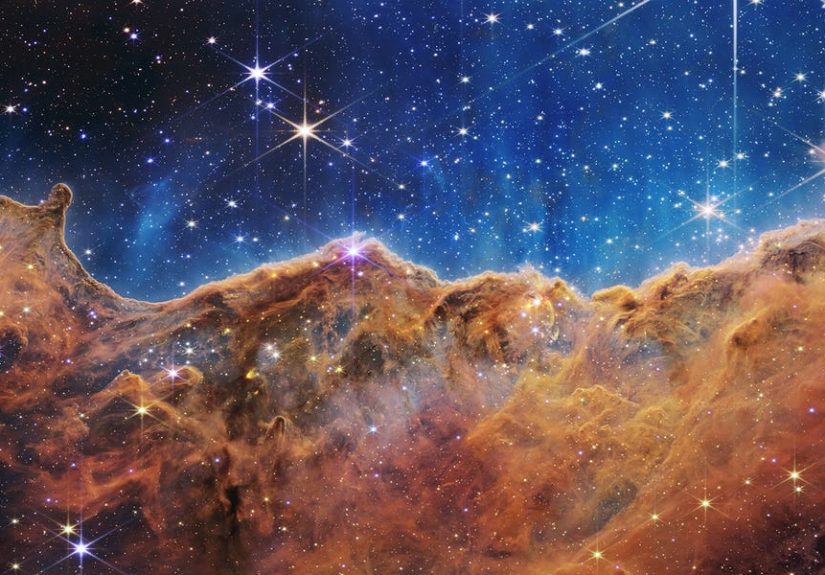
If the deep field was Webb showing off cosmic history, the Carina Nebula image was Webb showing off cosmic weather. Nicknamed the “Cosmic Cliffs,” this scene looked like a mountain range at sunset, except those “mountains” were towering walls of gas and dust sculpted by intense radiation from nearby young stars. In visible light, much of this region had been hidden. In infrared, Webb cut through the haze and exposed previously obscured structures, jets, and newborn stars.
This image made one of Webb’s strengths obvious even to non-scientists: it can see into places where optical telescopes struggle. The result was more than a gorgeous portrait. It was a lesson in how stars are born, how radiation shapes nebulae, and how violent and creative the universe can be at the same time. The Carina image also helped Webb become culturally sticky. People who never read astrophysics papers suddenly knew what the Cosmic Cliffs were, and for one shining moment, a stellar nursery was more viral than celebrity gossip. Humanity, you had a good week.
3. The Southern Ring Nebula Made Death Look Complicated
Then came the Southern Ring Nebula, which reminded everyone that the universe is spectacularly dramatic about endings. This planetary nebula formed when a dying star shed layers of gas and dust. Webb’s images, especially in infrared, exposed details that sharpened the story: shells of ejected material, complex structure, and the dust-shrouded companion system at the center. The telescope did not just show a pretty ring. It revealed the mechanics of stellar death and recycling.
That matters because the life cycles of stars shape everything from chemistry to planet formation. The heavy elements needed for rocky worlds and, eventually, life do not appear out of thin vacuum because the cosmos is feeling generous. They are forged in stars and dispersed through violent stellar processes. The Southern Ring image made that abstract truth visual. It was astronomy with emotional range: beautiful, unsettling, and weirdly elegant.
4. Stephan’s Quintet Proved Webb Could Handle Cosmic Chaos
Stephan’s Quintet might be the most cinematic of the bunch. This grouping of galaxies, with several interacting in a gravitational dance, gave Webb a chance to show both its resolution and its scientific ambition. The mosaic was massive, packed with detail, and rich with clues about galactic collisions, star formation triggered by interaction, and the environment around a supermassive black hole.
Galaxies are not static ornaments hung across the sky. They pull, distort, merge, ignite, and feed black holes. Webb’s image of Stephan’s Quintet made that process feel immediate. Instead of treating galaxy evolution as an idea buried in a lecture, the image presented it as a living event. It was one of the clearest signs that Webb could connect visual splendor with serious astrophysics. The image was gorgeous enough for a poster, but it was also data-rich enough to keep researchers busy for years. That is the Webb formula at its best.
5. WASP-96 b Quietly Stole the Future
The most important “image” in the debut package may have been the least poster-friendly one: the transmission spectrum of exoplanet WASP-96 b. No blazing nebula. No glittering galaxy cluster. Just a graph. And yet that graph was a huge deal, because it showed Webb detecting atmospheric features from a planet outside our solar system, including evidence of water vapor. That was the moment many people realized Webb was not only a camera. It was a chemical detective.
This is where the first release became historic rather than merely impressive. With one exoplanet spectrum, Webb hinted at a future in which astronomers could characterize distant worlds in extraordinary detail. Not every target would be Earth-like, and WASP-96 b itself is a hot gas giant rather than a charming vacation spot. But the principle was everything. If Webb could do this so early, then the door to comparative exoplanet science had swung wide open.
Why This Was NASA’s Greatest Achievement in Decades
Calling Webb’s first images NASA’s greatest achievement in decades is a bold statement, but it holds up surprisingly well. The reason is not nostalgia, and it is not because older missions suddenly became less important. It is because Webb united engineering triumph, scientific reach, and public imagination in a way that very few missions ever do.
First, the engineering was borderline absurd. Webb had to survive launch, travel to L2, deploy flawlessly, and align its segmented mirror with precision measured in fractions too tiny for casual conversation. Any failure in the sequence could have crippled the mission. The fact that the telescope not only survived but performed magnificently on debut is one of the most impressive technical victories NASA has pulled off in the modern era.
Second, the science return was immediate and broad. Some missions promise future payoff. Webb delivered range on day one. It reached into the deep universe, into stellar nurseries, into dying-star environments, into interacting galaxies, and into exoplanet atmospheres. That breadth is what separated the debut from a standard first-light moment. NASA was not unveiling a single capability. It was unveiling an observatory that could transform several fields at once.
Third, the first images re-centered NASA in the public imagination. The agency has had major wins in planetary exploration, Mars rovers, and Earth science, all of them significant. But Webb’s release had the rare quality of becoming a cultural event. Teachers used it in classrooms. Scientists dissected it in real time. News outlets put it on front pages. People who had not thought about infrared astronomy since approximately never suddenly had opinions about deep fields and redshift. That kind of public engagement is not fluff. It is part of how big science builds lasting support and shared wonder.
More Than Pretty Pictures: Webb Changed the Scientific Mood
There is a lazy habit in science coverage of calling telescope images “beautiful” and stopping there, as if astronomy were just a very expensive art program. Webb’s first images rejected that framing almost immediately. Yes, they were stunning. But they also altered expectations. Astronomers quickly realized that Webb might find galaxies forming earlier than many models anticipated, observe dusty structures with startling clarity, and make exoplanet atmosphere work feel less speculative and more routine.
In other words, Webb’s debut changed the scientific mood from hopeful to electric. It suggested that long-standing questions about the early universe might soon get better answers or, even better, more confusing ones. Science loves answers, but it secretly adores disruptive new questions. Webb started generating both almost immediately.
That is the deeper reason the first images matter so much. They were not the finish line after years of development. They were the starter pistol. The images showed that Webb was ready to become a discovery machine, and the years since have only reinforced that impression. What the public saw in July 2022 was not a victory lap. It was the opening chapter of a much longer scientific revolution.
The Human Experience of Seeing Webb’s First Images
There was also something deeply human about the release that deserves more attention. Space exploration can feel abstract when it lives in budgets, technical reviews, and launch schedules. Webb’s first images translated all that abstraction into emotion. Suddenly the mission was not just a line item, a delayed observatory, or an engineering headache. It was a shared experience.
For scientists, the moment carried the thrill of possibility. For engineers, it carried relief mixed with pride. For students, it was an invitation into astronomy that did not begin with dry definitions but with awe. For the rest of us, it was a reminder that even in an era of nonstop noise, people will still stop and stare when shown something genuinely extraordinary.
That emotional power is easy to underestimate, but it matters. Great achievements are not measured only by technical papers or hardware diagrams. They are also measured by whether they expand the public sense of what is possible. Webb did that. It made the universe feel both bigger and more reachable. It reminded us that human beings can build something delicate, ambitious, and improbable, send it into deep space, and use it to learn where we come from. That is not just science. That is civilization acting like civilization.
500 More Words on the Experience of Webb’s First Images
Watching the first James Webb images arrive felt a little like standing in a crowded theater before the lights go down, except the theater was the internet and the movie was the universe revealing better production values than anyone expected. There had been months of buildup, years of anticipation, and a truly heroic amount of anxious waiting from people who knew exactly how many things could go wrong. When the images finally appeared, the emotional reaction was immediate because they delivered on every level at once. They were scientifically important, visually overwhelming, and strangely personal.
For many people, the first encounter with Webb’s deep field was not a technical one. It was physical. You looked at the image and felt your scale change. The mind has a hard time processing what it means to see light that has traveled for billions of years and to understand that much of what appears in one frame is not a handful of stars but entire galaxies. It produces a mix of wonder and humility that is hard to duplicate in ordinary life. Your errands still exist. Your inbox still exists. But for a moment they seem hilariously small. The universe has a talent for perspective, and Webb delivered it in high resolution.
The Carina Nebula image created a different feeling. Unlike the deep field, which overwhelms with distance and age, the Cosmic Cliffs overwhelm with texture. People saw mountains, fog, glowing edges, and hidden stars emerging from dust. It felt familiar and alien at the same time, which is one reason the image spread so quickly. It looked like a landscape from a dream, except it was real. That combination is powerful. When science produces something that resembles art without trying to be art, it reaches people who may never read a research paper but still understand that they are looking at something meaningful.
There was also a collective satisfaction in knowing how much effort stood behind those pictures. Webb’s first images were not just the product of one summer or one administration or one lucky team. They represented decades of design, testing, funding fights, engineering improvisation, and stubborn belief. That knowledge changed how the images were received. People were not simply admiring space. They were admiring competence, patience, and collaboration on an almost unreasonable scale. In a world that often rewards speed and noise, Webb was a reminder that some of the best things humans do take a very long time and require thousands of people to be excellent at once.
For teachers and parents, the experience carried another layer. Webb’s first images gave them a new way to talk about science that did not begin with obligation. They began with amazement. A child did not need to know what infrared light was to be captivated by a stellar nursery or a galaxy cluster. Curiosity came first. Vocabulary could follow. That is the ideal gateway into science, and Webb opened it wide.
Even now, years later, those first images still carry a special charge. New Webb observations continue to appear, and many are extraordinary. But first images are different. They are the moment a mission stops being theoretical and becomes real in the public imagination. They are the instant the years of promises are tested against evidence. Webb passed that test with swagger. The experience of seeing those first pictures was not just about beauty or novelty. It was about feeling, almost all at once, how far human skill can reach when it is aimed at something larger than ourselves.
Conclusion
The James Webb Space Telescope’s first images were not just NASA’s latest success. They were the clearest demonstration in decades that the agency can still deliver a world-stopping scientific moment that changes both research and public imagination. The debut package showed range, precision, and ambition on an almost unfair level. It gave us ancient galaxies, newborn stars, stellar death, galactic interaction, and exoplanet chemistry in one unforgettable unveiling.
That is why the claim in this title is more than hype. Webb’s first images were NASA’s greatest achievement in decades because they fused engineering brilliance with scientific payoff and global wonder in a single event. They did not merely show us the universe. They reminded us what humanity looks like when it does something astonishing on purpose.