Table of Contents >> Show >> Hide
Every era gets the satire it deserves. Ours apparently gets screenshots of tone-deaf bosses, job listings with Olympic-level audacity, and products that get smaller while their prices stay spiritually gigantic. That is exactly why the Instagram account Eff You I Quit struck such a nerve. Its posts do not merely mock bad workplace behavior. They capture the polished, corporate version of greed: the kind that arrives in a staff memo, a “competitive salary” listing, or a candy bar that went on a mysterious diet without telling anyone.
Viral roundups of the account framed it as a running commentary on the modern labor market, where workers deal with bad management, exploitative policies, and economic nonsense dressed up as business strategy. That framing still works because the account’s appeal has never been about shock value alone. It is about recognition. People see these posts and think, “Oh good, it is not just my office, my manager, my grocery store, or my rent-eating budget.”
This article does not reproduce the original screenshots one by one. Instead, it distills the 45 recurring corporate-greed callouts that made the account resonate so strongly. Think of it as a field guide to the internet’s most elegant eye-roll at workplace exploitation, junk fees, shrinkflation, hiring theater, and executive logic that somehow always ends with regular people paying the bill.
The Account Behind the Corporate Side-Eye
What makes this Instagram account land is its tone. It is not shouting for the sake of shouting. It is pointing. Calmly. Dryly. Sometimes hilariously. It takes a screenshot, a quote, or a workplace story and lets the absurdity do the heavy lifting. In other words, it understands a timeless truth: if you want to expose corporate greed, you do not always need a manifesto. Sometimes you just need one unbelievable email and the courage to post it.
The feed also works because it connects private frustration to public patterns. Workers may still like their teammates or even their direct managers, but they are often far less happy with pay, promotion opportunities, scheduling, and the general sensation that “efficiency” always seems to mean one person doing the jobs of three. Consumers feel a similar irritation when prices rise, fees multiply, service declines, and companies call all of this “value optimization,” which is business-speak for “we would like more of your money and less of your joy.”
45 Times the Account Tastefully Called Out Corporate Greed
Across its viral posts and the labor conversations around them, the account keeps circling one big idea: greed rarely introduces itself honestly. It shows up wearing a friendly slogan, a corporate font, and a bullet-point list of “opportunities.”
Workplace Absurdities, Items 1–15
- The “we’re a family” speech that somehow ends in unpaid overtime. Nothing says family like being asked to sacrifice your weekend for free.
- The efficient employee who gets rewarded with more work. Congratulations on your competence; here is everyone else’s workload too.
- The boss who mistakes availability for loyalty. If you answer emails at 10:47 p.m. once, some employers treat it like a subscription.
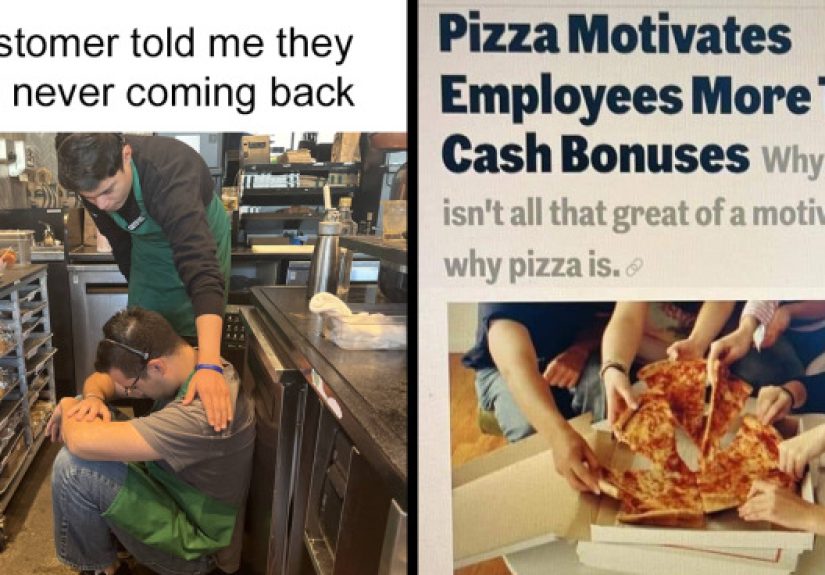
- The pizza party replacing an actual raise. Pepperoni is not legal tender, but many companies keep testing the theory.
- The record-profit memo arriving next to layoffs. It is amazing how “strong performance” and “headcount reduction” keep sharing the same paragraph.
- The last-minute schedule drop. Some workplaces post shifts so late that planning a life starts to feel like fantasy fiction.
- The open-availability requirement for low pay. Employers want Fortune 500 flexibility from workers making barely enough to cover groceries.
- The entry-level role demanding five years of experience. A classic corporate magic trick: needing a beginner who has already lived three careers.
- The degree inflation circus. Sometimes a job listing reads less like a real opening and more like a dare.
- The ghost job posting. Nothing builds trust like a role that is always hiring and somehow never actually hires.
- The seven-round interview for a modest salary. If the hiring process has more episodes than a prestige drama, something has gone wrong.
- The “competitive pay” listing with no number attached. If the salary is truly proud of itself, it should be willing to introduce itself.
- The unpaid test project dressed up as “part of the process.” Spec work has become the professional version of “can you just do one quick favor?”
- The noncompete clause for ordinary workers. Nothing says confidence in your company like legally trying to trap people inside it.
- The expectation of cheerful burnout. In some workplaces, exhaustion is bad, but exhaustion with a smile is “team spirit.”
Hiring, Pay, and Power Plays, Items 16–30
- The guilt trip around using paid time off. A benefit is not much of a benefit if employees need emotional armor to use it.
- The permanent understaffing plan. Many companies call it lean; workers call it Tuesday.
- The executive bonus during a pay freeze. Nothing motivates a team like watching “shared sacrifice” skip the boardroom.
- The worker told to train the cheaper replacement. Few moments capture corporate disrespect quite so cleanly.
- The return-to-office order with no real business case. If the job worked remotely for years, workers tend to notice when the explanation gets suspiciously vague.
- The surveillance software sold as productivity. When trust leaves the room, screen monitoring usually slides into its chair.
- The algorithmic schedule that wrecks sleep and childcare. Technology is impressive, but it should not be used to randomize a person’s life.
- The customer-facing employee forced to defend bad policy. Frontline staff get blamed for rules they did not write and cannot change.
- The company that renames missing benefits as “culture.” No, free coffee is not a substitute for decent healthcare.
- The contractor who is treated like a full-time worker without full-time protection. Corporate greed loves flexibility when it flows upward.
- The intern-level title with senior-level expectations. Same stress, smaller paycheck, shinier euphemism.
- The “do more with less” slogan. A remarkable phrase that somehow always means workers do more and executives keep more.
- The promotion that never comes because the company cannot “replace” you. Being too good at your job becomes the reason you cannot advance in it.
- The performance review that moves the goalposts. You hit the target, and management quietly wheels out a new target from behind a curtain.
- The listening session where nobody listens. Some corporate town halls are just complaints being placed into decorative storage.
Consumer Greed in a Suit and Tie, Items 31–45
- The shrinkflation special. Same package, smaller contents, bigger annoyance.
- The junk fee ambush. The price looked decent until checkout turned into a scavenger hunt for hidden charges.
- The credit card late-fee machine. A tiny mistake becomes a revenue strategy, then gets explained as policy.
- The overdraft trap. A shortfall becomes a business model faster than you can say “pending transaction.”
- The hotel or ticket price that balloons at the end. A master class in pretending math is optional until the final screen.
- The cancellation maze. Signing up takes one click; leaving requires the endurance of a trail ultramarathoner.
- The chatbot loop replacing customer service. If a robot says “I understand your frustration” enough times, apparently that counts as help now.
- The product quality downgrade hiding behind new packaging. Nothing says innovation like making the item worse more efficiently.
- The fake discount. First inflate the price, then slash it, then wait for confetti.
- The monopoly-style shrug. When competition disappears, courtesy often packs a bag and leaves too.
- The inflation excuse that outlives the inflation spike. Some companies discovered consumers were used to higher prices and decided to keep the experiment going.
- The CEO-pay rocket ship. Worker pay inches forward while executive compensation moves like it is late for a private jet.
- The quarterly earnings obsession. Long-term trust is sacrificed so a spreadsheet can look better for one very specific Tuesday.
- The anti-union campaign dressed up as concern. Few things are more revealing than a company suddenly becoming intensely interested in “open dialogue” the minute workers organize.
- The corporate apology that fixes the wording, not the problem. A rebrand is not reform, even if the statement uses a tasteful shade of blue.
Why These Posts Hit So Hard
The secret is that the account rarely needs to exaggerate. The modern economy is already doing enough improv. Federal labor data still show millions of people quitting jobs each month, while workplace surveys continue to find a familiar pattern: workers often feel decent about colleagues and direct supervisors, but much less enthusiastic about pay, advancement, and stress. That gap is where resentment grows. It is also where this kind of content thrives.
The consumer side is just as revealing. Hidden fees, late-fee crackdowns, fights over overdraft practices, and the wider public backlash to shrinkflation all suggest that people are not simply mad at “prices.” They are mad at feeling played. They are tired of discovering that the listed price is not the real price, the product size is not the old size, and the fine print is where the company keeps its little gremlins.
Then there is the giant neon billboard in the background: executive compensation. People can tolerate hard truths. What they struggle to tolerate is hypocrisy. When workers are told to be realistic about budgets while executive pay keeps orbiting the moon, the moral math becomes impossible to ignore. That is when a sarcastic Instagram post stops feeling like a joke and starts feeling like documentation.
What the Account Really Understands About Corporate Greed
The smartest thing this Instagram account does is avoid turning every problem into a cartoon villain story. Greed is not always a man in a silk tie cackling over a spreadsheet. More often, it is structural. It is a company that knows workers are replaceable, customers are trapped, or regulators move slowly. It is a system that rewards short-term wins, even when those wins are achieved by making jobs worse, service thinner, and everyday life more expensive.
That is why the account feels so effective. It translates abstract economic frustration into concrete scenes people can instantly recognize. One screenshot says more than a hundred polished press releases because it captures the moment the mask slips. The boss says the quiet part out loud. The company reveals what it values. The product gets smaller. The fee gets bigger. The worker gets blamed. The customer gets tired. And everyone watching from the sidelines thinks, “Ah. There it is.”
In that sense, the account is not really just “calling out corporate greed.” It is archiving the emotional texture of living with it. The annoyance. The absurdity. The fatigue. The tiny flash of validation that comes from seeing somebody else say, with style and perfect timing, “No, you are not imagining this. This is ridiculous.”
Real-World Experience: Why These Posts Feel So Personal
What makes a topic like this stick is that almost everyone has a memory attached to it. You may not remember the exact headline about junk fees or labor-market churn, but you probably remember standing in a checkout flow wondering why a perfectly ordinary purchase suddenly collected three mysterious charges like Pokémon. You probably remember a manager saying the company valued people right before asking those same people to absorb another vacancy, another shift, another “temporary” responsibility that never went away.
That is why posts from an account like this travel so fast. They are not consumed as news alone; they are processed as recognition. A person sees one screenshot about a boss demanding complete flexibility for part-time wages and immediately remembers the month they could not plan dinner, childcare, or even a doctor’s appointment because their schedule changed like weather in the Midwest. Someone else sees a post about “competitive salary” with no posted pay and remembers spending hours customizing a resume for a role that paid less than their current job plus a side of disappointment.
The consumer version is just as relatable. Most people now have at least one story about a product that got smaller, worse, or both while the price stood there acting innocent. It is a strange kind of frustration because nothing dramatic happens. No alarm sounds. No store manager appears wearing a cape labeled “Corporate Greed.” Instead, you open a bag of chips, notice it feels suspiciously light, and have a tiny out-of-body experience. The package is familiar. The logo is familiar. The betrayal, somehow, is also familiar.
And then there is the emotional whiplash of corporate language. Workers and customers are constantly asked to accept obvious downsides wrapped in cheerful vocabulary. A benefit cut becomes a “realignment.” Understaffing becomes “efficiency.” A price jump becomes “market conditions.” A bad support experience becomes “enhanced automation.” Reading these phrases too often can make a person feel like they are being gaslit by a slide deck.
That is another reason the Instagram account works: it restores plain English. It takes corporate phrasing and translates it back into human language. “We are optimizing labor” becomes “we are asking fewer people to do more.” “We value transparency” becomes “there is a fee at the end.” “We are committed to culture” becomes “we did not budget for actual improvements.” The humor matters because it breaks the spell. Once people laugh at the wording, they can see the logic underneath it more clearly.
There is also a small but important comfort in public mockery. Not cruelty, not pile-ons, but mockery with purpose. When people have been dismissed, underpaid, overmanaged, or quietly nickel-and-dimed, seeing those patterns called out with precision can feel oddly stabilizing. It says that your frustration is not random, and it is not uniquely yours. Other people noticed the same thing. Other people also rolled their eyes at the memo, the fee, the fake perk, the shrinking package, the endless interview process, the executive sermon about sacrifice delivered from a leather chair worth more than someone’s rent.
That shared recognition is powerful. It does not solve the labor market. It does not eliminate junk fees. It does not magically make every company ethical and every boss competent. But it does something valuable: it creates a record of what people are actually experiencing. And once enough people recognize the same pattern, it becomes much harder for institutions to pretend the pattern is imaginary. That is why an Instagram post can sometimes feel bigger than a meme. It is not just content. It is evidence with punchlines.
Conclusion
45 Times This Instagram Account Tastefully Called Out Corporate Greed is more than a catchy listicle title. It is a neat summary of why this kind of content matters. The account became popular because it captured a truth many workers and consumers were already feeling: corporate greed is rarely just one outrageous event. More often, it is a thousand smaller indignities stacked on top of each other until somebody finally screenshots them and says, “Look at this nonsense.”
That is the beauty of the account’s style. It does not preach. It reveals. It shows how greed can hide inside workplace jargon, hiring rituals, executive pay logic, hidden fees, and products that keep offering less for more. And because the examples feel so familiar, the posts hit harder than a generic rant ever could. They are funny, yes. But they are also painfully recognizable. Which, for corporate America, is probably not the kind of brand awareness anyone should want.