Table of Contents >> Show >> Hide
- It Wasn’t a Sales Flop. It Was a Strategic Flop.
- Why Expectations Were So Ridiculously High
- Where the Port Went Off-Course
- Why Millions Still Bought It
- How This Helped Damage Atari’s Momentum
- The Strange Legacy of a “Bad” Game That Still Matters
- The Player Experience: Excitement, Confusion, and the Long Walk Back to the Arcade
- Final Thoughts
- SEO Tags
Some flops arrive with a dramatic thud. Atari’s Pac-Man for the 2600 was weirder than that. It sold millions, dominated headlines, and rode one of the biggest pop-culture crazes of the early 1980s. By the usual math, that sounds like a hit. By the much more painful math of player disappointment, retailer mistrust, and corporate overconfidence, it was a cautionary tale wearing a yellow smile.
That contradiction is what makes Atari’s Pac-Man so fascinating. This was not a random licensed cash-in buried in a discount bin next to forgotten sporting goods. This was Pac-Manthe maze-chomping mascot that had already become a cultural phenomenon. The character was everywhere: arcades, lunchboxes, songs, Saturday-morning energy, and family living rooms full of children who wanted the arcade magic at home. Atari had the biggest home console of the moment, the Atari 2600, and it looked perfectly positioned to print money and delight the masses.
Money? It absolutely printed. Delight? That is where the ghosts started circling.
The real story behind Atari’s Pac-Man flop is not that the game failed to sell. It is that the game failed to satisfy. It exposed the gap between brand power and product quality, between market hype and technical reality, and between “we can ship this” and “we should ship this.” In other words, Atari did not simply miss the maze. It ran face-first into the wall, made a strange buzzing noise, and kept going as if confidence alone could replace craft.
It Wasn’t a Sales Flop. It Was a Strategic Flop.
Let’s clear up the first ghost in the room: Atari’s Pac-Man was not a commercial nonentity. In fact, it became the Atari 2600’s best-selling game and moved more than 7 million cartridges. That is exactly why it matters so much. A small bad game can be forgotten. A gigantic bad game becomes a landmark.
The cartridge sold because the Pac-Man name was enormously strong. Atari was the king of the home-console hill, and consumers were eager to bring the arcade sensation into their living rooms. Parents, kids, and casual players all knew the character. It was not niche. It was not “for enthusiasts.” It was mainstream enough to turn a home-game launch into an event.
But sales numbers alone can be sneaky little gremlins. They tell you what people bought. They do not tell you whether people felt thrilled, fooled, or mildly betrayed after plugging the thing in. Atari’s version of Pac-Man became famous because it sold on trust and then chipped away at that trust. The cartridge was a blockbuster that behaved like a warning label.
Why Expectations Were So Ridiculously High
To understand the backlash, you have to remember just how hot Pac-Man was. This was not merely a successful arcade title. It was a full-blown craze. The character became one of the first true video game icons, helping push games into everyday American culture. By the early 1980s, Pac-Man was recognizable well beyond the arcade crowd. If you had never mastered the patterns, you still knew the yellow circle with a permanent appetite problem.
Atari, meanwhile, had helped normalize the idea that arcade-style action could be enjoyed at home. The Atari 2600 was not the first home system, but it was the machine that made cartridge-based home gaming feel central to popular play. Kids raced through Frogger, battled in Combat, and chased high scores in Space Invaders. So when Pac-Man arrived, consumers did not view it as some technical experiment. They saw it as the next inevitable crown jewel.
That is what made the letdown sting. Expectations were not merely high; they were cosmic. Players did not want an abstract maze game that vaguely resembled Pac-Man after three cups of soda and poor lighting. They wanted the arcade smash, or at least something that captured its spirit. Atari instead delivered a version that often felt like a translation made through a broken megaphone.
Where the Port Went Off-Course
The Atari 2600 Was Powerful for Its TimeAnd Very Limited by 1982
Part of the problem was hardware. The Atari 2600 was a landmark machine, but by the time Pac-Man reached it, the system was already old enough to have some wrinkles. The console had only 128 bytes of RAM, and Atari was still trying to squeeze major experiences into tiny cartridges. That kind of limitation did not automatically doom every game, but it meant developers had to perform miracles with very little room to breathe.
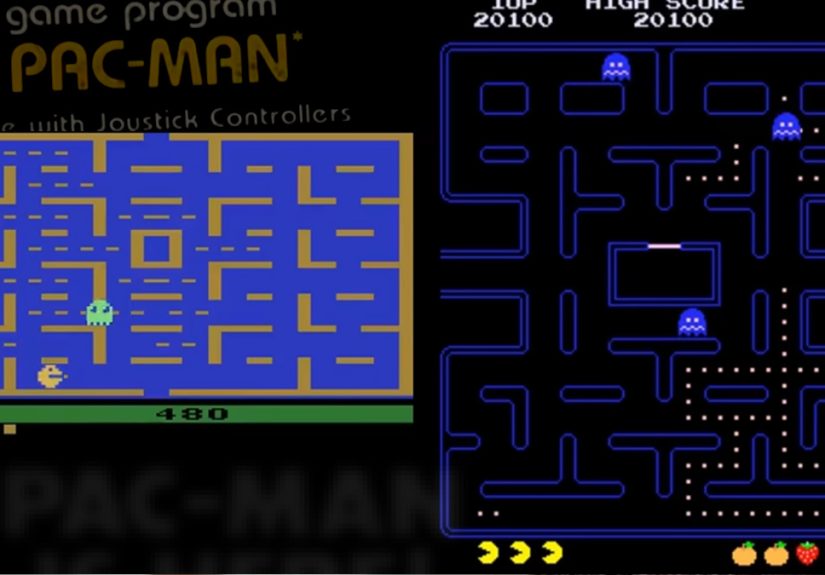
Pac-Man was a bad candidate for compromise because the arcade original was all about clarity and rhythm. Its appeal came from clean maze geometry, distinct ghost behavior, recognizable audiovisual feedback, and that delicious sense of being hunted in a crisp, readable space. Once you muddy the movement, flicker the enemies, flatten the maze, and weaken the audiovisual identity, you do not just trim detailsyou alter the personality of the game.
That is exactly what happened. The Atari 2600 port was built under tight constraints and forced into a 4KB cartridge format instead of a roomier option. Cost control, not creative ambition, shaped too many decisions. The result was a version that looked thinner, sounded rougher, and felt less precise than players expected from the arcade machine they loved.
The Visuals and Sound Became a Punchline
The most notorious issue was the flicker. The ghosts blinked in a way that made them feel unstable and distracting rather than menacing. The maze looked simplified and odd. The colors did not evoke the arcade game in a satisfying way. The sound effects also felt off, as though Atari had tried to recreate a pop song with a kazoo and a coffee grinder.
Even the terminology in the home version hinted at how far things had drifted. Instead of straightforward arcade-style dots and fruit, players got “video wafers” and “vitamins.” That detail is funny in hindsight, but it also captures the game’s core problem: it did not feel like a loving home adaptation. It felt like a branded approximation assembled by committee logic and manufacturing pressure.
And that distinction matters. Players can forgive technical compromises when the soul survives. They can forgive chunky graphics, missing flourishes, and simplified effects if the gameplay still sings. Atari’s Pac-Man did not consistently sing. It buzzed, blinked, and politely asked everyone to lower their expectations.
Management Turned a Technical Challenge Into a Business Gamble
Here is where the story becomes less about pixels and more about executive judgment. Atari did not merely release a compromised port. It bet enormously on that port. The company reportedly produced roughly 12 million cartridges, even though there were about 10 million Atari 2600 consoles in circulation. That is not confidence. That is the corporate equivalent of buying extra stadiums before your band has finished tuning up.
Atari was betting on two things at once: that nearly every existing 2600 owner would want the game, and that the game would help sell even more consoles. In theory, that sounds bold. In practice, it was dangerously optimistic. Once the product failed to match the hype, the scale of the decision magnified the consequences.
One important nuance, though: it is too neat to blame the entire 1983 crash on Pac-Man alone. Even people connected to Atari’s history have pushed back on that simplification. The broader market had bigger problemsoversupply, weak quality control, shaky forecasting, fierce competition, and a growing mismatch between what consumers expected and what too many publishers delivered. Pac-Man was not the only crack in the wall. It was one of the loudest.
Why Millions Still Bought It
If the port was such a disappointment, why did it still become such a giant seller? Because brand recognition is a powerful thing, and so is timing. Pac-Man arrived when the character’s popularity was enormous and home gaming still felt magical. Plenty of households were not comparing every frame to the arcade cabinet with museum-level seriousness. They simply wanted Pac-Man at home.
There is also a historical fairness issue worth mentioning. In 1982, the average buyer did not always approach home-console ports with modern expectations. Today, we are spoiled by near-perfect conversions, downloadable patches, and the ability to watch side-by-side videos before spending a dollar. In the early 1980s, many consumers bought based on brand trust, box art, commercials, and the general promise of arcade-style fun. The thrill of owning the game at home carried real weight.
So yes, Atari’s Pac-Man sold because the market was massive, the name was huge, and the dream of arcade play in the living room was irresistible. But once players had more time with it, the gap between dream and reality became harder to ignore. The game sold first and disappointed seconda sequence that can be even more damaging than a simple low-selling dud.
How This Helped Damage Atari’s Momentum
A company can survive one awkward release. What it struggles to survive is a pattern: too much product, too much hype, and not enough quality control. Atari’s Pac-Man helped normalize exactly that pattern. It told the market that a famous name might be enough. It suggested that massive demand would cover for obvious flaws. It nudged management toward the kind of thinking that later haunted Atari even more.
This is one reason the game looms so large in discussions of the 1983 crash. Not because it single-handedly toppled the industry like some yellow bowling ball, but because it symbolized a wider breakdown in discipline. Retailers had to deal with bloated inventories. Consumers became warier. Competitors and third-party publishers flooded shelves with uneven software. At the same time, personal computers were becoming more appealing, and the novelty of primitive-looking console games was beginning to wear thin.
By 1983, the North American video game business ran into a brutal correction. Oversaturation, quality issues, and shifting consumer tastes all played a role. Atari’s Pac-Man fit that story because it showed what happened when a market leader stopped treating quality as the main event and started treating the logo as the hero.
The Strange Legacy of a “Bad” Game That Still Matters
Here is the funny part: Atari’s Pac-Man remains historically important precisely because it misfired so publicly. It became a textbook example of how beloved intellectual property can be weakened by a poor adaptation. It also became a reminder that technical limits are realbut management choices decide whether those limits become creative challenges or reputation hazards.
The cartridge did not erase Pac-Man’s greatness. The arcade original remained iconic, and later home versions did a far better job of carrying the concept into living rooms. Nor did the port erase Atari’s importance. The company still helped build the home-game business and create the conditions for video games to become part of everyday culture.
But the flop did expose a fault line that business history repeats constantly: a great brand can get people to the checkout counter, but it cannot guarantee satisfaction after the receipt cools down. When the product and the promise drift apart, even a smash hit can quietly become a strategic own goal.
The Player Experience: Excitement, Confusion, and the Long Walk Back to the Arcade
To really appreciate why Atari’s Pac-Man landed so awkwardly, it helps to imagine the player experience in human terms rather than spreadsheet terms. A kid in 1982 does not care about inventory forecasts, licensing strategy, or the dangers of producing more cartridges than there are consoles. A kid cares about one thing: “Do I finally get to play Pac-Man at home?”
And in that first moment, the answer felt glorious. The box looked exciting. The brand was huge. The idea of carrying an arcade legend into the family room felt like science fiction becoming real. This was the era when a cartridge itself felt magicalsmall, sturdy, and packed with possibility. You snapped it into the console, flipped the switch, and waited for that little burst of electronic wonder.
Then came the second moment: confusion. The maze looked odd. The ghosts flickered. The sound was not the sound in your memory. The movement felt familiar, but not that familiar. It was like hearing your favorite song covered by a band that learned it from a humming roommate in the next apartment. The tune was technically there, but the swagger had left the building.
Some players still enjoyed it, especially those who were simply happy to have a home version of the sensation everyone was talking about. There is a real nostalgia in that. For many families, the cartridge was still “their Pac-Man,” flaws and all. And historically, that matters. Gaming memories are not always built on objective quality. They are built on the joy of sharing a screen, taking turns, yelling at ghosts, and trying to beat somebody’s score before dinner.
But for players who knew the arcade game well, the disappointment could be immediate. The original was elegant. The 2600 port felt compromised in obvious ways. Instead of the clean tension of cornering ghosts and mastering patterns, the home version often introduced a kind of visual and sensory awkwardness that made the game feel cheaper than the dream attached to it.
That emotional mismatch is probably the most important “experience” tied to Atari’s Pac-Man. People did not react to it like a harmless little oddity. They reacted to it like a promise that came back smudged. And once consumers experience that feeling often enough, they become cautious. They rent instead of buy. They ask neighbors first. They start thinking, “Maybe I’ll just play the real thing at the arcade.”
In hindsight, the cartridge is almost poignant. It captures the exact moment when home gaming’s ambition outpaced one company’s discipline. You can feel the optimism in it. You can also feel the corners cut. That is why the game still gets discussed today. Not because it was the absolute worst thing ever plugged into a television, but because it represents a very human business mistake: loving the size of the opportunity more than the quality of the experience.
And maybe that is the most enduring ghost in the maze. Atari had the audience. It had the platform. It had the hottest character in gaming. What it needed was a port that respected the player as much as the market opportunity. Instead, it shipped a lesson.
Final Thoughts
Atari’s Pac-Man went off-course because it treated a classic like a guaranteed transaction instead of a design problem that needed patience, technical honesty, and restraint. The game sold because the brand was unstoppable. It flopped in spirit because the execution did not honor the brand’s magic. That mismatch hurt more than one cartridge. It hurt confidence.
So yes, Atari’s Pac-Man is one of gaming history’s most famous flopsbut not because nobody bought it. Quite the opposite. People bought it in huge numbers. And that is exactly why it became such a powerful warning. In entertainment, the larger the promise, the louder the disappointment when a classic loses the plot.