Table of Contents >> Show >> Hide
- Why Sentence Types Matter
- How to Identify Different Types of Sentences in 15 Steps
- Step 1: Start With the Sentence’s Purpose
- Step 2: Identify Declarative Sentences
- Step 3: Identify Interrogative Sentences
- Step 4: Identify Imperative Sentences
- Step 5: Identify Exclamatory Sentences
- Step 6: Study the End Punctuation
- Step 7: Find the Subject and Verb
- Step 8: Learn the Difference Between Independent and Dependent Clauses
- Step 9: Identify Simple Sentences
- Step 10: Identify Compound Sentences
- Step 11: Identify Complex Sentences
- Step 12: Identify Compound-Complex Sentences
- Step 13: Watch for Sentence Fragments
- Step 14: Avoid Confusing Compound Elements With Compound Sentences
- Step 15: Use a Two-Part Identification Method
- Quick Reference: Sentence Types by Function
- Quick Reference: Sentence Types by Structure
- Common Mistakes When Identifying Sentence Types
- Practice: Identify the Sentence Type
- Experience Notes: What Actually Helps When Learning Sentence Types
- Conclusion
- SEO Tags
Sentences are the tiny engines that keep writing moving. Some make statements. Some ask questions. Some give commands. Some burst through the door wearing an exclamation point like a party hat. And then there are sentences that quietly reveal their inner machinery through clauses, conjunctions, punctuation, and structure.
Learning how to identify different types of sentences is not just a grammar exercise for people who alphabetize their spice racks. It helps students write better essays, professionals send clearer emails, bloggers create more readable content, and anyone with a keyboard avoid sentences that accidentally wobble into confusion. Once you know what to look for, sentence identification becomes less like decoding ancient runes and more like sorting laundry: statements here, questions there, compound-complex monsters in their own special pile.
This guide walks you through 15 practical steps for recognizing sentence types by both function and structure. You will learn how to spot declarative, interrogative, imperative, and exclamatory sentences, then move into simple, compound, complex, and compound-complex sentences. Along the way, you will see clear examples, quick tests, common mistakes, and real-world tips that make grammar feel much less dramatic than it sounds.
Why Sentence Types Matter
Sentence types shape meaning. A sentence can deliver information, request an answer, give instructions, express emotion, or combine several ideas into one smooth thought. When you understand the type of sentence you are reading or writing, you can better control tone, rhythm, clarity, and emphasis.
For example, “You finished the report” is a statement. “Did you finish the report?” is a question. “Finish the report” is a command. “You finished the report!” shows surprise or excitement. Four versions, almost the same words, four different effects. Grammar is sneaky like that.
How to Identify Different Types of Sentences in 15 Steps
Step 1: Start With the Sentence’s Purpose
The fastest way to classify a sentence is to ask, “What is this sentence trying to do?” Sentences are commonly grouped by function into four main categories: declarative, interrogative, imperative, and exclamatory.
A sentence that gives information is probably declarative. A sentence that asks something is interrogative. A sentence that tells someone to do something is imperative. A sentence that shows strong feeling is exclamatory. This first step gives you a broad label before you examine the sentence’s structure.
Step 2: Identify Declarative Sentences
A declarative sentence makes a statement. It can state a fact, share an opinion, explain an idea, or describe a situation. Declarative sentences usually end with a period.
Examples:
- The library closes at six o’clock.
- My dog believes every delivery driver is a villain.
- Clear writing depends on strong sentence variety.
To identify a declarative sentence, check whether the sentence is simply telling the reader something. It does not demand an answer, issue a command, or explode with intense emotion. It just says what it says and goes home peacefully.
Step 3: Identify Interrogative Sentences
An interrogative sentence asks a question and usually ends with a question mark. These sentences often begin with words such as who, what, when, where, why, how, do, does, did, can, could, should, or would.
Examples:
- What time does the meeting begin?
- Did you save the final draft?
- Why is the printer making that suspicious grinding noise?
Some questions are direct, while others are more casual. “You already ate lunch?” is still interrogative because it asks for confirmation, even though it does not follow the most formal question pattern.
Step 4: Identify Imperative Sentences
An imperative sentence gives a command, makes a request, offers instructions, or gives advice. The subject is often implied rather than directly stated. In most imperative sentences, the hidden subject is “you.”
Examples:
- Please close the door.
- Read the instructions before assembling the desk.
- Stop feeding the group chat at midnight.
Imperative sentences can end with a period or an exclamation point, depending on urgency. “Bring your notebook.” is calm. “Bring your notebook!” sounds like the notebook is the last hope for civilization.
Step 5: Identify Exclamatory Sentences
An exclamatory sentence expresses strong emotion, surprise, excitement, anger, or urgency. It usually ends with an exclamation point.
Examples:
- That was an incredible performance!
- I can’t believe we won!
- What a beautiful view!
Be careful: not every sentence with an exclamation point is purely exclamatory. “Run!” is technically imperative because it gives a command, even though it has emotional force. To identify the type correctly, look at purpose first and punctuation second.
Step 6: Study the End Punctuation
Punctuation gives helpful clues, but it should not be your only evidence. A period often signals a declarative sentence. A question mark usually signals an interrogative sentence. An exclamation point often signals an exclamatory sentence or an urgent imperative sentence.
Quick punctuation guide:
- Period: statement, mild command, or calm instruction
- Question mark: direct question
- Exclamation point: strong emotion or urgent command
Think of punctuation as a traffic signal. It tells you where the sentence is going, but you still need to look both ways before crossing into a final answer.
Step 7: Find the Subject and Verb
To identify sentence structure, first find the subject and verb. The subject tells who or what the sentence is about. The verb tells what the subject does or what condition the subject is in.
Example: “The sleepy cat knocked over the water glass.”
Subject: “The sleepy cat.” Verb: “knocked.” This sentence has one main subject-verb relationship, which makes it easier to analyze.
In commands, remember that the subject may be implied. In “Turn off the lights,” the subject is understood as “you.” The sentence still has a complete meaning, even though the word “you” is not written.
Step 8: Learn the Difference Between Independent and Dependent Clauses
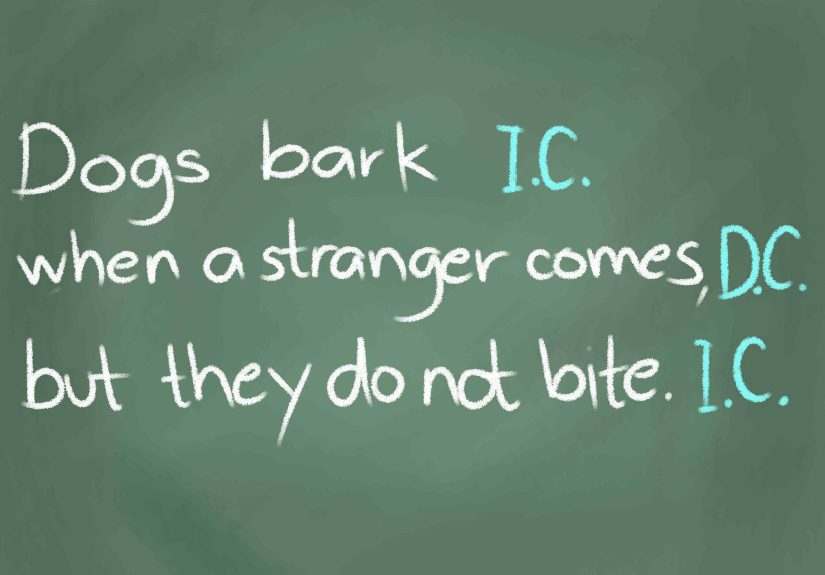
A clause is a group of words with a subject and a verb. An independent clause expresses a complete thought and can stand alone as a sentence. A dependent clause has a subject and verb but cannot stand alone because it begins with a word that makes the thought incomplete.
Independent clause: “The students finished the project.”
Dependent clause: “Because the students finished the project.”
The second example leaves the reader waiting. Because the students finished the project… what happened? Did the teacher dance? Did the printer collapse? A dependent clause needs an independent clause to complete the idea.
Step 9: Identify Simple Sentences
A simple sentence has one independent clause. It may be short or long, but it contains only one complete thought.
Examples:
- The baby laughed.
- My brother and I cleaned the garage after lunch.
- The old wooden bridge near the river collapsed during the storm.
Do not assume that a simple sentence must be tiny. A simple sentence can have compound subjects, compound verbs, phrases, and modifiers. The key is that it has only one independent clause.
Step 10: Identify Compound Sentences
A compound sentence has two or more independent clauses joined correctly. These clauses can be connected with a comma and a coordinating conjunction, a semicolon, or a semicolon with a transition word.
The coordinating conjunctions are often remembered with the acronym FANBOYS: for, and, nor, but, or, yet, so.
Examples:
- I wanted to bake cookies, but we were out of flour.
- The movie started late; the audience grew restless.
- She studied all night; therefore, she felt ready for the exam.
To test for a compound sentence, split it into separate sentences. If both parts can stand alone, you likely have a compound sentence.
Step 11: Identify Complex Sentences
A complex sentence has one independent clause and at least one dependent clause. The dependent clause often begins with a subordinating conjunction such as because, although, when, while, if, since, before, after, unless, or even though.
Examples:
- Because the rain stopped, we walked to the park.
- I stayed inside while the storm passed.
- The teacher smiled when the class finally understood the lesson.
When a dependent clause comes first, it is usually followed by a comma. When it comes after the independent clause, the comma is often unnecessary unless the sentence needs it for clarity or contrast.
Step 12: Identify Compound-Complex Sentences
A compound-complex sentence combines the features of compound and complex sentences. It has at least two independent clauses and at least one dependent clause.
Example: “Although the laptop was old, it still worked well, and I used it for every assignment.”
Independent clause 1: “it still worked well.” Independent clause 2: “I used it for every assignment.” Dependent clause: “Although the laptop was old.”
Compound-complex sentences are useful when ideas are connected but not equal in importance. They let writers show relationships such as time, cause, contrast, and result without chopping everything into short, robotic statements.
Step 13: Watch for Sentence Fragments
A sentence fragment is an incomplete sentence that is punctuated like a complete one. Fragments often happen when a dependent clause is left alone.
Fragment: “Because the bus was late.”
Complete sentence: “Because the bus was late, we missed the first announcement.”
Fragments can be used intentionally in creative writing or advertising, but in academic, professional, and formal writing, they often look like mistakes. To identify a fragment, ask whether the words express a complete thought. If the reader is left waiting for the rest of the idea, something is missing.
Step 14: Avoid Confusing Compound Elements With Compound Sentences
A sentence can have two subjects or two verbs without being compound. A compound sentence must have two independent clauses, not just a list of actions or people.
Not compound: “Maya washed the dishes and swept the floor.”
This is a simple sentence with one subject, “Maya,” and two verbs, “washed” and “swept.”
Compound: “Maya washed the dishes, and Leo swept the floor.”
This sentence has two independent clauses: “Maya washed the dishes” and “Leo swept the floor.” That is why it qualifies as compound.
Step 15: Use a Two-Part Identification Method
The best way to identify different types of sentences is to label both function and structure. A sentence can be declarative and compound. It can be interrogative and simple. It can be imperative and complex.
Example: “When you finish the chapter, answer the review questions.”
Function: imperative, because it gives an instruction. Structure: complex, because it has one dependent clause and one independent clause.
This two-part method gives you a fuller understanding of how the sentence works. Instead of saying, “That is a question,” you can say, “That is an interrogative simple sentence” or “That is an interrogative complex sentence.” Suddenly, you sound like you own a tiny grammar laboratory.
Quick Reference: Sentence Types by Function
| Sentence Type | Purpose | Common Punctuation | Example |
|---|---|---|---|
| Declarative | Makes a statement | Period | The test begins at nine. |
| Interrogative | Asks a question | Question mark | Did you study last night? |
| Imperative | Gives a command or request | Period or exclamation point | Please open your book. |
| Exclamatory | Shows strong emotion | Exclamation point | That was amazing! |
Quick Reference: Sentence Types by Structure
| Sentence Structure | Clause Pattern | Example |
|---|---|---|
| Simple | One independent clause | The birds sang loudly. |
| Compound | Two or more independent clauses | The birds sang, and the sun rose. |
| Complex | One independent clause plus one or more dependent clauses | When the sun rose, the birds sang. |
| Compound-complex | Two or more independent clauses plus one or more dependent clauses | When the sun rose, the birds sang, and the campers woke up. |
Common Mistakes When Identifying Sentence Types
Relying Only on Punctuation
Punctuation helps, but it does not tell the whole story. “Sit down!” is imperative, not exclamatory, because its main purpose is to give a command. Always check what the sentence is doing.
Counting Words Instead of Clauses
A long sentence is not automatically complex. A short sentence is not automatically simple. The real question is how many independent and dependent clauses the sentence contains.
Missing the Implied Subject in Commands
Imperative sentences often hide the subject “you.” “Call me tomorrow” has a verb and a complete meaning, even though the subject does not appear on the page.
Confusing Dependent Clauses With Complete Sentences
Words such as because, although, if, when, and while often introduce dependent clauses. If one of these clauses stands alone, check carefully. You may be looking at a fragment wearing a sentence costume.
Practice: Identify the Sentence Type
Try labeling each sentence by function and structure.
- The train arrived early.
- Did the train arrive early?
- Because the train arrived early, we had time for coffee.
- The train arrived early, but our luggage did not appear.
- Grab your ticket before the gate closes.
- What a stressful morning that was!
- Although the train arrived early, our luggage did not appear, and the taxi left without us.
Answers: 1. Declarative simple. 2. Interrogative simple. 3. Declarative complex. 4. Declarative compound. 5. Imperative complex. 6. Exclamatory simple. 7. Declarative compound-complex.
Experience Notes: What Actually Helps When Learning Sentence Types
In real writing practice, the easiest way to learn sentence types is not to memorize definitions in isolation. Definitions matter, of course, but grammar becomes much clearer when you connect each definition to a real sentence you might actually use. A student can repeat “a compound sentence has two independent clauses” twenty times and still freeze when looking at a paragraph. But when that same student learns to split a sentence into complete-thought units, the idea suddenly becomes useful.
One helpful experience-based method is the “cover and test” technique. Cover the second half of a sentence and read the first half aloud. Then cover the first half and read the second half aloud. If both parts can stand alone as complete sentences, you may have a compound structure. For example, in “I packed my bag, and my sister checked the map,” both halves work independently. In “I packed my bag because my sister checked the map,” only one part stands firmly on its own. That small test can save a lot of confusion.
Another practical tip is to mark verbs first. Many learners try to identify sentence types by reading from left to right and hoping grammar will politely introduce itself. It will not. Grammar has terrible social skills. Instead, underline every verb or verb phrase. Then find the subject connected to each verb. Once you can see the subject-verb pairs, clauses become easier to identify. More clauses usually mean more structure to analyze.
When editing essays, sentence variety becomes especially important. A paragraph filled only with short simple sentences can sound choppy: “The storm came. The lights went out. We found candles. The dog barked.” That style can work for drama, but it gets tiring fast. A paragraph filled only with long compound-complex sentences can become a grammatical jungle where readers need snacks and a compass. Strong writing usually mixes sentence types so the rhythm feels natural.
Teachers, tutors, and editors often notice the same pattern: students understand sentence types faster when they write their own examples. Instead of only labeling textbook sentences, create four versions of one idea. For example: “The cake burned.” “Did the cake burn?” “Take the cake out of the oven.” “The cake burned again!” This playful approach makes function obvious. Then expand the idea structurally: “The cake burned.” “The cake burned, and the smoke alarm screamed.” “Because the cake burned, we ordered pizza.” “Because the cake burned, we ordered pizza, and nobody complained.” Suddenly, sentence structure feels less abstract.
The biggest lesson from practice is this: identifying sentence types is a skill, not a personality test. You do not have to be a “grammar person” to get good at it. You only need a repeatable process: check the purpose, inspect the punctuation, find the subject and verb, separate the clauses, and decide how the clauses connect. Do that often enough, and sentence types stop looking mysterious. They become tools you can use to make your writing clearer, sharper, and more enjoyable to read.
Conclusion
Learning how to identify different types of sentences gives you more control over reading, writing, editing, and communication. Start with function: declarative, interrogative, imperative, or exclamatory. Then examine structure: simple, compound, complex, or compound-complex. Use punctuation as a clue, but do not let it do all the thinking. The real secret is learning to recognize subjects, verbs, independent clauses, dependent clauses, and connectors.
Once you understand how sentences work, you can write with more variety and confidence. You can keep simple sentences punchy, compound sentences balanced, complex sentences logical, and compound-complex sentences under control. In other words, you can stop fearing grammar and start making it carry the groceries.