Table of Contents >> Show >> Hide
- How These MCU Villains Were Ranked
- 1. Thanos He Didn’t Almost Win, He Actually Won
- 2. Baron Zemo The Man Who Broke the Avengers Without Throwing a Punch
- 3. Mysterio Dead, Defeated, and Still Somehow Winning
- 4. Hela The Queen of Asgard Who Forced a Total Reset
- 5. Scarlet Witch One Choice Away From Multiversal Disaster
- 6. Erik Killmonger The Villain Who Changed Wakanda Forever
- 7. Ultron Seconds From Human Extinction
- 8. Ego The Living Planet Who Nearly Rewrote the Universe
- 9. Kang the Conqueror One Portal Away From Escaping the Quantum Realm
- 10. Namor The King Who Brought Wakanda to Its Knees
- 11. Green Goblin The Villain Who Nearly Destroyed Spider-Man’s Soul
- 12. Ronan the Accuser A Dance-Off Away From Destroying Xandar
- 13. Dormammu and Kaecilius Beaten Only by an Infinite Time Loop
- What Makes a Great MCU Almost-Win?
- Fan Experience: Why These Near-Victories Make MCU Rewatches Better
- Conclusion: The Closest MCU Villain Victories Still Matter
- SEO Metadata
The Marvel Cinematic Universe has a funny habit: it lets heroes win just often enough for us to relax, then casually hands the steering wheel to a villain who parks the bus inches from total catastrophe. Some MCU villains merely caused trouble. Others practically had the victory banner printed, folded, and ready for their dramatic post-credit celebration.
That is what makes this ranking so deliciously stressful. We are not simply asking, “Who was the strongest MCU villain?” Power is only part of the equation. The real question is: which Marvel villains came closest to winning before the heroes pulled off one final desperate save? Sometimes “almost won” means the villain literally succeeded before time travel, sacrifice, or emotional growth rewrote the scoreboard. Other times, it means the villain lost the fight but still changed the world, broke the heroes, or left a mess so large that even Nick Fury would need a spreadsheet and three cups of coffee.
Note: This article discusses major MCU plot events and contains spoilers for Marvel movies and shows through the current MCU timeline.
How These MCU Villains Were Ranked
To keep this ranking fair, each villain is judged by three factors: how complete their plan was, how little time or luck separated them from victory, and how much damage remained even after the heroes stopped them. A villain who gets defeated but permanently changes the MCU may rank higher than someone with a bigger laser beam and worse planning skills. Looking at you, every villain who builds a glowing sky portal and assumes nobody will punch the machine.
With that in mind, here are the MCU villains who almost won, ranked by how close they were to victory.
1. Thanos He Didn’t Almost Win, He Actually Won
The movie: Avengers: Infinity War
Thanos belongs at the top because he is the ultimate “the villain won” example in MCU history. By the end of Avengers: Infinity War, he collects all six Infinity Stones, survives Thor’s last-second attack, snaps his fingers, and wipes out half of all life in the universe. That is not “close.” That is a completed villain objective with a sunset retirement plan.
The only reason the Avengers reverse the Snap is because the surviving heroes discover time travel, rebuild the Infinity Gauntlet, and stage one of the most complicated do-overs in blockbuster history. Without that tiny detailtiny as in “break the rules of physics and steal cosmic gemstones from the past”Thanos would have remained the most successful villain in the Marvel Cinematic Universe.
What makes his victory so chilling is that the heroes do nearly everything right. Thor gets Stormbreaker. Wanda destroys the Mind Stone. Doctor Strange plays the long game. Tony Stark fights harder than ever. And still, Thanos wins. The Mad Titan did not come close to victory; victory came close to him, shook his giant purple hand, and moved into his farmhouse.
2. Baron Zemo The Man Who Broke the Avengers Without Throwing a Punch
The movie: Captain America: Civil War
Baron Zemo is proof that you do not need a magic hammer, alien army, or planet-sized ego to nearly win. Sometimes all you need is patience, grief, intelligence, and a truly devastating security tape.
In Captain America: Civil War, Zemo’s plan is not to conquer Earth. He wants to destroy the Avengers from the inside. By the end of the film, he succeeds. Tony Stark and Steve Rogers are divided. The Avengers are fractured. Several heroes become fugitives. The team that could have stood together against future threats is emotionally and politically shattered.
Zemo is captured, but that barely feels like a loss. His mission was never escape; it was revenge. In practical terms, Zemo weakens Earth’s greatest defenders right before Thanos begins making his final move. That is villain efficiency at its finest. No glowing portal. No world-ending beam. Just trauma, timing, and a plan sharp enough to cut through vibranium-level friendship.
3. Mysterio Dead, Defeated, and Still Somehow Winning
The movie: Spider-Man: Far From Home
Quentin Beck, better known as Mysterio, loses the physical battle in Spider-Man: Far From Home, but his posthumous plan lands like a villainous mic drop. He fails to keep control of Tony Stark’s drone technology, but he succeeds in framing Spider-Man for the London attack and exposing Peter Parker’s secret identity to the world.
That ending changes Peter’s life overnight. It turns him from a friendly neighborhood hero into a global controversy. It also sets the stage for Spider-Man: No Way Home, where Peter’s attempt to repair the damage opens the door to multiversal chaos. That means Mysterio’s last trick outlives him and pushes the MCU into one of its messiest Spider-Man disasters.
Few MCU villains get defeated and still manage to ruin the hero’s next movie. Mysterio does exactly that. His victory was not world domination; it was reputation destruction. And wow, did he hit the upload button with confidence.
4. Hela The Queen of Asgard Who Forced a Total Reset
The movie: Thor: Ragnarok
Hela comes terrifyingly close to ruling Asgard and expanding her conquest across the universe. The moment she appears in Thor: Ragnarok, she destroys Mjolnir like it is a decorative paperweight. She takes Asgard’s throne, wipes out its warriors, raises an undead army, and reveals the darker history behind Odin’s empire.
Thor does not beat Hela in the traditional sense. He realizes Asgard cannot survive if she does. The only way to stop her is to unleash Surtur and allow Ragnarok to destroy Asgard itself. That is not exactly a clean victory. That is more like burning down the restaurant because the raccoon in the kitchen became king.
Hela’s plan fails, but only because the heroes accept a massive sacrifice. She was powerful enough that Thor’s final solution was not “defeat Hela” but “remove the entire battlefield.” That earns her a very high spot among MCU villains who almost won.
5. Scarlet Witch One Choice Away From Multiversal Disaster
The movie: Doctor Strange in the Multiverse of Madness
Wanda Maximoff’s fall into the Scarlet Witch is one of the MCU’s most emotionally painful villain turns. In Doctor Strange in the Multiverse of Madness, she is not chasing money, fame, or a throne. She wants her children back, and the Darkhold twists that grief into something dangerous enough to threaten the multiverse.
Wanda defeats powerful sorcerers, invades another universe through dreamwalking, and comes extremely close to taking America Chavez’s ability to travel across realities. If she succeeds, she could cross the multiverse at will. That would not just endanger one Earth; it could create endless damage across countless worlds.
What stops her is not brute force. Doctor Strange and America Chavez help her face the reality of what she has become. Wanda’s defeat is emotional, not tactical. That makes her “almost win” feel even closer. She had the power. She had the opportunity. What she lacked, in the final moment, was the ability to keep lying to herself.
6. Erik Killmonger The Villain Who Changed Wakanda Forever
The movie: Black Panther
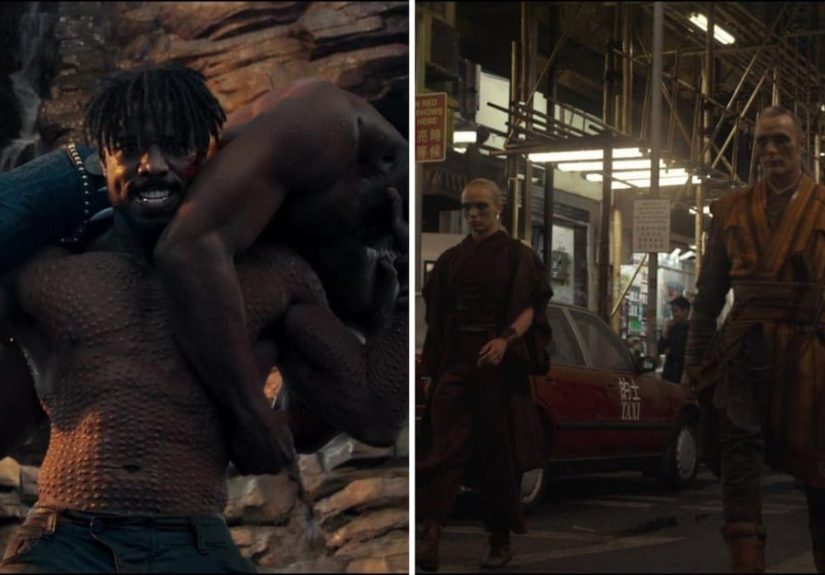
Erik Killmonger does something few MCU villains manage: he legally wins power. He defeats T’Challa in ritual combat, takes the Wakandan throne, and begins moving weapons into the world to launch his global revolution. For a terrifying stretch of Black Panther, Killmonger is not an invader. He is the king.
His plan is stopped before the weapons leave Wakanda on a massive scale, but Killmonger still changes the nation’s future. By the end of the film, T’Challa chooses to open Wakanda to the world. That decision does not copy Killmonger’s violent plan, but it does answer the moral question Killmonger forced into the open: what does a powerful nation owe to people suffering beyond its borders?
That is why Killmonger ranks so high. He loses the fight, but his argument leaves a permanent mark. In the MCU, a villain who changes a hero’s worldview has won at least part of the war.
7. Ultron Seconds From Human Extinction
The movie: Avengers: Age of Ultron
Ultron’s plan in Avengers: Age of Ultron is absurdly dramatic, but also frighteningly close to working. He lifts Sokovia into the sky, intending to drop it like a meteor and trigger an extinction-level event. For a villain born from Tony Stark’s fear and artificial intelligence, Ultron is basically a worst-case software update with legs.
The Avengers stop him, but only after the city is already airborne. The stakes are no longer theoretical at that point. The machine is running. Civilians are in danger. The heroes are scrambling. Vision, Thor, Iron Man, Hulk, and the rest of the team all have to work together to prevent disaster.
Ultron does not get enough credit for how close he comes. He nearly ends humanity using the Avengers’ own technology and paranoia against them. If the team had been a few minutes slower, the MCU would have gone from superhero saga to planetary obituary.
8. Ego The Living Planet Who Nearly Rewrote the Universe
The movie: Guardians of the Galaxy Vol. 2
Ego’s plan in Guardians of the Galaxy Vol. 2 is cosmic horror disguised as family drama. He wants to use his son Peter Quill’s Celestial power to activate seeds planted across countless worlds, transforming them into extensions of himself. In simple terms, Ego wants the universe to become Ego. Modest fellow.
He gets incredibly close. The Expansion begins. Energy spreads across planets. Peter is temporarily pulled into Ego’s vision, and for a moment, it looks as if the Guardians may not be able to snap him out of it. Ego does not lose because his plan is weak. He loses because Peter chooses love, memory, and found family over cosmic domination.
Ego’s near-victory is easy to overlook because Guardians wraps trauma in jokes, music, and colorful space nonsense. But the scale of his plan is enormous. If Peter had accepted him, Ego might have become one of the most successful MCU villains ever.
9. Kang the Conqueror One Portal Away From Escaping the Quantum Realm
The movie: Ant-Man and the Wasp: Quantumania
Kang the Conqueror spends much of Ant-Man and the Wasp: Quantumania trapped in the Quantum Realm, but he is never harmless. He has already built an empire there, terrified entire civilizations, and positioned himself as a multiversal threat waiting for the right exit door.
His near-win comes when he is moments away from escaping. If Kang leaves the Quantum Realm with his technology and army, the consequences could stretch far beyond Scott Lang’s family. The heroes stop him at the portal, but the margin is painfully thin. Scott and Hope do not outclass him; they survive him.
That is what makes Kang dangerous. He feels less like a villain who was beaten and more like a disaster that was delayed. The MCU may have shifted its long-term plans, but within the story itself, Kang came extremely close to breaking out and bringing conquest with him.
10. Namor The King Who Brought Wakanda to Its Knees
The movie: Black Panther: Wakanda Forever
Namor is not a simple villain, which makes his near-victory more interesting. In Black Panther: Wakanda Forever, he acts to protect Talokan from the surface world, but his methods push Wakanda into a devastating conflict. He exposes Wakanda’s vulnerability, floods the capital, and leaves the nation grieving and shaken.
Shuri eventually defeats him in combat, but the result is not a clean superhero win. She chooses mercy and forms a tense peace instead of killing him. Namor remains alive, powerful, and politically patient. In fact, he seems to understand that the surface world may still push Wakanda and Talokan into future alignment.
Namor almost wins because he forces Wakanda into a negotiation from a position of pain. He does not get everything he wants, but he survives with his kingdom intact and his long game still on the table. That is not failure. That is a strategic pause with ankle wings.
11. Green Goblin The Villain Who Nearly Destroyed Spider-Man’s Soul
The movie: Spider-Man: No Way Home
Norman Osborn’s Green Goblin does not almost conquer the world in Spider-Man: No Way Home. His victory is more personal and, in many ways, more brutal. He attacks Peter Parker’s belief that everyone can be saved. He turns Peter’s compassion into a weapon and pushes him toward a line he may never be able to uncross.
The Goblin nearly wins when Peter, overwhelmed by grief and rage, comes close to killing him. That moment matters because Spider-Man’s greatest strength is not just agility or web-slinging. It is his refusal to become cruel, even when cruelty would be easier.
Peter is stopped before he makes the choice that would haunt him forever. Still, the Goblin leaves lasting damage. By the end of the film, Peter loses his public identity, his relationships, and his old life. Norman is cured, but the Goblin’s impact remains. Some villains want a throne. This one wanted to prove goodness could break.
12. Ronan the Accuser A Dance-Off Away From Destroying Xandar
The movie: Guardians of the Galaxy
Ronan the Accuser may not be the MCU’s most layered villain, but he gets dangerously close to victory in Guardians of the Galaxy. Once he obtains the Power Stone, he has enough destructive force to wipe out Xandar. His ship reaches the planet. His weapon is ready. The Nova Corps is overwhelmed.
The Guardians stop him through teamwork, sacrifice, and one of the strangest distraction tactics in superhero cinema. Yes, the final save involves Peter Quill dancing. No, that does not make Ronan less dangerous. It just means the MCU once saved a civilization with rhythm and emotional confusion.
Ronan ranks lower than cosmic masterminds like Thanos and Ego because his plan is more direct and less transformative. Still, he was moments away from destroying an entire world. That is close enough to earn a spot.
13. Dormammu and Kaecilius Beaten Only by an Infinite Time Loop
The movie: Doctor Strange
Kaecilius succeeds in bringing Earth dangerously close to Dormammu’s Dark Dimension. By the end of Doctor Strange, ordinary battle tactics are useless. Dormammu is not the kind of villain you punch into a wall and call it character development.
Doctor Strange wins by using the Time Stone to trap Dormammu in a repeating bargain. That solution is brilliant, but it also proves how close Earth came to losing. Strange does not overpower Dormammu. He annoys him into negotiation. It is less “victory through strength” and more “customer service hold music as a weapon.”
If Strange had not mastered that time loop, the planet could have been absorbed into a nightmare dimension. Dormammu and Kaecilius nearly win because they push the hero into a solution so desperate and strange that only Doctor Strange could make it sound like a plan.
What Makes a Great MCU Almost-Win?
The best MCU villains who almost won share one important trait: they force the heroes to change. Thanos forces the Avengers to confront failure. Zemo exposes how fragile their unity really is. Killmonger changes Wakanda’s future. Wanda forces Doctor Strange and the audience to reckon with grief when it becomes obsession. Even Mysterio, a man powered by drones and theater-kid resentment, changes Spider-Man’s life completely.
That is why “almost won” stories often hit harder than simple good-versus-evil battles. When a villain nearly succeeds, the audience feels the cost. The heroes may save the day, but they cannot always restore the world to what it was before. The best Marvel villains leave fingerprints on the timeline.
Fan Experience: Why These Near-Victories Make MCU Rewatches Better
Rewatching MCU movies with this question in mind changes the experience. Instead of waiting for the hero to win, you start noticing how often the villain is only one decision, one delay, or one lucky interruption away from success. It makes familiar scenes feel tense again. The first time you watch Infinity War, you may hope the Avengers can stop Thanos. On a rewatch, the horror comes from seeing how carefully the movie builds toward his victory. Every Stone he collects feels like another lock clicking shut.
The same thing happens with Civil War. Zemo seems quiet compared with flashier villains, but that is exactly why his plan ages so well. He understands that the Avengers are strongest together, so he does not attack their bodies. He attacks their trust. Watching the film again, you realize he is not improvising. He is patiently guiding emotional explosives into the same room and waiting for someone to light the match.
There is also a fun, slightly nerdy pleasure in debating what “winning” means. Did Killmonger lose because he died, or did he partly win because Wakanda changed? Did Mysterio fail because Peter defeated the drones, or did he win because Peter’s life collapsed afterward? These questions make MCU villain rankings more interesting than a simple power chart. A giant cosmic being may be stronger, but a clever human with the right secret can do damage that lasts longer.
As a viewer, the near-wins also make the heroes feel more human. Thor cannot simply overpower Hela. Peter cannot undo Mysterio’s lie with one swing. Shuri cannot defeat Namor without facing her own anger. Doctor Strange cannot blast Dormammu into submission; he has to think creatively and suffer repeatedly until the impossible enemy gets tired of him. These moments remind us that heroism in the MCU is rarely about being unbeatable. It is about making the right choice when winning looks ridiculous, painful, or almost impossible.
That is why these villains remain memorable. They do not just fill screen time between jokes and explosions. They put pressure on the heroes’ values. They make victory expensive. They leave consequences behind. And sometimes, like Thanos, they win so completely that the next movie has to break time itself just to clean up the mess. Honestly, that is a strong villain résumé. Terrible for the universe, excellent for storytelling.
Conclusion: The Closest MCU Villain Victories Still Matter
The MCU works best when its villains are more than obstacles. The most memorable antagonists are the ones who nearly rewrite the rules of the universe, expose a hero’s weakness, or force a permanent change. Thanos, Zemo, Mysterio, Killmonger, Hela, Wanda, and the others on this list all prove that a villain does not need to stand victorious at the final credits to matter.
Some almost won by power. Some almost won by strategy. Some almost won by breaking the hero emotionally. But the scariest MCU villains are the ones whose plans keep echoing long after the fight ends. In a universe full of gods, geniuses, sorcerers, kings, and teenagers with spider powers, that kind of lasting impact is the real victory.