Table of Contents >> Show >> Hide
- What Is the T-14 Armata?
- Why 2020 Became the Big Date
- The Technology That Made the Armata Stand Out
- The Production Problem: Building One Tank Is Not Building an Army
- Why Russia Kept Upgrading Older Tanks
- What Happened After 2020?
- Is the T-14 Armata a Failure?
- Lessons From the Armata Story
- The Bigger Picture: Tanks Are Changing, Not Disappearing
- Experience-Based Reflections on the Topic
- Conclusion
When Russia rolled out the T-14 Armata, the message was loud, polished, and very Moscow-parade-friendly: the future of armored warfare had arrived, and it had a very serious face. The tank was presented as a leap beyond the Soviet-era designs that had dominated Russian armored formations for decades. It had an unmanned turret, a protected crew capsule, advanced sensors, a modern platform concept, and enough headline-grabbing promise to make defense writers reach for their strongest coffee.
The headline “Russia’s new tank set to enter service in 2020” sounded, at the time, like a clean milestone. A new main battle tank would move from showpiece to soldier. The T-14 Armata would begin replacing older tanks, modernize Russia’s ground forces, and give NATO planners something unpleasant to discuss in conference rooms with no windows. But as with many ambitious military programs, the road from “set to enter service” to “widely fielded and operational” turned out to be less like a victory parade and more like a Russian winter road: long, bumpy, and full of delays.
This article looks at what the T-14 Armata promised, why 2020 mattered, what actually happened, and why the tank remains one of the most fascinating examples of the gap between military ambition and industrial reality.
What Is the T-14 Armata?
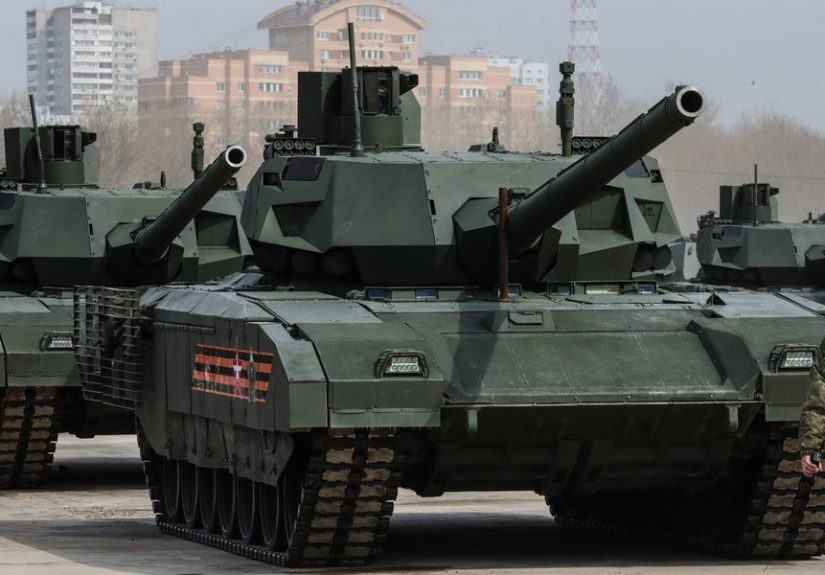
The T-14 Armata is Russia’s next-generation main battle tank, built on the Armata Universal Combat Platform. Unlike older Russian tanks such as the T-72, T-80, and T-90, the Armata was designed as a fresh platform rather than another deep upgrade of a Soviet-era design. That distinction matters. Russia has spent decades getting excellent mileage out of upgraded older tanks, but the T-14 was supposed to be something different: a modern, modular, high-tech armored vehicle for the 21st century.
The tank first received major international attention during the 2015 Moscow Victory Day Parade. That public debut was a carefully staged signal. Russia wanted the world to see that it was not merely refurbishing old equipment; it was building something new. For a country whose defense industry often mixes genuine engineering talent with dramatic public messaging, the Armata was the perfect stage prop and, potentially, a serious battlefield machine.
A New Design Philosophy
The T-14’s most famous feature is its unmanned turret. In traditional tank layouts, crew members are located inside the turret and hull, which can expose them to serious risk if the vehicle is hit. The Armata places its three-person crew in an armored capsule in the front of the hull, separating them from the turret and ammunition systems. In simple terms, Russia tried to build a tank where the crew gets a better chance of surviving if everything else has a very bad day.
The Armata platform was also designed with modularity in mind. The same base concept could support different armored vehicles, including infantry fighting vehicles and support variants. On paper, this is smart defense planning: create one flexible family of vehicles instead of maintaining a garage full of unrelated mechanical personalities.
Why 2020 Became the Big Date
The 2020 service target became important because Russian officials and defense industry sources repeatedly suggested that the T-14 would move into serial production or operational service around that period. Earlier plans were extremely ambitious, with discussion of large numbers of Armata tanks eventually replacing older vehicles. The idea was bold: Russia would gradually shift from legacy armor to a modern fleet built around the Armata family.
That sounded impressive. It also sounded expensive, technically demanding, and difficult to execute. Spoiler alert: it was all three.
By the late 2010s, reports began showing that the original expectations were being scaled back. Instead of thousands of tanks quickly entering service, Russia appeared to be moving toward smaller batches, trials, and limited deliveries. The 2020 date remained a useful headline, but the practical reality was more cautious. The tank was still being tested, refined, and reviewed, while Russia continued investing heavily in upgraded versions of older tanks.
The Technology That Made the Armata Stand Out
The T-14 attracted attention because it looked like a genuine attempt to rethink Russian tank design. Its layout, crew protection concept, sensor package, and platform approach made it more than just “another T-72 with fresh paint and a motivational speech.”
Unmanned Turret and Crew Capsule
The unmanned turret is the star of the show. By moving the crew into a protected capsule, the design aims to reduce the risk to personnel. This is not just a technical feature; it reflects a broader trend in modern armored vehicle design, where survivability depends not only on armor thickness but also on layout, sensors, and active protection.
Of course, designing a tank with an unmanned turret is not easy. It requires reliable sensors, cameras, electronics, fire-control systems, and crew interfaces. If those systems fail, the crew cannot simply pop up and operate the turret the old-fashioned way. Modern technology is wonderful until it starts acting like a printer five minutes before a deadline.
Modern Sensors and Active Protection
The T-14 has been associated with advanced defensive systems intended to detect and help defeat incoming threats. Modern tanks cannot rely only on heavy armor because contemporary battlefields include drones, precision-guided munitions, top-attack weapons, and portable anti-armor systems. The Armata’s design tries to answer this environment with sensors, defensive aids, and a more integrated protection concept.
That said, public claims about advanced military systems should always be treated carefully. Defense marketing is a global sport, and every country enjoys describing its newest machine as revolutionary. The real test is not how a tank looks in a parade, but how reliably it performs in large numbers, under stress, with trained crews, spare parts, maintenance teams, and logistics support.
The Production Problem: Building One Tank Is Not Building an Army
The biggest challenge for the T-14 Armata has never been whether Russia could build prototypes. It clearly could. The harder question was whether Russia could produce, maintain, and field the tank at scale. That is where the story becomes less glamorous and more important.
Mass production is the great destroyer of beautiful defense brochures. A prototype can be hand-finished, carefully maintained, and displayed under ideal conditions. A real military vehicle must be produced repeatedly, repaired quickly, operated by ordinary crews, and supported by a supply chain that does not faint every time someone asks for a spare part.
The Armata’s cost has been one of its major obstacles. Compared with upgrading existing tanks, producing a next-generation vehicle is expensive. Russia already had large numbers of T-72, T-80, and T-90 tanks that could be modernized. From a military budget perspective, upgrading older vehicles may not sound futuristic, but it can deliver more usable combat power per ruble. In other words, the T-14 may have been the luxury sports car, while the T-72B3 and T-90M were the pickup trucks that actually showed up for work.
Why Russia Kept Upgrading Older Tanks
Russia’s decision to keep modernizing older tanks was not irrational. The T-72 family, despite its age, exists in large numbers and can be upgraded with improved optics, communications, armor packages, and fire-control systems. The T-90, especially in newer variants, also remains a practical platform for Russian forces.
For a military that values mass, replacement capacity, and logistical familiarity, older upgraded tanks can be more useful than a small number of advanced but expensive vehicles. A tank that exists in quantity, can be repaired, and has trained crews may be more valuable than a cutting-edge vehicle that is rare, costly, and difficult to support.
This is one reason the 2020 service claim aged awkwardly. The Armata did not disappear, but it did not transform Russia’s armored forces overnight. Instead, it became part of a broader pattern: high-end systems announced with great confidence, followed by slower production, limited deliveries, and continued reliance on older equipment.
What Happened After 2020?
By 2020, the T-14 had not become a mass-fielded replacement for Russia’s older tanks. Reports pointed to continued trials, production delays, technical issues, and shifting delivery expectations. Later statements suggested limited production or small deliveries, but not the sweeping transformation once imagined.
The war in Ukraine added another layer to the story. The conflict demonstrated the vulnerability of armored vehicles in an environment filled with drones, mines, artillery, and portable anti-armor weapons. It also put enormous pressure on Russia’s defense industry. Instead of showcasing large numbers of T-14s, Russia relied heavily on upgraded older tanks and pulled older vehicles from storage.
Public reporting has included claims and counterclaims about whether the T-14 appeared in or near the conflict zone, but the broader picture is clear: the Armata has not become a common battlefield presence. Its limited use, if any, underscores the same core issue. A prestige vehicle is valuable for messaging, but a war demands vehicles that can be risked, replaced, repaired, and deployed in numbers.
Is the T-14 Armata a Failure?
Calling the T-14 a total failure would be too simple. Calling it a full success would require a heroic amount of optimism and possibly a fog machine. The truth sits somewhere in the middle.
As a technology demonstrator, the Armata matters. It showed that Russian designers were thinking seriously about crew survivability, automation, modular platforms, and modern protection systems. It influenced discussion about the future of tanks and forced analysts to consider whether traditional tank layouts were reaching their limits.
As a mass procurement program, however, the T-14 has struggled. The original vision of large-scale replacement has not materialized. Cost, complexity, technical hurdles, sanctions pressure, industrial constraints, and Russia’s continued reliance on upgraded legacy armor have all limited its impact.
Lessons From the Armata Story
The Armata story teaches several useful lessons about modern defense programs. First, advanced technology is only one part of military capability. A tank also needs production capacity, logistics, training, maintenance, doctrine, and funding. Remove any of those ingredients and the recipe starts tasting like disappointment soup.
Second, modernization is not always about building the newest machine. Sometimes it is about upgrading what already exists. Russia’s approach shows that even countries with ambitious next-generation programs may choose practical modernization when budgets and battlefield demands become harsh.
Third, public military announcements often move faster than production lines. A parade can happen in a day. A procurement program can take decades. That difference is where many dramatic headlines go to get a little embarrassed.
The Bigger Picture: Tanks Are Changing, Not Disappearing
The T-14 Armata arrived during a period when many experts were debating whether tanks still mattered. After years of conflicts involving drones, precision weapons, and anti-armor systems, some observers argued that the tank’s age was ending. That conclusion is too neat. Tanks remain useful, but they are no longer kings of the battlefield in the old sense.
Modern tanks must operate as part of a larger system. They need infantry support, air defense, electronic warfare, reconnaissance, drones, engineering units, and strong logistics. A tank by itself is not a magic steel dragon. It is one piece of a combined-arms puzzle, and if the other pieces are missing, the dragon becomes a very expensive target.
The Armata was designed with some of these modern pressures in mind. Its sensors, protection systems, and crew layout reflect the changing battlefield. But its limited deployment also shows that advanced design alone is not enough. A next-generation tank must be affordable enough to build, reliable enough to operate, and useful enough to risk.
Experience-Based Reflections on the Topic
For writers, researchers, and defense watchers, the story of “Russia’s new tank set to enter service in 2020” is a perfect reminder that military technology should be studied with patience, skepticism, and a very sturdy chair. The first wave of headlines around the T-14 Armata made it sound like a near-instant revolution. That is common in defense reporting. A new weapon appears, official statements sound confident, photos look dramatic, and suddenly everyone is discussing the future as if it already parked outside.
But following the Armata over time reveals a more useful experience: the difference between announcement and adoption. Many readers first encountered the T-14 through eye-catching images from Moscow parades. It looked sleek, serious, and different from older Russian tanks. The unmanned turret and crew capsule were genuinely interesting ideas. For anyone who enjoys military history or technology analysis, the design was worth studying. It invited big questions: Are traditional tank layouts outdated? Can automation improve survivability? Will future armored vehicles look more like the Armata?
Then came the slow drip of reality. Production dates shifted. Delivery numbers became smaller. Older tanks remained central. Reports about costs and technical challenges piled up. This is where the Armata became more than a tank story; it became a case study in how states manage ambition. The experience of watching the program unfold is a reminder that even powerful countries struggle to convert prototypes into large operational fleets.
There is also a media lesson here. A headline from 2017 or 2018 can be technically accurate at the moment it is written and still become misleading years later if readers do not update the context. “Set to enter service in 2020” was a projection, not a guarantee carved into granite by the tank gods. By 2026, the better reading is historical: Russia intended or claimed that the Armata would enter service around 2020, but large-scale fielding did not follow the early hype.
For web publishers, that distinction matters. A strong article should not simply repeat the original claim. It should explain the promise, the delay, and the current meaning. Readers want the full story, not a time capsule with dust on the dashboard. The best approach is to treat the title as a doorway into analysis: What was Russia trying to achieve? Why was the T-14 important? Why did service entry become complicated? What does the program reveal about modern armored warfare?
The Armata also offers a broader lesson about technology enthusiasm. Whether the subject is tanks, smartphones, electric cars, or suspiciously smart refrigerators, the first version of the future often arrives late, costs more than expected, and needs several software updates. The T-14 may still influence future armored design, but its journey shows that innovation is not the same as transformation. Transformation happens only when a system is produced, fielded, maintained, and integrated into real operations.
In that sense, the T-14 Armata is both impressive and incomplete. It is impressive because it pushed ideas that many tank designers take seriously: crew protection, automation, modularity, and active defense. It is incomplete because the original promise of widespread service by 2020 did not become the sweeping reality suggested by early headlines. The tank remains a symbol of Russian military ambition, but also of the industrial, financial, and practical barriers that ambition must survive.
Conclusion
Russia’s T-14 Armata was presented as the tank of the future, and in some design respects, it really did point toward future armored warfare. Its unmanned turret, protected crew capsule, and modern platform concept made it one of the most discussed armored vehicles of the last decade. The 2020 service target gave the program a dramatic deadline and helped turn the Armata into a global defense headline.
Yet the years since have shown that entering service is not the same as transforming an army. The T-14 faced delays, cost concerns, technical challenges, and the stubborn practicality of older upgraded tanks. Russia continued relying on modernized legacy platforms, while the Armata remained limited in visible deployment and uncertain in scale.
The result is a story less about one tank conquering the future and more about how difficult the future is to manufacture. The T-14 Armata may still matter, but its greatest lesson is already clear: military power is not proven by a parade debut or a bold date on a production schedule. It is proven by reliability, numbers, training, logistics, and the ability to perform when conditions are far less friendly than a camera-ready square in Moscow.
Note: This article is based on publicly reported defense information and focuses on historical context, procurement analysis, and technology trends. It does not provide operational guidance, instructions, or assistance for using military equipment.