Table of Contents >> Show >> Hide
- Why Stephen Hawking’s Name Became Part of the Conversation
- What the Unsealed Documents Actually Say About Hawking
- What the Documents Do Not Show
- Did Stephen Hawking Ever Go to Epstein’s Island?
- Why This Story Blew Up Online
- The More Honest Reading of the Hawking-Epstein Connection
- What Readers Should Take Away
- The Real Experience Behind a Viral Allegation
- Conclusion
Few things travel faster online than a celebrity rumor with a scandal attached. Add Jeffrey Epstein’s name, a stack of unsealed court records, and one of the most famous scientists in modern history, and the internet practically starts doing wind sprints. That is exactly what happened when Stephen Hawking’s name resurfaced in connection with Epstein-related documents.
But here is the big truth that often gets lost under the confetti cannon of social media speculation: being mentioned in Epstein-related documents is not the same thing as being accused of a crime, and it is definitely not the same thing as proof. In Hawking’s case, the gap between what the documents actually show and what the internet claimed they showed is wide enough to drive a very large conspiracy truck through.
This article breaks down what the Stephen Hawking Epstein island allegations really are, what the records actually say, why the rumor exploded, and why readers should treat viral screenshots with the same caution they would give a “free cruise” email from a prince they have never met. The goal is simple: separate fact from fiction without adding more noise to an already noisy story.
Why Stephen Hawking’s Name Became Part of the Conversation
The renewed attention came after court documents tied to Virginia Giuffre’s civil lawsuit against Ghislaine Maxwell were unsealed in early 2024. Because Epstein cultivated a social circle filled with wealthy, famous, academic, and politically connected people, many recognizable names appeared in those materials. That immediately turned the release into a rumor factory.
Hawking’s name showed up in that swirl, and people online quickly jumped to the most dramatic conclusion possible. That is internet tradition at this point. The problem is that the actual record was far more limited and far less sensational than many posts claimed.
Reports from major outlets made an important distinction: the documents included famous names for many reasons. Some people were witnesses. Some were mentioned in passing. Some were discussed in email exchanges. Some had already been publicly linked to Epstein’s orbit years earlier. In other words, name recognition was not evidence of misconduct. It was often just context.
What the Unsealed Documents Actually Say About Hawking
The central detail is a 2015 email from Epstein to Ghislaine Maxwell. In that message, Epstein discussed offering a reward to people who could help disprove an allegation involving Hawking. That point matters because the document is not a finding against Hawking. It is Epstein discussing how to push back on a claim.
That difference is huge. It is the difference between “someone made an allegation” and “an allegation was established.” Those are not interchangeable ideas, even though social media often treats them like identical twins wearing matching sunglasses.
Coverage of the unsealed records also noted that Hawking’s name appeared in connection with requests involving photos and videos. Again, that is not the same thing as a proven accusation or criminal charge. It shows that he was among the many notable figures mentioned in materials surrounding Epstein’s world, not that the records proved he committed wrongdoing.
Multiple reports emphasized another crucial point: the documents released in 2024 did not contain a direct, substantiated allegation from Giuffre against Hawking in the way social posts suggested. Reputable coverage consistently drew that line, even while acknowledging that his name was present in the record.
What the Documents Do Not Show
This is where the rumor often outruns the evidence by several laps.
No Proof of Criminal Conduct
The unsealed materials did not establish that Stephen Hawking committed a crime. They did not present a judicial finding against him. They did not charge him with anything. And they did not transform online speculation into fact.
No Verified “Smoking Gun” Transcript
One of the biggest drivers of confusion was the circulation of fake images designed to look like snippets from court transcripts. These images spread widely and included crude, fabricated claims involving Hawking. Major fact-checks found that those screenshots were not part of the actual released court records. They were internet fakes dressed up like legal documents, which is a grimly modern genre of misinformation.
No Shortcut From Mention to Guilt
This point cannot be overstated. In a giant legal record involving a man who surrounded himself with public figures, a name appearing in documents may indicate social contact, travel, conversation, an attempted rebuttal, or simple inclusion in a list. It does not automatically mean abuse, trafficking, or criminal participation. Treating every mention as guilt is bad logic and even worse reporting.
Did Stephen Hawking Ever Go to Epstein’s Island?
Yes, the public record indicates Hawking visited the U.S. Virgin Islands in 2006 for a scientific gathering associated with Epstein’s funding. That part is real. It is not a meme, not a mystery, and not newly invented internet folklore.
Contemporaneous reporting from the Virgin Islands described a high-level physics symposium in St. Thomas called Confronting Gravity, attended by Stephen Hawking and other major physicists. Edge Foundation materials from the same period also documented the event and included references to Hawking and other scientists during the conference. The conference mixed academic discussion with social activities, which later came under far more scrutiny because of what the world eventually learned about Epstein.
So yes, Hawking’s presence in the region and his participation in a conference backed by Epstein are grounded in real reporting. That is the factual core. But factual core is not the same thing as the wild speculative castle built on top of it later.
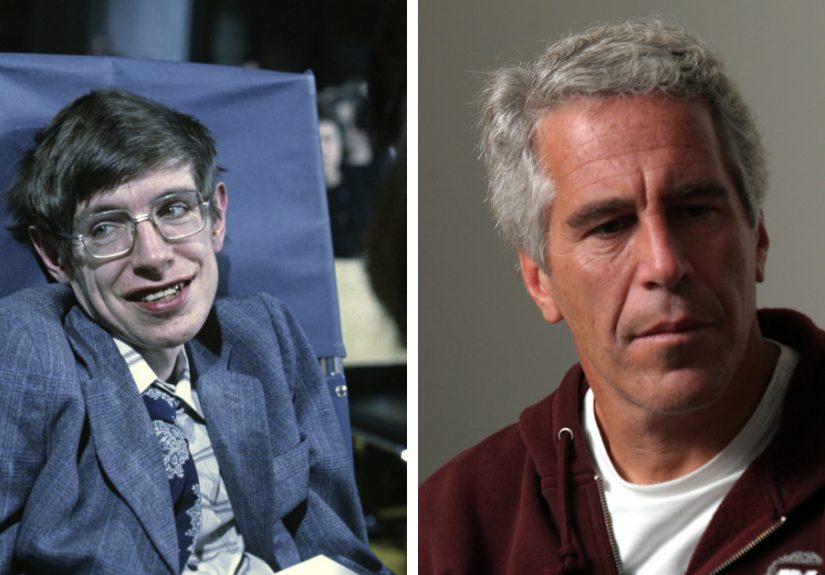
In 2026, renewed attention followed the release and recirculation of photographs tied to Epstein files. One widely discussed image showed Hawking with two women in bikinis. His family said the women were his longtime caretakers and that the picture was taken during the 2006 science symposium. That does not erase the uncomfortable optics of Epstein’s proximity to elite academic circles, but it does matter when interpreting what a photograph can and cannot prove.
Why This Story Blew Up Online
The Hawking allegations hit a perfect storm of modern internet behavior.
Famous Name, Minimal Context
Stephen Hawking is one of the rare scientists whose name is globally recognizable. That alone makes him irresistible bait for a viral post. A lesser-known academic would not have generated nearly the same frenzy.
Epstein-Related Material Invites Speculation
Anything tied to Epstein is guaranteed to produce outrage, curiosity, and rumor. Some of that attention is understandable. Epstein’s crimes were horrific, and the public wants answers about the people around him. But the understandable desire for truth can still get hijacked by bad evidence and sensational framing.
Fake Legal Aesthetics Are Persuasive
When misinformation is wrapped in a courtroom-looking screenshot, people assume it has authority. It looks official, so it must be official. That is the trick. It is the digital equivalent of putting a raccoon in a lab coat and calling it a doctor. Appearance is not proof.
Photos Encourage Storytelling, Not Accuracy
A photo captures a second. The internet uses it to invent a movie. A still image of Hawking in the Virgin Islands is real evidence that he was there. It is not, by itself, evidence of criminal behavior. Context is everything, and context is usually the first thing social media throws overboard.
The More Honest Reading of the Hawking-Epstein Connection
If the goal is accuracy rather than adrenaline, the most defensible conclusion is this: Stephen Hawking had a documented, limited connection to an Epstein-funded scientific event in 2006, and his name later appeared in unsealed documents partly because Epstein referenced an allegation involving him in a 2015 email. That is a real connection, but it is not the same thing as proof that Hawking participated in Epstein’s crimes.
That conclusion may feel less dramatic than the internet version, but reality often has the bad manners to be less cinematic than rumor. It is also the conclusion most consistent with reputable reporting.
There is still a broader and more troubling issue worth taking seriously: Epstein spent years using philanthropy, money, access, and intellectual networking to insert himself into elite circles, including science. That larger story is real and ugly. It raises legitimate questions about how institutions and influential people failed to see, ignored, or rationalized his presence. But that broader moral failure should not be turned into unsupported accusations against every recognizable person who crossed his path.
What Readers Should Take Away
The Stephen Hawking Epstein island allegations are a textbook case of how a real fragment of evidence can be stretched into a much bigger fictional narrative. The real fragment is that Hawking attended a science event in the Virgin Islands connected to Epstein’s funding, appeared in related materials, and was mentioned in a later email. The fictional narrative is that this automatically proves criminal misconduct. It does not.
Good reporting has an annoying habit of being careful. Viral content has an equally annoying habit of being reckless. When those two collide, the loudest version is often the least reliable one.
So if a post claims the “Epstein files proved” something explosive about Hawking, the smartest response is not immediate belief. It is a pause. Then a second pause. Then maybe a third, because the internet has earned that level of skepticism. Ask what the document actually says, who verified it, whether it was part of the real release, and whether the claim is being inflated beyond the evidence.
That is not being naïve. That is being literate.
The Real Experience Behind a Viral Allegation
The most revealing part of this whole episode is not just the allegation itself, but the experience of watching rumor behave like a living thing. It starts small, usually with a real detail. A name in a filing. A photo from years ago. An email fragment. Then the internet grabs that detail, feeds it sugar, gives it roller skates, and sends it downhill. By the time most readers encounter the story, they are no longer looking at the original fact. They are looking at a heavily edited, emotionally charged version built for maximum reaction.
That experience is especially intense when the person at the center is someone as famous as Stephen Hawking. People already “know” Hawking as a symbol: genius, science, perseverance, black holes, pop culture cameos, the voice that could cut through a room even when generated by a machine. So when his name appears in a scandal-adjacent story, many readers do not process it carefully. They process it emotionally. The reaction is instant: shock, disbelief, anger, curiosity, smugness, memes, reposts. Context comes later, if it arrives at all.
There is also the experience of public confusion. Many readers do not know how to read court documents, what it means for names to be unsealed, or how civil records differ from criminal findings. That uncertainty creates a wide-open lane for bad actors, clout chasers, and screenshot merchants. A fake document can feel convincing because most people are not reading the full docket. They are reading a post from someone who says they already did. That is how misinformation becomes a shortcut. It saves people the work of verifying, while charging them interest in the form of false certainty.
Then there is the visual effect. One resurfaced photo can carry enormous emotional weight, even when it proves less than viewers assume. A single image of Hawking in the Caribbean encourages people to build a complete narrative around it. But photographs are famously incomplete witnesses. They show who was in frame, not everything that was happening around the frame, before it, after it, or whether the image is being fairly described. The experience of seeing the image feels decisive. The evidence often is not.
On a broader level, this story captures the public’s frustration with Epstein’s network. People know powerful circles protected him for too long. They know survivors were failed. They know some institutions looked the other way. Because of that, there is a hunger for clarity and accountability. That hunger is valid. But it can also make people vulnerable to overreach, where suspicion expands faster than proof. In that environment, every mention starts to look like guilt, every photo starts to look like confession, and every rumor starts to sound like a leak.
The healthier experience is slower and less glamorous. It means tolerating uncertainty. It means admitting when a connection is real but limited. It means saying, “This is troubling,” without leaping to “This is proven.” In a scandal ecosystem powered by outrage and speed, that kind of restraint may not go viral. But it is still the closest thing readers have to intellectual self-defense.
Conclusion
When the dust settles, the Stephen Hawking Epstein island allegations look less like a solved scandal and more like a cautionary tale about how real records, old photos, and fake screenshots can collide online. Hawking’s connection to an Epstein-funded event in 2006 is real. His appearance in later unsealed materials is real. The leap from those facts to proven criminal wrongdoing is not supported by the evidence that reputable reporting has laid out.
That may disappoint people looking for a neat villain-of-the-week storyline, but journalism is supposed to be better than fan fiction with court captions. The responsible takeaway is not that every rumor is false or that every famous person around Epstein deserves a free pass. It is that facts matter, wording matters, and evidence matters most of all.