Table of Contents >> Show >> Hide
- What Does “Sum from 1 to N” Mean?
- The Sum from 1 to N Formula
- Why the Formula Works
- Step-by-Step Examples
- Connection to Arithmetic Series
- Triangular Numbers: The Visual Side of the Formula
- Common Mistakes When Using the Formula
- Real-Life Uses of the Sum from 1 to N
- Practice Problems
- How to Remember the Formula
- Experience Notes: Learning and Teaching the Sum from 1 to N
- Conclusion
- SEO Tags
Adding numbers from 1 to N sounds like the kind of task a calculator was invented to avoid. If someone asks you to find 1 + 2 + 3 + 4 + … + 1000 by hand, your first instinct might be to fake an urgent phone call. Fortunately, mathematics has a much better escape plan: a simple formula that turns a long addition problem into one quick multiplication and division.
The sum from 1 to N is one of the most useful patterns in arithmetic, algebra, coding, finance, data analysis, and everyday problem solving. It appears when you count seats in rows, total points over levels in a game, calculate repeated savings, estimate handshakes in a room, or write a loop in programming. The formula is short, friendly, and surprisingly elegant:
Sum from 1 to N = N(N + 1) / 2
In this guide, we will explain what the formula means, why it works, how to use it, and how to avoid common mistakes. We will also walk through clear examples, practical applications, and real learning experiences that make this topic easier to remember. No math panic required. We are just counting smarter, not harder.
What Does “Sum from 1 to N” Mean?
The phrase sum from 1 to N means adding every whole number starting at 1 and ending at a chosen positive integer, represented by N. In math, N is simply a placeholder for the final number in the list.
For example, if N = 5, then the sum from 1 to N is:
1 + 2 + 3 + 4 + 5 = 15
If N = 10, then the sum is:
1 + 2 + 3 + 4 + 5 + 6 + 7 + 8 + 9 + 10 = 55
These numbers are also called natural numbers, which usually means counting numbers such as 1, 2, 3, 4, 5, and so on. The result of adding the first N natural numbers is also known as the Nth triangular number, because the total can be arranged as dots in the shape of a triangle.
The Sum from 1 to N Formula
The main formula is:
S = N(N + 1) / 2
Here is what each part means:
- S means the total sum.
- N means the last number being added.
- N + 1 comes from pairing the first and last numbers.
- / 2 appears because the pairing method counts the sum twice.
So, instead of adding every number one by one, you only need to plug N into the formula. That is the mathematical equivalent of using a shortcut through the grocery store instead of walking every aisle looking for one loaf of bread.
Formula in Sigma Notation
You may also see the sum from 1 to N written using sigma notation:
∑k=1N k = N(N + 1) / 2
This means: “Add k as k goes from 1 to N.” It looks fancy, but it is saying the same thing as 1 + 2 + 3 + … + N. Sigma notation is common in algebra, calculus, statistics, computer science, and engineering.
Why the Formula Works
The easiest way to understand the sum from 1 to N formula is through pairing. Imagine you want to add the numbers from 1 to 10:
1 + 2 + 3 + 4 + 5 + 6 + 7 + 8 + 9 + 10
Now pair the first and last numbers:
- 1 + 10 = 11
- 2 + 9 = 11
- 3 + 8 = 11
- 4 + 7 = 11
- 5 + 6 = 11
There are 5 pairs, and each pair equals 11. So the total is:
5 × 11 = 55
The formula does the same thing in a general way. The pair total is always N + 1, because the first and last numbers are 1 and N. The number of pairs is N / 2 when N is even. That gives:
S = (N / 2)(N + 1)
Which is the same as:
S = N(N + 1) / 2
What If N Is Odd?
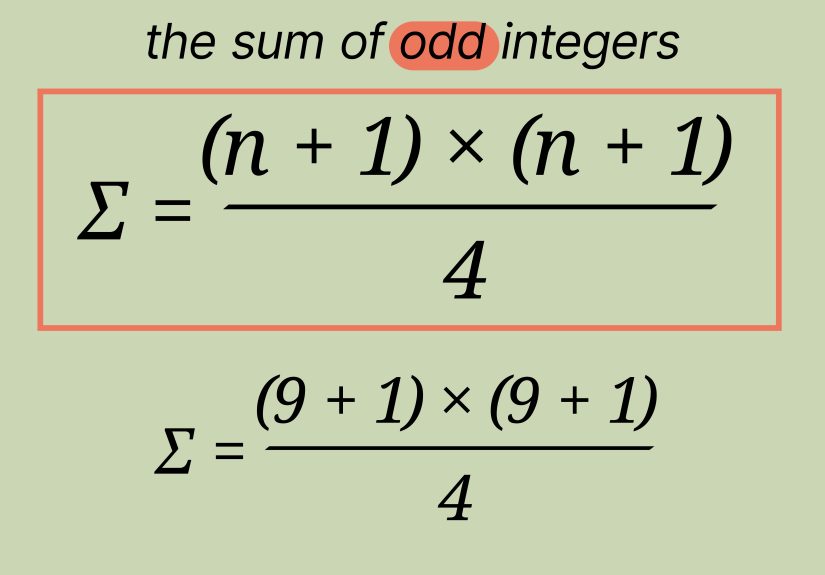
The formula still works when N is odd. Suppose N = 9:
1 + 2 + 3 + 4 + 5 + 6 + 7 + 8 + 9
Pair the outside numbers:
- 1 + 9 = 10
- 2 + 8 = 10
- 3 + 7 = 10
- 4 + 6 = 10
That gives 4 pairs of 10, plus the middle number 5:
40 + 5 = 45
Now use the formula:
9(9 + 1) / 2 = 9 × 10 / 2 = 45
Same result. The formula does not get nervous around odd numbers. It has excellent emotional stability.
Step-by-Step Examples
Example 1: Find the Sum from 1 to 20
Use the formula:
S = N(N + 1) / 2
Substitute N = 20:
S = 20(20 + 1) / 2
S = 20 × 21 / 2
S = 420 / 2
S = 210
So, the sum from 1 to 20 is 210.
Example 2: Find the Sum from 1 to 100
This is the classic example often connected with the famous story of young Carl Friedrich Gauss, who supposedly found the sum quickly by pairing numbers. Whether told as history or math folklore, the method is excellent.
Use the formula:
S = 100(100 + 1) / 2
S = 100 × 101 / 2
S = 10,100 / 2
S = 5,050
The sum from 1 to 100 is 5,050.
Example 3: Find the Sum from 1 to 1,000
Adding 1,000 numbers manually would be a heroic waste of coffee. The formula handles it in seconds:
S = 1000(1000 + 1) / 2
S = 1000 × 1001 / 2
S = 1,001,000 / 2
S = 500,500
The sum from 1 to 1,000 is 500,500.
Example 4: Find N When the Sum Is Known
Sometimes you know the total and need to find N. Suppose the sum from 1 to N is 78. What is N?
Start with the formula:
N(N + 1) / 2 = 78
Multiply both sides by 2:
N(N + 1) = 156
Now think of two consecutive numbers that multiply to 156. Those numbers are 12 and 13:
12 × 13 = 156
So, N = 12.
Check:
1 + 2 + 3 + … + 12 = 12(13) / 2 = 78
Connection to Arithmetic Series
The sum from 1 to N is a special type of arithmetic series. An arithmetic series is the sum of an arithmetic sequence, where each term increases or decreases by the same amount.
The general arithmetic series formula is:
S = n(a1 + an) / 2
In the sum from 1 to N:
- The first term, a1, is 1.
- The last term, an, is N.
- The number of terms is N.
So the formula becomes:
S = N(1 + N) / 2
Which is the same as:
S = N(N + 1) / 2
This connection is important because once you understand the sum from 1 to N, you are already halfway to understanding many other series formulas.
Triangular Numbers: The Visual Side of the Formula
The results of the sum from 1 to N are called triangular numbers. The first few are:
1, 3, 6, 10, 15, 21, 28, 36, 45, 55
Why triangular? Because you can arrange dots in rows to form a triangle:
- 1 dot makes the first triangular number.
- 1 + 2 dots make the second triangular number: 3.
- 1 + 2 + 3 dots make the third triangular number: 6.
- 1 + 2 + 3 + 4 dots make the fourth triangular number: 10.
If you duplicate the triangle and rotate it, the two triangles form a rectangle. That rectangle has N rows and N + 1 columns, so it contains N(N + 1) dots. Since one triangle is half of that rectangle, the triangular number is N(N + 1) / 2.
This visual proof is one of the best ways to remember the formula because it turns an abstract equation into something you can actually see.
Common Mistakes When Using the Formula
Mistake 1: Forgetting to Divide by 2
The most common mistake is calculating N(N + 1) and stopping there. That gives double the correct answer. For N = 10, N(N + 1) equals 110, but the correct sum is 55.
Mistake 2: Using the Formula for the Wrong Sequence
The formula N(N + 1) / 2 works for the numbers 1 through N. It does not directly work for sequences such as 3 + 6 + 9 + 12 or 5 + 10 + 15 unless you adjust the problem or use the arithmetic series formula.
Mistake 3: Confusing N with the Total
N is the last number in the list, not the final answer. If N = 50, the sum is not 50. The sum is:
50(51) / 2 = 1,275
Mistake 4: Applying It to Infinite Series
The sum from 1 to N is a finite sum. That means it has an ending point. The expression 1 + 2 + 3 + 4 + … forever does not have a normal finite total. The formula only applies when N is a specific positive integer.
Real-Life Uses of the Sum from 1 to N
1. Counting Handshakes
If every person in a room shakes hands with every other person exactly once, the total number of handshakes is related to triangular numbers. For 10 people, each unique pair shakes hands once:
10 × 9 / 2 = 45
This is similar to the sum from 1 to N, though the formula becomes N(N – 1) / 2 because no one shakes hands with themselves. Unless the party is very strange.
2. Programming Loops
In programming, nested loops often create totals like 1 + 2 + 3 + … + N. Understanding this formula helps estimate how long an algorithm may take. If a loop runs 1 time, then 2 times, then 3 times, up to N times, the total number of operations is N(N + 1) / 2.
3. Saving Money
Imagine you save $1 on day 1, $2 on day 2, $3 on day 3, and so on for 30 days. How much do you save?
30(31) / 2 = 465
You would save $465. Not bad for a plan that starts with one lonely dollar.
4. Sports and Games
Some games use level-based rewards where level 1 gives 1 point, level 2 gives 2 points, level 3 gives 3 points, and so on. To find the total points after N levels, use the sum from 1 to N formula.
5. Seating and Stacking Problems
If chairs, cans, logs, or boxes are stacked in rows that increase by one item each time, the total often forms a triangular number. For example, rows of 1, 2, 3, 4, and 5 items contain:
5(6) / 2 = 15 items
Practice Problems
Problem 1
Find the sum from 1 to 15.
Solution: 15(16) / 2 = 120
Problem 2
Find the sum from 1 to 75.
Solution: 75(76) / 2 = 2,850
Problem 3
Find the sum from 1 to 200.
Solution: 200(201) / 2 = 20,100
Problem 4
A student reads 1 page on Monday, 2 pages on Tuesday, 3 pages on Wednesday, and continues this pattern for 14 days. How many pages does the student read?
Solution: 14(15) / 2 = 105 pages
Problem 5
A game gives you 1 coin for level 1, 2 coins for level 2, and so on. How many coins do you earn by completing 50 levels?
Solution: 50(51) / 2 = 1,275 coins
How to Remember the Formula
A good way to remember the formula is to say:
“Take the last number, multiply by the next number, then cut it in half.”
For N = 8, the last number is 8. The next number is 9. Multiply them:
8 × 9 = 72
Cut it in half:
72 / 2 = 36
So the sum from 1 to 8 is 36.
This little phrase is often easier to remember than the formal equation. Once the idea sticks, the formula feels natural.
Experience Notes: Learning and Teaching the Sum from 1 to N
One of the most interesting things about the sum from 1 to N is that students often understand the answer before they fully understand the formula. At first, N(N + 1) / 2 can look like something dropped from a spaceship. It has letters, multiplication, parentheses, and division all sitting together like they are waiting for a group photo. But once learners see the pairing trick, the formula suddenly feels less like a rule and more like common sense.
In my experience, the best way to introduce this topic is not to start with the formula. Start with a challenge. Ask someone to add the numbers from 1 to 20. Most people will begin adding from left to right: 1 + 2 = 3, plus 3 = 6, plus 4 = 10, and so on. This works, but it is slow. Then show the pairing method: 1 + 20, 2 + 19, 3 + 18. Each pair equals 21. Since there are 10 pairs, the answer is 210. That moment usually creates a small but satisfying “aha!” reaction. It is the mathematical version of finding out your suitcase had wheels all along.
Another useful experience is connecting the formula to real objects. Coins, buttons, sticky notes, or even snacks can be arranged in triangular rows. Put 1 item in the first row, 2 in the second, 3 in the third, and continue. When learners count the total, they see the triangular number physically. Then duplicate the triangle with another set of items and rotate it into a rectangle. Suddenly, N(N + 1) / 2 is not just symbols on a page. It is half a rectangle. This works especially well for visual learners who need to see the structure before trusting the equation.
The formula also becomes more memorable when it is tied to everyday routines. For example, a 30-day savings challenge is a great demonstration. Save $1 on day one, $2 on day two, and continue until day 30. Many people guess the total will be around $300 because they focus on the middle of the pattern. When they calculate 30 × 31 / 2 and get $465, the result feels surprising in a good way. It shows how small increases can build into a much larger total.
In programming, this formula can be an eye-opener. Beginners may write a loop to add every number from 1 to N, which is perfectly fine for small values. But when N becomes huge, the formula is faster and cleaner. Instead of making a computer count step by step, you give it the answer directly. That lesson is bigger than one formula: it teaches the value of recognizing patterns before doing unnecessary work.
The most common teaching mistake is presenting the formula as something to memorize without context. Memorization can help, but understanding lasts longer. When learners know that the formula comes from pairing numbers or from half of a rectangle, they are less likely to forget it. They can rebuild the formula if memory fails. That is real learning: not just carrying the tool, but knowing how the tool was made.
Finally, the sum from 1 to N is a wonderful reminder that math is often about perspective. The long way and the short way both reach the same answer, but the short way reveals structure. Instead of seeing a pile of numbers, you see pairs, patterns, shapes, and relationships. That shift is powerful. It turns arithmetic from busywork into insight. And frankly, any formula that saves time and makes you look clever deserves a comfortable place in your mental toolbox.
Conclusion
The sum from 1 to N formula is one of the simplest and most useful formulas in mathematics. It helps you add consecutive natural numbers quickly, understand arithmetic series, recognize triangular numbers, solve counting problems, and analyze patterns in real life. The key formula is:
S = N(N + 1) / 2
Use it whenever you need to add 1 + 2 + 3 + … + N. The formula works because the first and last numbers can be paired, and each pair has the same total. It also connects beautifully to geometry through triangular numbers and half-rectangle visual proofs.
Whether you are studying for a math test, writing code, solving a puzzle, or planning a savings challenge, this formula is a small shortcut with big usefulness. It proves that math is not always about working harder. Sometimes, it is about noticing the pattern hiding in plain sight.
SEO Tags
Note: This article is written as original, publication-ready HTML content based on widely accepted mathematical principles and reputable educational references.