Table of Contents >> Show >> Hide
- The One Thing Designers Can Spot Instantly: Visible Clutter
- Why Entryway Clutter Looks Worse Than Other Kinds of Clutter
- The Biggest Entryway Clutter Offenders
- What Designers Do Instead
- How to Fix a Bad-Looking Entryway in Real Life
- A Simple Entryway Reset That Works
- The Real Secret: Your Entryway Should Feel Easy
- Real-Life Experiences: What Happens When You Finally Fix Entryway Clutter
- Conclusion
Your entryway has a tough job. It has to welcome guests, survive muddy shoes, catch rogue keys, hold packages, and somehow still look like a stylish part of your home instead of a tiny disaster zone with a doormat. That is a lot to ask from a few square feet.
But according to designers, there is one thing that almost always makes an entryway look bad: visible clutter. Not bold wallpaper. Not a dramatic mirror. Not even that slightly questionable bench you bought at midnight during a “treat yourself” moment. The real offender is the pileup of everyday life left out in plain sightshoes, coats, bags, mail, umbrellas, pet leashes, random boxes, and all the little objects that quietly turn a welcoming space into a visual traffic jam.
The good news is that this problem is fixable, and it usually does not require a full renovation or a designer-sized budget. It requires better editing, smarter storage, and a little honesty about how your household actually behaves when everyone comes home tired, hungry, wet, late, or all four at once.
Here is why clutter is the one thing designers say always looks bad in an entryway, plus exactly how to fix it without making your home feel stiff, sterile, or suspiciously like nobody lives there.
The One Thing Designers Can Spot Instantly: Visible Clutter
An entryway is the first impression of your home. It tells guests what to expect, and it tells you something too, every single day. Walk into a clean, organized entry, and your brain gets a little “Ah, yes, civilization.” Walk into a pile of sneakers, unopened mail, and three jackets draped over one hook, and your brain goes straight into low-grade chaos mode.
That is why visible clutter lands so hard in this space. In a bedroom, a little mess can hide behind a door. In a home office, papers can pretend to be “active projects.” In an entryway, clutter is front and center. There is no warm-up act. The mess is the opening number.
Designers often point out that clutter in an entryway looks worse than clutter elsewhere because the space is usually small, highly functional, and heavily trafficked. Even a few extra items can make it feel cramped, dark, and disorganized. The result is a space that looks accidental rather than intentional.
Why Entryway Clutter Looks Worse Than Other Kinds of Clutter
1. It interrupts flow
An entryway is not just a place to look pretty. It is a pathway. When shoes line the floor, bags lean against the wall, and a bench becomes a holding pen for “stuff I will deal with later,” the room stops functioning properly. People have to step around things. The door area feels tighter. The whole house starts with an obstacle course.
2. It shrinks the space visually
Most entryways are not exactly grand hotel lobbies. They are compact. That means too many visible items create visual noise fast. Open baskets stuffed to the top, overloaded hooks, and piles on a console table make the area feel smaller than it really is.
3. It steals attention from everything else
You could have the perfect vintage runner, a gorgeous brass sconce, and a mirror so chic it deserves its own agent. None of that matters if all anyone sees first is a mountain of shoes. Clutter is bossy. It takes over the room and shouts down every design choice you made.
4. It makes the home feel less inviting
There is a difference between a lived-in home and a stressed-out home. A thoughtfully layered entryway feels warm. A cluttered one feels like everyone barely made it through the door. Guests notice that energy right away, and homeowners feel it too.
The Biggest Entryway Clutter Offenders
Not all clutter is equal. In entryways, a few categories show up again and again as the main reason the space looks bad.
Shoes and boots
This is the classic culprit. A couple of pairs may look normal. Ten pairs make the room feel like the lost-and-found bin at a youth soccer tournament. Shoes scattered across the floor instantly read as messy, especially when they are different colors, sizes, and styles competing for attention.
Coats, hats, and outerwear overload
Hooks are usefuluntil they become a textile avalanche. If every hook holds three things and one mystery scarf has apparently lived there since February, the entryway starts looking heavy and chaotic.
Mail and packages
Nothing says “I’ll get to it eventually” like a leaning tower of envelopes on the console table. Add a couple of delivery boxes, receipts, sunglasses, and charging cables, and suddenly your entryway is cosplaying as a shipping department.
Bags, backpacks, and purses
Bags are easy to drop and hard to ignore. They often land in a heap, and because they are bulky, they visually crowd the space faster than smaller objects do.
Too much open storage
This is the sneaky one. Open baskets, hooks, cubbies, and trays can absolutely helpbut only up to a point. If everything is visible, the storage itself can start looking like clutter. A dozen “organized” items out in the open still read as a dozen items out in the open.
What Designers Do Instead
The fix is not to make your entryway empty. Designers are not asking you to remove all signs of human life and pretend nobody owns shoes. They are asking you to create a space that controls the clutter instead of displaying it like a permanent exhibit.
Create a real drop zone
The most successful entryways have a landing spot for the things people naturally carry home. That means keys need a tray. Mail needs a basket or drawer. Shoes need a rack, mat, or cabinet. Bags need one designated hook or shelf. When there is no assigned place, the floor and tabletop become the default.
The trick is to design the space for your actual habits, not your imaginary best self. If your family never hangs up coats in a bedroom closet, pretending they will suddenly do that now is adorable but unhelpful. Put practical storage where the problem starts.
Use closed storage whenever possible
Designers love furniture that works harder than it looks. A slim cabinet for shoes, a console with drawers, or a storage bench with a lift-up seat instantly makes the space feel calmer because it hides the messy details. Closed storage does not just organize the entryway; it visually simplifies it.
If your entry is tiny, look for narrow-depth cabinets, wall-mounted drawers, or benches with baskets tucked neatly underneath. The goal is not to add bulky furniture. It is to reduce what the eye has to process.
Limit what stays out
Good styling in an entryway follows the “a little goes a long way” rule. One tray for essentials? Great. Seven loose objects surrounding the tray like planets around the sun? Not great.
Keep only the everyday necessities accessible. Everything else should be edited, rotated seasonally, or stored elsewhere. If it is not used regularly, it should not be earning prime real estate by the front door.
Right-size the furniture
Designers regularly talk about scale for a reason. An oversized bench in a small foyer can make the room feel blocked. A tiny table floating awkwardly in a large entry can feel unfinished. When the furniture fits the footprint, the whole space feels more polished.
In practical terms, leave enough clearance for the door swing and walking path. If people have to pivot sideways just to get inside, the furniture is too big, no matter how cute it looked online.
Add elements that balance function with beauty
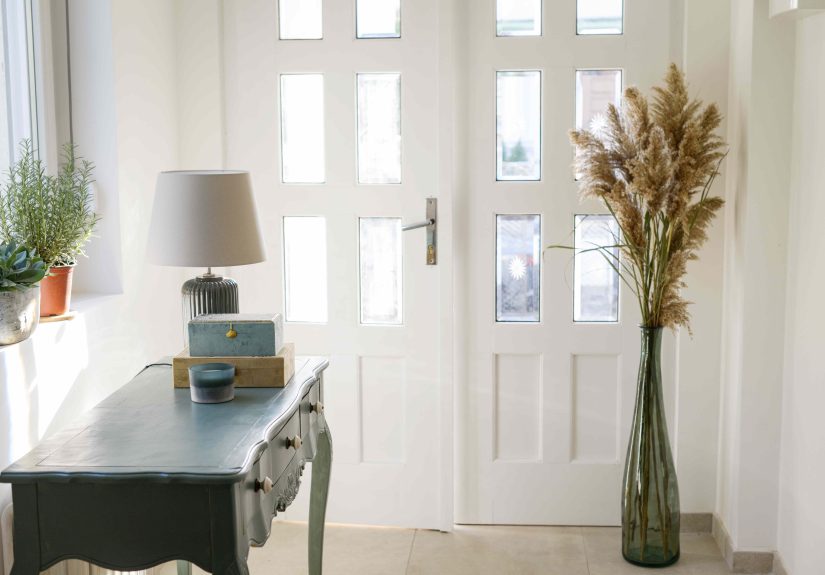
Once clutter is under control, the entryway needs warmth. This is where designers bring in the pieces that make the space feel deliberate rather than purely utilitarian: a mirror, a washable rug, attractive lighting, a piece of art, or a small lamp if there is a console table.
These details matter because they pull the eye toward something pleasing. A mirror adds light and function. A rug grounds the area and catches dirt. Better lighting makes the whole entry feel cleaner and more welcoming. Suddenly the space says, “Welcome home,” instead of, “Please ignore the pile.”
How to Fix a Bad-Looking Entryway in Real Life
For a small apartment entry
Use vertical space. Install a few well-spaced hooks, not a whole forest of them. Add a shallow shoe cabinet and a narrow ledge for keys. Choose one mirror that makes the area feel bigger. Keep the floor as clear as possible, because in a small entry, floor clutter is the fastest route to visual chaos.
For a family home
Assign zones by person or category. One basket for sports gear is better than sports gear everywhere. One shelf for kid backpacks is better than backpacks migrating across the hallway. Families do not need less stuff; they need better containment.
For a home with no formal foyer
You can still create an entry moment. Use a rug to define the zone, a console or cabinet to anchor it, and a mirror or artwork above it. Even in an open-plan layout, these elements tell the eye, “This is the landing space,” which keeps clutter from spilling into the rest of the room.
For a larger entryway
A bigger space can handle more personality, but it is not an excuse for more clutter. Use one or two larger statement pieces instead of lots of small objects. A substantial bench, oversized art, or a bold pendant light has more impact than a bunch of little accessories fighting for attention.
A Simple Entryway Reset That Works
If your entryway currently looks like it hosted a very small but very hectic parade, start here:
- Remove everything that does not belong in the entryway.
- Count how many pairs of shoes actually need to live there daily.
- Keep only one or two coats per person in the space during the current season.
- Add a tray, drawer, or bowl for keys and tiny essentials.
- Give mail a container, not a surface.
- Hide as much as possible behind doors, drawers, or lidded baskets.
- Finish with one beautiful element: a mirror, lamp, art piece, or rug.
That is it. Not magic. Not a 42-step lifestyle transformation. Just editing, storing, and styling in the right order.
The Real Secret: Your Entryway Should Feel Easy
The best entryways are not the ones with the most expensive furniture or the most dramatic lighting. They are the ones that make coming home feel smooth. You open the door, put your things down, take off your shoes, and move on with your life without creating a mess in the process.
That is why clutter is the one thing designers say always looks bad here. It is not only unattractive; it signals that the space is not working. Once the entryway supports your routine, it almost automatically looks better. And once it looks better, the rest of the house feels more pulled together too.
So if your foyer has been feeling a little tired, awkward, or strangely stressful, do not start by shopping for another decorative object. Start by removing the pile. Designers have been right about this one all along: in an entryway, clutter is the quickest way to kill style.
Real-Life Experiences: What Happens When You Finally Fix Entryway Clutter
One of the most relatable things about entryway clutter is that it usually starts innocently. A pair of shoes gets kicked off after a long day. Then someone drops the mail on the nearest surface. Then a tote bag lands on the chair “for just a minute,” except that minute quietly becomes three days. Before long, the entryway is no longer an entryway. It is a holding area for delayed decisions.
Many homeowners describe the same pattern: they do not notice the buildup at first because each item seems small. A hoodie here, a package there, a dog leash hanging from a knob, and suddenly the space feels messy all the time. What surprises people is how much that tiny area affects the mood of the whole house. When the first thing you see is disorder, the rest of your home somehow feels less calm too, even if the kitchen and living room are perfectly fine.
A common experience in small apartments is the “shoe creep” problem. At first there are only two or three pairs by the door. Then weather changes, guests visit, or someone starts exercising more often, and the collection grows legs. Residents often say they become weirdly blind to it until they leave, come back, and realize the entrance looks like a stockroom for feet. Adding a closed shoe cabinet or even a strict one-pair-per-person rule often changes the whole look of the area overnight.
Families with kids tend to have a different version of the same issue. Backpacks, sports gear, lunch bags, jackets, and permission slips all seem magnetically attracted to the front door. Parents often discover that the problem is not that the family is messy by nature. It is that the entryway has not been given enough job-specific storage. Once each child has one hook, one bin, and one spot for shoes, mornings feel less frantic and the entry starts looking like part of the home again instead of a staging zone before liftoff.
There is also the emotional side of it. People often say that once they cleared the visible clutter, the entryway felt more welcoming in a surprisingly personal way. Coming home after work felt softer. Having friends stop by became less embarrassing. Even mundane routinestaking off shoes, hanging up a coat, putting down keysfelt smoother because the space was no longer fighting back.
Another frequent experience is realizing that open storage is only helpful until it is too helpful. Plenty of homeowners begin with hooks, baskets, and open cubbies because those solutions seem easy. Then they notice the area still looks busy, even when everything is technically “organized.” That is usually the moment closed storage wins. A drawer, cabinet, or storage bench can make the same items disappear visually, which instantly makes the room feel calmer.
Seasonal changes reveal this truth too. In summer, an entryway may look perfectly manageable. Then winter arrives with boots, scarves, heavier coats, wet umbrellas, and the occasional mysterious glove that apparently belongs to no one. People quickly realize that good entryway design is not static. It needs to flex with real life. Swapping storage by season, rotating outerwear, and editing what stays near the door are the habits that keep the space looking polished all year.
In the end, the shared experience is simple: when the entryway works, everything feels easier. The house looks better. The daily routine runs better. And that one tiny stretch of space stops announcing every unfinished task to anyone who walks in. It becomes what it was meant to be all alonga graceful transition into home.
Conclusion
If there is one universal lesson designers keep repeating, it is this: an entryway does not need more stuff to look better. It needs fewer visible distractions and smarter places to put the things you actually use. Once clutter is handled, even a modest entry can feel stylish, welcoming, and impressively grown-up. And honestly, that is a pretty good return on a shoe cabinet and a little self-control.