Table of Contents >> Show >> Hide
- What Does “UFO Navy” Really Mean?
- From UFO to UAP: Why the Name Changed
- The Navy Videos That Changed the Conversation
- Why the Navy Took UAP Reports Seriously
- What Official Reports Have Said So Far
- The Science Problem: Better Data or Better Guessing?
- Why “UFO Navy” Became a National Security Topic
- Famous Navy UAP Examples and What They Teach Us
- What Skeptics and Believers Both Get Right
- Experiences and Reflections Related to UFO Navy
- Conclusion: UFO Navy Is Really About Data, Safety, and Trust
- SEO Tags
Note: This article is written in clean body-only HTML for web publishing. It is based on public U.S. government information, official UAP reporting, and reputable American media coverage, with no source links inserted into the article body.
What Does “UFO Navy” Really Mean?
The phrase “UFO Navy” sounds like the title of a midnight cable documentary where a retired admiral points at blurry radar dots while dramatic music does push-ups in the background. But behind the catchy phrase is a serious modern story about the U.S. Navy, unidentified flying objects, military pilots, radar systems, national security, and a government vocabulary shift from “UFO” to “UAP,” or unidentified anomalous phenomena.
For decades, UFO stories lived mostly in pop culture: silver saucers, desert highways, little green beings, and someone’s uncle swearing he saw “something weird over the cornfield.” Then Navy pilots entered the chat. Suddenly the conversation was not just about campfire speculation. It involved aircraft carriers, fighter jets, infrared cameras, radar operators, formal reports, congressional briefings, and official government offices trying to separate mystery from misidentification.
The Navy’s role matters because many of the most famous modern UAP cases were recorded or reported by U.S. Navy aviators and personnel. These cases do not prove alien spacecraft are buzzing the planet like tourists looking for parking. They do prove something more grounded and still important: trained military observers have reported objects they could not immediately identify, sometimes in restricted training areas where unknown objects can create real safety and security concerns.
From UFO to UAP: Why the Name Changed
“UFO” simply means unidentified flying object. That is it. It does not automatically mean aliens, interstellar engines, or a spacecraft with a cup holder designed for a three-fingered pilot. However, the term became so loaded with science-fiction baggage that government agencies increasingly adopted “UAP.”
Originally, UAP commonly meant “unidentified aerial phenomena.” Today, official usage often expands it to “unidentified anomalous phenomena,” a broader phrase that can include unusual observations in the air, at sea, in space, or across domains. The change is not just cosmetic. It helps military and scientific communities talk about unexplained observations without making the conversation sound like a movie poster.
That distinction matters for SEO readers too. People search for “UFO Navy,” “Navy UFO videos,” “UAP Navy pilots,” “Tic Tac UFO,” and “Pentagon UFO videos,” but the modern official discussion increasingly uses UAP. A strong understanding of the topic requires both terms: UFO is the public keyword; UAP is the official language.
The Navy Videos That Changed the Conversation
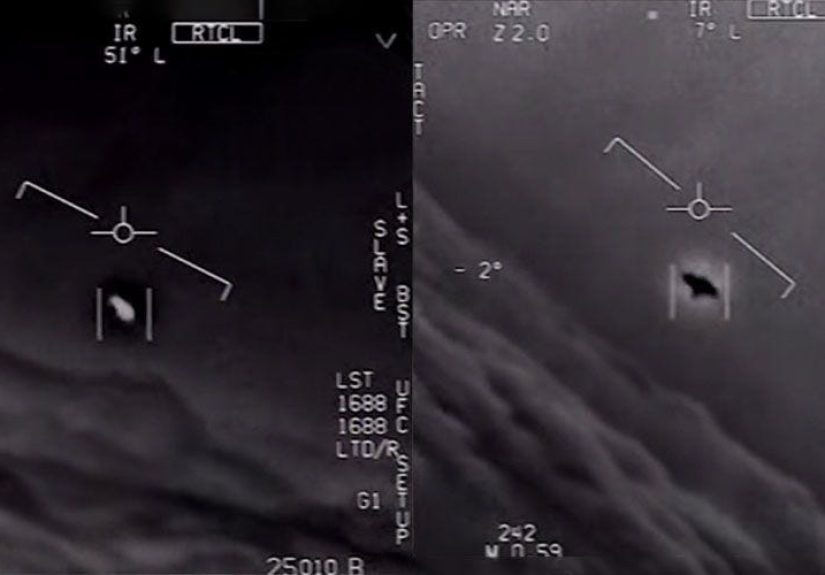
The modern UFO Navy story is closely tied to three famous videos often known as “FLIR,” “GIMBAL,” and “GOFAST.” These videos were captured by Navy aircraft sensors during incidents connected to 2004 and 2015 encounters. They circulated publicly for years before the Department of Defense officially authorized their release in 2020.
The 2004 Nimitz Encounter
The 2004 case is usually associated with the USS Nimitz Carrier Strike Group off the coast of Southern California. Navy personnel reported unusual radar tracks, and fighter pilots were directed to investigate. The most famous eyewitness account came from Navy pilot David Fravor, who described a white, oblong object with no obvious wings or exhaust. Because humans are apparently incapable of seeing an oval object without comparing it to snack food, the object became widely known as the “Tic Tac” UFO.
The story became iconic because it included multiple elements that make any serious investigator sit up straighter: experienced pilots, radar observations, infrared footage, and a military training environment. Still, none of those details automatically identify the object. They make the case interesting; they do not make it solved.
The 2015 Roosevelt-Related Videos
The “GIMBAL” and “GOFAST” videos are commonly associated with Navy aircraft operating off the East Coast in 2015. In “GIMBAL,” pilots react to an object seen on infrared imagery that appears to rotate. In “GOFAST,” a small object seems to move quickly over the ocean, though later analysis has highlighted how sensor angle, altitude, and parallax can make speed difficult to judge from a short clip.
That is the maddening part of many UAP cases: a video can be real and still not show what people think it shows. A camera can capture something genuine while the interpretation remains wrong, incomplete, or exaggerated. In other words, “authentic video” does not equal “confirmed alien craft.” It means the footage came from a real military source and shows an object or image that required further analysis.
Why the Navy Took UAP Reports Seriously
The Navy’s interest in UAP is not mainly about proving or disproving extraterrestrial life. It is about safety, security, and airspace awareness. If an unknown object appears in a training range, pilots need to know whether it is a drone, a balloon, a sensor artifact, a foreign surveillance platform, a civilian aircraft where it should not be, or something else entirely.
Military aviators train in carefully managed airspace. When an unknown object interrupts that environment, it can create a hazard. A balloon drifting into the wrong area may sound boring until it meets a high-speed aircraft. A drone may look small until it becomes a national security question. Even a radar error matters if it causes confusion during operations.
This practical framing is why the Navy began encouraging more formal reporting. For years, pilots may have avoided reporting strange observations because nobody wants to be “the UFO person” in a ready room full of people with call signs and an advanced talent for sarcasm. Reducing stigma helps collect better data. Better data makes it easier to identify ordinary causes, and when something remains unexplained, investigators can at least say so with more confidence.
What Official Reports Have Said So Far
Public UAP reports from U.S. agencies have generally landed in a careful middle ground. They do not say, “Nothing to see here.” They also do not say, “Please welcome our new overlords from Planet Paperwork.” Instead, they emphasize limited data, inconsistent reporting, sensor challenges, and the need for rigorous analysis.
Many Cases Have Ordinary Explanations
Official reviews have identified many UAP reports as balloons, birds, drones, aircraft, satellites, airborne clutter, atmospheric effects, or sensor-related problems. This does not make the topic fake. It makes it normal. In aviation, many unusual sightings become less mysterious once investigators know the location, angle, speed, weather, sensor mode, and nearby traffic.
AARO, the All-domain Anomaly Resolution Office, has published official imagery and case information showing that some reports are resolved as ordinary objects. That may disappoint people hoping every fuzzy dot is a cosmic visitor, but it is exactly how a serious process should work. Solve what can be solved. Label uncertainty honestly. Keep analyzing the cases with enough data to deserve more attention.
Some Cases Remain Unresolved
Unresolved does not mean impossible. It means there is not enough information to make a confident identification. A short infrared clip may lack range, size, wind data, radar confirmation, or full sensor context. Eyewitness reports can be sincere and still incomplete. Even trained observers can misjudge speed, distance, or motion when an object is unfamiliar or when the viewing geometry is unusual.
The best UAP investigations look for patterns across multiple sensors and reliable records. A pilot’s visual report is useful. Radar data is useful. Infrared video is useful. Time stamps, location, altitude, weather, and nearby aircraft data are useful. A blurry clip posted with dramatic music and a caption in all caps is less useful, though admittedly excellent at starting internet arguments.
The Science Problem: Better Data or Better Guessing?
NASA’s involvement in UAP research added an important scientific voice to the discussion. The agency’s independent study team focused less on re-litigating famous cases and more on how to study future reports properly. That approach is refreshing because UAP debates often suffer from a shortage of data and a surplus of confidence.
Scientific study needs repeatable observations, calibrated sensors, clear metadata, and methods that can be checked by others. Without those ingredients, even smart people end up arguing over pixels. A bright object in the sky might be a drone, a planet, a satellite flare, a balloon, a bird, a reflection, or something not yet identified. The trick is not to pick the most exciting answer first. The trick is to gather enough information that the boring answers either fit or fail.
Artificial intelligence and machine learning may eventually help sort UAP reports by comparing new observations with known patterns: aircraft routes, satellite paths, balloon behavior, weather phenomena, and sensor artifacts. But AI is not a magic alien detector. It is a tool for pattern recognition, and like any tool, it needs good input. Feed it messy data and it may confidently produce digital soup.
Why “UFO Navy” Became a National Security Topic
The Navy UFO story became bigger than curiosity because unknown objects in military airspace raise serious questions. If a UAP is a foreign surveillance system, that matters. If it is an unauthorized drone, that matters. If it is a sensor problem affecting pilot awareness, that matters too. Even if many cases turn out to be ordinary, the process of finding out is still valuable.
The United States operates in crowded skies and increasingly complex domains. Commercial drones are cheaper and more capable than ever. Satellites are more visible to the public. Balloons can fly at high altitudes. Advanced aircraft testing may be classified. Electronic warfare can create confusing signals. Add human perception, fast-moving jets, and imperfect sensors, and you have a recipe for mystery stew.
That is why serious UAP work avoids jumping straight to aliens. National security investigators first ask practical questions: Was the object in restricted airspace? Did it interfere with training? Was it detected by more than one sensor? Could it be a drone, balloon, aircraft, satellite, weather effect, or sensor artifact? Is there evidence of foreign technology? Is the report detailed enough to analyze?
Famous Navy UAP Examples and What They Teach Us
The “Tic Tac” Lesson: Eyewitnesses Matter, But Data Matters More
The 2004 Nimitz case remains one of the most discussed Navy UFO events because it combines credible witnesses with sensor-related evidence. The pilots involved were not random skywatchers with lawn chairs and a thermos. They were trained aviators operating in a military environment. Their testimony deserves attention.
Still, a serious review must separate credibility from certainty. A credible witness can report exactly what they saw and still not know what the object was. That is not an insult; it is how observation works. The best path forward is to combine testimony with radar records, infrared footage, environmental data, and technical analysis.
The “GIMBAL” Lesson: Sensor Images Can Be Tricky
The GIMBAL video looks strange partly because infrared targeting systems do not behave like ordinary phone cameras. Rotation, glare, tracking modes, and angle can all affect interpretation. A viewer may see a dramatic motion while an analyst sees a camera system doing complicated camera-system things. The lesson is simple: military footage can be authentic and still require expert interpretation.
The “GOFAST” Lesson: Apparent Speed Can Fool the Eye
The GOFAST video is a favorite in UAP discussions because the object appears to zip over the ocean. But apparent motion depends on distance, altitude, camera movement, and viewing angle. Something can look extremely fast when it is actually slower and farther away, especially when filmed from a moving aircraft. This does not make the video useless. It makes geometry the uninvited guest at the UFO party.
What Skeptics and Believers Both Get Right
Believers are right that some Navy UAP reports are interesting and should not be mocked into silence. Skeptics are right that extraordinary claims need strong evidence. The healthiest position is not blind belief or automatic dismissal. It is disciplined curiosity.
A disciplined approach says: take pilot reports seriously, protect aviation safety, investigate incursions, release unclassified information when possible, and avoid turning every unknown object into a spaceship. That approach may not satisfy the loudest voices online, but it is far more useful than shouting “aliens” or “nothing” before the evidence is reviewed.
The UFO Navy topic sits at the intersection of mystery, technology, military operations, and public trust. People want transparency because they suspect the government knows more than it says. Agencies want caution because some data may reveal sensor capabilities, military locations, or operational methods. Both concerns can be real at the same time.
Experiences and Reflections Related to UFO Navy
One of the most relatable experiences connected to the UFO Navy topic is the feeling of watching a short military video and realizing how quickly the human brain wants a complete story. A small dot moves across a screen, pilots react with surprise, and suddenly everyone becomes a part-time aerospace engineer, intelligence analyst, and interstellar travel consultant. The internet does not wait for peer review. It grabs popcorn.
For many readers, the first experience with Navy UFO material is curiosity. The videos are not polished Hollywood scenes. They are grainy, technical, and strangely ordinary-looking. That makes them more intriguing, not less. A blockbuster alien invasion would show a glowing mothership hovering over a skyline. A real military sensor clip shows numbers, crosshairs, ocean texture, and a tiny object that refuses to explain itself. The mystery feels quieter, and somehow that makes it louder.
Another common experience is confusion over language. UFO sounds exciting. UAP sounds like a government committee put a mystery in a filing cabinet. Yet the shift in language helps reduce the giggle factor. A Navy pilot reporting an unidentified object should not have to worry about becoming a punchline. Aviation safety depends on reporting unusual conditions, whether the cause is a drone, a balloon, a sensor glitch, or something genuinely unknown.
There is also an experience of disappointment when an exciting case receives a mundane explanation. A balloon? Birds? Satellite glare? Come on, universe, at least bring a little drama. But that disappointment is part of learning how investigation works. A solved case is not a failed mystery. It is a successful analysis. Every ordinary explanation helps refine the process for the cases that remain harder to solve.
The most valuable experience readers can take from the UFO Navy story is learning to live with uncertainty without filling every gap with fantasy. “Unidentified” is not a final answer. It is a starting point. It invites questions: What sensor captured it? Was there radar confirmation? What was the wind doing? Were satellites nearby? Was the aircraft turning? How far away was the object? What data is missing?
Following this topic can also sharpen media literacy. Headlines often move faster than evidence. A phrase like “Pentagon confirms UFO video” can sound like “Pentagon confirms aliens,” even though those are wildly different claims. The careful reader learns to pause. Confirmed video means the footage is real. It does not automatically confirm the most dramatic interpretation of what appears in the footage.
In the end, the UFO Navy experience is a lesson in curiosity with seatbelts. It is perfectly reasonable to be fascinated by Navy UAP reports. It is also wise to stay grounded. The sky is full of objects, sensors are imperfect, humans misread things, and some cases genuinely deserve more study. That combination is not boring. It is the real mystery: not a guaranteed alien answer, but a serious question about what we observe, how we observe it, and how honestly we handle what we do not yet know.
Conclusion: UFO Navy Is Really About Data, Safety, and Trust
The story of UFO Navy is not just about strange shapes on cockpit screens. It is about how a modern military handles uncertainty in crowded airspace. It is about pilots feeling safe enough to report unusual observations. It is about government agencies learning to collect better data. It is about the public asking fair questions while resisting the urge to turn every mystery into a flying saucer with mood lighting.
The Navy UFO videos helped move UAP from fringe fascination into official discussion. The best takeaway is not that every unexplained object is extraordinary. It is that unexplained objects in military environments deserve careful, transparent, science-minded review. Some will be balloons. Some will be birds. Some will be drones, satellites, aircraft, atmospheric effects, or sensor quirks. A smaller number may remain unresolved because the available data is simply not strong enough.
That may not be the cinematic ending some people want, but it is the honest one. In the UFO Navy story, the most powerful tool is not a laser cannon or a secret hangar. It is better evidence. Until the data improves, the smartest position is open-minded skepticism: curious enough to investigate, cautious enough not to overclaim, and humble enough to admit that the sky still knows how to keep a few secrets.