Table of Contents >> Show >> Hide
- What Is the Kiwi Vision Morgan Square?
- First Impressions: Smart Tool or Just Smart Marketing?
- Where the Morgan Square Actually Helps You Build Faster
- Where It Does Not Magically Transform Your Workflow
- Build Quality, Compatibility, and Ease of Use
- The Biggest Weaknesses
- Is the Morgan Square Worth the Money?
- Final Verdict: Does It Help You Build Faster?
- Real-World Experiences With the Morgan Square
If you have ever tried to frame a wall, mark repeated cuts, or lay out studs while juggling a tape measure, a square, a pencil, and your rapidly fading patience, you already understand the sales pitch behind the Kiwi Vision Morgan Square. It promises to simplify one of the most repetitive parts of building: measuring and marking. In other words, fewer hand swaps, fewer tiny mistakes, and less muttering at lumber.
That sounds great in theory. But plenty of tools sound like a revolution right up until they end up living in a drawer next to the “miracle” paint edger and the drill accessory you bought at 2 a.m. So the real question is not whether the Morgan Square is clever. It is. The real question is whether it actually helps you build faster in the real world.
After looking at the product design, current retail listings, founder background, and available review coverage, the short answer is this: yes, the Kiwi Vision Morgan Square can help you build faster, but mostly in the right kind of work. It shines brightest in repetitive layout tasks such as framing, centerline marking, and quick stock marking. It is less of a miracle wand for finish carpentry, one-off cuts, or highly customized work where layout methods already vary from task to task.
What Is the Kiwi Vision Morgan Square?
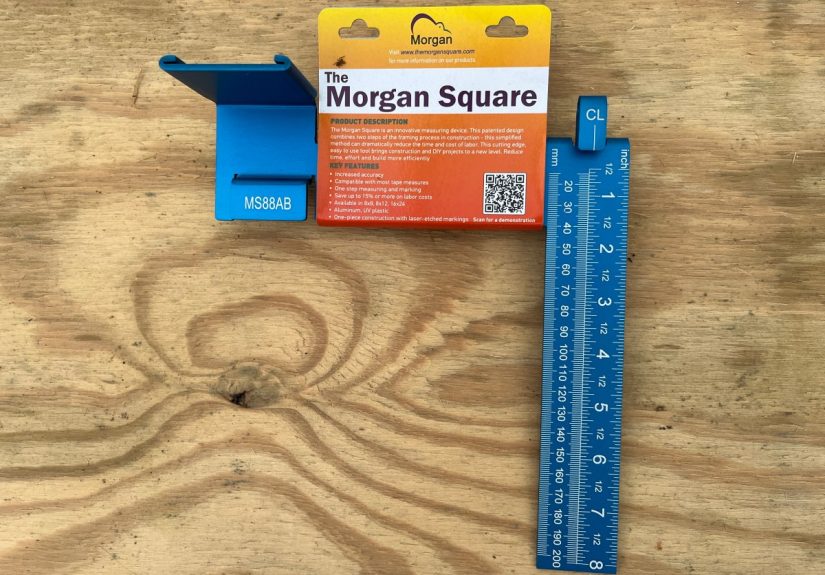
The Morgan Square is a measuring and marking tool designed by Kiwi Vision. Its core idea is simple: combine a square and a tape measure into one working setup so you can measure and mark in one motion instead of switching between tools every few seconds. That is the whole trick, and honestly, it is a pretty good trick.
The tool attaches to a tape measure and lets the user pull a measurement while keeping a square reference in place. It also includes a centerline mark and a 1 1/2-inch tongue that is especially useful for common framing tasks. On paper, that means faster stud layout, quicker line marking, and fewer opportunities to misread, shift, or re-measure. On a busy job, those small savings add up.
Kiwi Vision launched the Morgan Square after developing the idea into a patented product, and the tool has expanded into multiple versions, including plastic and aluminum models as well as different sizes. The product now has visibility through direct sales and major retail channels, which is usually a sign that a niche idea has managed to survive the difficult leap from “interesting invention” to “people are actually buying this.”
First Impressions: Smart Tool or Just Smart Marketing?
The first thing that stands out about the Morgan Square is that it solves a very specific annoyance. That is often how good hand tools are born. Nobody asked for a musical hammer or a Wi-Fi level. People just wanted something that made common work less clumsy.
The Morgan Square does that by reducing the awkward dance of holding a tape, balancing a square, and reaching for a pencil while a board tries to slide away like it has somewhere better to be. If you do a lot of repeated marking, the concept makes immediate sense. It is not trying to reinvent carpentry. It is trying to cut one annoying step out of it.
That practical design is a big reason the tool has attracted attention. A hands-on Bob Vila review gave it a strong rating and highlighted the easy learning curve, durable anodized aluminum construction on the tested model, and the way the attached setup reduced wasted motion during layout. That matters because many “innovative” tools require a learning period so long that the old method starts looking charming again. The Morgan Square appears to avoid that problem.
Where the Morgan Square Actually Helps You Build Faster
1. Repetitive framing layout
This is where the Morgan Square makes its best case. If you are laying out studs, marking repeated centerlines, or handling common framing dimensions, the design can speed things up in a noticeable way. The 1 1/2-inch tongue lines up nicely with standard stud width, which makes repeated layout feel more direct and less fussy.
When a tool saves even a few seconds per mark on a job with dozens or hundreds of marks, that is not a gimmick. That is efficiency. Framing work rewards consistency, and consistency loves tools that reduce extra motion.
2. Quick board and sheet marking
The Morgan Square is also useful when breaking down boards or marking stock before cuts. Instead of using the tape, setting it down, grabbing a square, repositioning, and then marking, you can stay in one rhythm. That is especially handy in a small shop or garage where workflow is already half planning and half dodging clutter.
If your current process feels like a relay race involving only one person, this tool can tighten that up.
3. Solo work
The faster you can do accurate layout by yourself, the more helpful the Morgan Square becomes. Working alone exposes every little inefficiency. No one is there to hold the stock, hand you a pencil, or confirm the measurement you already checked twice because trust issues are part of woodworking now.
By keeping the measuring and marking setup together, the Morgan Square reduces the small interruptions that slow solo builders down. It will not make you grow an extra arm, but it does help the two you have work smarter.
Where It Does Not Magically Transform Your Workflow
1. One-off precision cuts
If you are doing custom cabinetry, fine furniture, or detail-heavy finish work, the speed advantage may shrink. Those jobs often depend on reference surfaces, story sticks, test fitting, and task-specific layout choices. In that context, the Morgan Square is still useful, but it may not be the star of the show.
It helps most when the work is repetitive and linear. It helps less when every cut is a new puzzle.
2. Users who already have a highly optimized system
If you are a seasoned pro with a layout routine you can do in your sleep, the Morgan Square might feel like an upgrade, or it might feel like someone rearranged your kitchen and called it innovation. Good tools do not automatically beat familiar habits.
In other words, this tool helps you build faster if it fits your workflow. If it fights your workflow, it becomes another object to manage.
3. Jobs that do not involve much repeated layout
For occasional DIY jobs, the value depends on the project. If you are framing, building a shed, or doing deck work, the payoff is easier to see. If you are hanging one shelf and building one birdhouse a year, the Morgan Square may be more of a neat gadget than a genuine speed boost.
Build Quality, Compatibility, and Ease of Use
One of the stronger points in available coverage is that the Morgan Square does not seem flimsy. Aluminum versions are described as durable, lightweight, and laser-etched, with both imperial and metric markings. Kiwi Vision also offers plastic models, which make the entry cost lower for hobbyists and casual users.
Compatibility is important here because the entire concept depends on the square pairing smoothly with a tape measure. Kiwi Vision says the tool works with most standard tape measures, and newer wide-tape compatible versions broaden the appeal for users who prefer chunkier tapes. That is good news, because a brilliant layout tool becomes much less brilliant if it turns your favorite tape measure into a relationship problem.
Ease of use also seems to be one of the Morgan Square’s best selling points. The learning curve appears short, which is exactly what you want in a hand tool. Nobody wants to watch a 37-minute tutorial just to draw a straight line on a two-by-four.
The Biggest Weaknesses
No honest Kiwi Vision Morgan Square review should pretend this tool is flawless. Its biggest weakness is that the independent review pool is still relatively small. That does not mean the product is bad. It simply means the public record is not yet overflowing with long-term testing from a wide range of tradespeople.
The second weakness is practical rather than philosophical: one review noted that the pencil slot was too tight for some carpenter pencils. That is not a deal-breaker, but it is the sort of thing that matters when a product is built around convenience. If a convenience tool asks you to shave down your pencil like you are preparing it for a museum exhibit, that counts as friction.
There is also the usual reality of niche tools: some people will love it immediately, and others will wonder why their speed square and tape were apparently not invited to the future.
Is the Morgan Square Worth the Money?
For builders, framers, remodelers, and serious DIYers who repeatedly mark studs, lengths, or centerlines, the answer is probably yes. The tool appears thoughtfully designed, commercially established, and genuinely useful for the kind of layout work it targets.
For casual users, the answer is more conditional. If you like clever tools, want cleaner workflow, and regularly tackle construction-style projects, you will probably appreciate it. If your projects are infrequent and simple, the Morgan Square may be more “nice to have” than “where have you been all my life?”
The best way to think about it is this: the Morgan Square is not a replacement for all layout tools. It is a workflow tool. If workflow is where you lose time, it earns its keep. If your bottleneck is somewhere else, such as cutting, setup, or material handling, it will not suddenly turn you into a speed-building legend.
Final Verdict: Does It Help You Build Faster?
Yes, the Kiwi Vision Morgan Square does help you build faster when your work includes repeated measuring and marking, especially in framing and similar layout-heavy tasks. Its strength is not magic. Its strength is efficiency. It reduces tool switching, simplifies common marks, and helps keep your process moving.
That said, the speed gains are situational. This is not a universal shortcut for every builder and every project. It is a strong specialty tool with broader appeal than most specialty tools, and that is a compliment. If your workday includes repeated layout, it can be a meaningful time-saver. If your projects are more varied, delicate, or occasional, the benefits may be real but smaller.
So here is the clean takeaway: the Morgan Square is a smart buy for people who build often enough to feel every wasted motion. If you have ever thought, “Why am I constantly switching between these same three tools?” Kiwi Vision has already heard you complaining and turned it into a product.
Real-World Experiences With the Morgan Square
To understand whether the Morgan Square helps in actual projects, it helps to imagine the experience of using it in the kinds of jobs people really do. Not showroom demos. Real jobs. Sawdust in your shoes, coffee getting cold, and at least one board that refuses to behave.
Take a basic wall-framing project. With traditional layout, you hook the tape, find your mark, hold the square, grab the pencil, mark one line, shift, and make sure your centerline stays honest. Repeat that over and over. The process works, but it is a lot of tiny motions. With the Morgan Square attached to the tape, that experience becomes more fluid. You hook, slide, mark, and move. It feels less like performing a sequence and more like staying in a groove. That is the kind of change users notice after ten minutes, not ten weeks.
Now picture a solo DIY builder making repeated cuts for a shed, a workbench, or garage shelving. This is the user who tends to appreciate the Morgan Square the fastest. Why? Because solo builders feel every extra tool movement more than teams do. When nobody is nearby to hand you a pencil or hold a board steady, convenience becomes productivity. The experience of using the tool in that setting is not dramatic, but it is satisfying. The layout step feels cleaner. You lose your place less often. You are less likely to re-measure simply because your workflow got interrupted.
In a woodworking shop, the experience is a little more mixed. For rough stock prep, utility cuts, and quick marking on boards or plywood, the tool feels efficient and easy to trust. But when the work gets more exact, some users may go back to their preferred squares, gauges, or story sticks. That does not mean the Morgan Square stops being useful. It just means the “wow, this is faster” feeling may taper off when the job shifts from repetitive layout to precision joinery.
There is also the human side of the experience. Some tools feel intuitive right away, and the Morgan Square seems to land in that category. That matters more than people admit. A clever tool that feels awkward often gets abandoned after the honeymoon period. A simple tool that removes one recurring annoyance has a much better chance of staying on the bench or in the truck.
The most honest experience-based conclusion is this: the Morgan Square does not transform building into a video game speedrun. What it does is remove drag. And in construction or DIY work, removing drag is often how real speed happens. Fewer hand swaps. Fewer tiny layout errors. Less second-guessing. Less wandering around asking, “Where did I put the pencil?” Again.