Table of Contents >> Show >> Hide
- Why Lorne Michaels’ Opinion Still Carries Real Weight
- The Colbert Cancellation Changed the Conversation
- Why Jimmy Fallon Looks Relatively Secure at NBC
- Why Seth Meyers Is Safe, but in a Different Way
- What “Safe For Now” Really Means
- The Political Pressure Around Late Night
- How Lorne Michaels Built the Fallon-Meyers Bridge
- What NBC Gets by Keeping Both Hosts
- Could Late Night Still Change Dramatically?
- Experience Notes: What This Moment Feels Like for Viewers, Writers, and Comedy Fans
- Conclusion: Safe Does Not Mean Untouchable
Note: This article is written as an original web-ready editorial analysis, synthesized from publicly reported entertainment and media-business coverage, without source links in the body.
Late-night television has always lived on a strange schedule: written during the day, performed at night, clipped by breakfast, judged by lunch, and forgotten by dinner unless something went viral enough to start a group chat war. So when Lorne Michaels, the quiet emperor of American sketch comedy, says Seth Meyers and Jimmy Fallon are safe at NBC “for now,” it is less a casual update and more a weather report from inside the storm.
The storm, of course, is the ongoing shake-up in late-night TV. CBS made headlines by announcing the end of The Late Show with Stephen Colbert, a decision the network described as financial rather than creative or political. The move shocked viewers because Colbert was not some forgotten host whispering jokes into the void. He remained one of the most visible figures in late-night comedy, especially for viewers who wanted sharp political commentary with their bedtime snack.
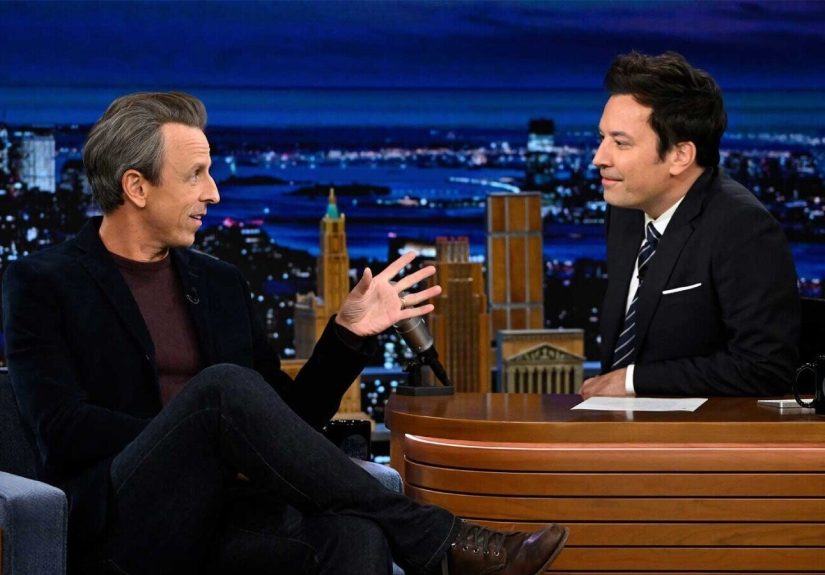
That is why Michaels’ confidence in The Tonight Show Starring Jimmy Fallon and Late Night with Seth Meyers matters. Fallon and Meyers are not just NBC employees; they are part of the Lorne Michaels comedy pipeline that has shaped television for decades. Michaels helped guide both men from Saturday Night Live into late-night hosting, and his continued role as executive producer gives his comments extra weight. When Lorne speaks, NBC may not officially bow, but everyone in the building at least stops chewing their salad.
Why Lorne Michaels’ Opinion Still Carries Real Weight
Lorne Michaels is not merely a producer with a nice office and a mysterious calendar. He is the creator of Saturday Night Live, the longtime steward of NBC comedy, and one of the most influential talent spotters in American television. His track record includes turning sketch performers into household names, creating a weekly comedy institution, and building a late-night ecosystem that stretches from Studio 8H to The Tonight Show.
That history matters because late-night television is not just about ratings. It is about trust, institutional memory, production discipline, and the ability to make a show every single weekday without collapsing into a pile of cue cards. Michaels understands that machine better than almost anyone. He has watched television evolve from three-network dominance to cable fragmentation to streaming chaos to the current era where a monologue joke may matter less on TV than as a 42-second vertical clip.
So when Michaels says Fallon and Meyers appear safe, he is likely speaking from more than optimism. Both hosts have contracts running through 2028, and NBC has continued to present late night as a core part of its brand. That does not mean the format is bulletproof. It means NBC still sees value in having familiar comedy voices attached to its nightly schedule, its Peacock strategy, its YouTube presence, and its larger entertainment identity.
The Colbert Cancellation Changed the Conversation
The cancellation of The Late Show with Stephen Colbert turned industry anxiety into a five-alarm fire. CBS said the decision was financial, pointing to the difficult economics of late-night television. That explanation was believable to anyone who has watched traditional TV advertising shrink. It was also controversial because Colbert’s show remained culturally prominent, politically pointed, and connected to broader debates around corporate ownership and media pressure.
Late-night shows are expensive. They require large staffs, studio space, writers, producers, bookers, crews, editors, bands or music departments, digital teams, and a constant guest pipeline. In the old world, that machine was supported by strong linear ratings and reliable advertising revenue. In the new world, many viewers encounter late-night shows in fragments: a YouTube monologue here, a TikTok interview clip there, a celebrity game segment reposted on Instagram, and perhaps the full episode if the couch is comfortable and the remote has not vanished into another dimension.
That shift has made the business harder. A show can still be culturally relevant while becoming financially less attractive to a network. This is the uncomfortable truth behind the Colbert decision and the reason Michaels’ reassurance about Fallon and Meyers includes an invisible asterisk. “Safe” in today’s media business rarely means “safe forever.” It usually means “safe unless the math changes, the merger changes, the boss changes, or the audience changes again.” In other words: television is now a subscription service to uncertainty.
Why Jimmy Fallon Looks Relatively Secure at NBC
Jimmy Fallon remains one of NBC’s most valuable late-night assets because his version of The Tonight Show was practically engineered for the internet before every executive started saying “digital-first” in meetings. Fallon’s comedy style leans heavily on celebrity games, musical bits, impressions, viral-friendly interviews, and lighthearted segments that can travel far beyond the 11:35 p.m. time slot.
That matters because Fallon’s show is not only a broadcast program. It is a content factory. A single performance, game, or celebrity moment can live on YouTube, social media, entertainment blogs, and streaming platforms long after the original episode airs. For advertisers and network executives, that multiplatform life helps justify the show’s continued existence even as traditional late-night viewing declines.
Fallon also occupies one of the most famous chairs in American television. The Tonight Show brand stretches back through Johnny Carson, Jay Leno, Conan O’Brien, and other major figures in NBC history. Canceling or radically shrinking that franchise would not be a small programming tweak. It would be a statement that NBC no longer believes in one of its own crown jewels. Networks can make bold decisions, but they usually prefer not to drop a piano on their own foot unless the insurance paperwork is excellent.
Fallon’s Strength: Shareable Entertainment
Fallon’s biggest advantage is that his show does not depend entirely on political heat. While he does monologues and topical jokes, his strongest identity is upbeat, celebrity-driven entertainment. That can be a weakness for viewers who want sharper satire, but it is a strength for a network trying to avoid unnecessary turbulence. A Fallon segment with a pop star, actor, athlete, or viral musician can reach viewers who never planned to watch late-night television at all.
In the current media environment, that flexibility is gold. Fallon can function as a traditional host, a digital clip generator, a music platform, and a celebrity publicity stop. He is not immune to budget pressure, but his format gives NBC multiple ways to extract value from the show.
Why Seth Meyers Is Safe, but in a Different Way
Seth Meyers has a very different late-night identity. Where Fallon often goes broad and playful, Meyers has built Late Night around smart political commentary, writerly structure, and the signature segment “A Closer Look.” His show feels less like a celebrity party and more like a sharp newsroom that accidentally discovered punchlines. That makes Meyers valuable in a different lane.
Meyers has credibility with viewers who want analysis, satire, and a host who can take a complicated political story and turn it into a coherent comedy argument. His years as head writer and “Weekend Update” anchor on Saturday Night Live trained him for exactly that job. He can make policy sound ridiculous, hypocrisy sound theatrical, and congressional dysfunction sound like a workplace sitcom with worse lighting.
Still, Meyers has been honest about the uncertainty facing late night. He has acknowledged that the future of the format is partly outside any host’s control. That honesty is important. It shows that even successful hosts understand the business model has changed. Talent matters, but talent alone cannot reverse advertising decline, audience fragmentation, or corporate cost-cutting.
Meyers’ Challenge: A Smarter Show in a Smaller Slot
The challenge for Meyers is that his show airs later and has already faced visible budget pressure. The loss of the 8G Band as a regular live feature reflected the broader scrutiny on late-night costs. That did not mean NBC had lost faith in Meyers. It did mean the network was willing to trim the format to make the economics work.
That may be the future of late night: not instant cancellation, but gradual adjustment. Smaller budgets. Leaner staffs. More reusable digital packaging. More emphasis on clips. Fewer expensive flourishes. The host remains, the desk remains, the jokes remain, but the machinery around the show becomes more efficient. Show business, sadly, is still business. Even the punchlines have invoices.
What “Safe For Now” Really Means
The phrase “safe for now” sounds reassuring until you stare at it for more than three seconds. It does not mean Fallon and Meyers can coast until retirement with monogrammed mugs. It means NBC currently appears committed to them, especially with both hosts under contract through 2028. It also means the network is likely watching the numbers carefully.
Television safety used to be easier to define. If a show won its time slot, attracted advertisers, and kept affiliates happy, it was safe. Now the calculation is messier. Networks consider broadcast ratings, streaming performance, YouTube views, social engagement, production costs, brand value, subscriber funnels, political risk, talent relationships, and whether a segment can be chopped into six clips before midnight.
In that environment, Fallon and Meyers are safer than many because they serve different strategic purposes. Fallon protects NBC’s entertainment legacy and celebrity-friendly reach. Meyers protects NBC’s sharper political-comedy credibility. Together, they give the network a balanced late-night lineup: one show for games, music, and broad pop culture; another for satire, politics, and desk-driven commentary.
The Political Pressure Around Late Night
Late-night comedy has always irritated powerful people. That is part of the job description. Hosts make jokes about presidents, corporations, media executives, celebrities, scandals, and occasionally their own networks if the legal department is blinking slowly from the back of the room.
In recent years, however, the relationship between politics and late-night television has become more intense. Colbert, Meyers, Jimmy Kimmel, and other hosts have regularly criticized Donald Trump and his allies. Supporters of these hosts see that criticism as necessary satire. Critics argue late night became too politically one-sided and alienated large parts of the audience. Both arguments help explain why late night is now discussed not just as entertainment, but as a cultural battlefield.
Michaels has generally avoided turning every industry question into a political manifesto. That restraint is part of his style. He knows comedy survives by staying nimble. But NBC’s support for Fallon and Meyers suggests the network is not ready to abandon late-night commentary simply because the climate is tense. If anything, political tension can make these shows more visible, even as it also makes them riskier.
How Lorne Michaels Built the Fallon-Meyers Bridge
One reason this story is so interesting is that Fallon and Meyers represent two different branches of the same Lorne Michaels tree. Fallon came from the performer side of SNL: musical, loose, impression-friendly, and celebrity-adjacent. Meyers came from the writer-anchor side: precise, structured, topical, and analytical. NBC did not simply hire two random hosts. It extended the SNL talent-development model into nightly television.
That model has worked because SNL is a pressure cooker. Performers and writers learn how to create quickly, respond to news, collaborate under stress, and survive public criticism. Late-night hosting requires many of the same muscles. You need timing, stamina, improvisational confidence, and the emotional resilience to deliver jokes on days when the news feels like it was written by a sleep-deprived raccoon.
Michaels’ influence gave Fallon and Meyers credibility inside NBC. It also gave them a shared comedy lineage while allowing them to develop distinct voices. That is why the future of these shows is also a question about Michaels’ broader legacy. If NBC keeps investing in Fallon and Meyers, it is also preserving the late-night empire Michaels helped build.
What NBC Gets by Keeping Both Hosts
Keeping Fallon and Meyers gives NBC continuity at a time when viewers are already overwhelmed by change. Streaming platforms rise and merge. Cable channels shrink. Broadcast networks fight for live events. Viewers bounce between apps like they are trying to win a prize. In that landscape, familiar hosts still matter.
Fallon and Meyers provide nightly rhythm. They create predictable promotional windows for NBCUniversal projects, film studios, musicians, athletes, authors, and political figures. They also generate a constant stream of digital content. Even when a full episode does not dominate the ratings conversation, individual segments can travel widely.
There is also brand value. NBC has a long association with late-night comedy, from Johnny Carson to David Letterman’s Late Night, from Conan O’Brien to Jay Leno, from SNL to Fallon and Meyers. Walking away from that history would be a major identity shift. NBC may adjust the economics, but abandoning the entire category would mean surrendering a piece of its cultural DNA.
Could Late Night Still Change Dramatically?
Absolutely. “Safe for now” does not mean “unchanged forever.” The most likely future is evolution rather than extinction. Shows may become cheaper to produce. Seasons may shift. Digital teams may become even more important. Segments may be designed with online audiences in mind from the first draft. Networks may expect hosts to support streaming platforms, podcasts, live events, and social channels in addition to the traditional broadcast.
In practical terms, Fallon and Meyers may remain on NBC while their shows continue adapting around them. Fallon’s program may lean even harder into music, games, and celebrity moments built for sharing. Meyers may continue emphasizing political deep dives and desk pieces that perform well online. Both shows may become less dependent on the old idea of millions of people watching live at the same time.
The future of late night may not look like the past. It may look smaller, faster, more digital, and more fragmented. But that does not mean it has no future. People still want someone funny to explain the absurdity of the day. They just may not wait until 11:35 to hear it.
Experience Notes: What This Moment Feels Like for Viewers, Writers, and Comedy Fans
For longtime viewers, the uncertainty around Fallon and Meyers feels personal because late-night shows often become part of a nightly routine. People do not simply “consume content” at the end of the day. They decompress. They fold laundry with a monologue playing. They watch an interview while pretending they are not eating cereal at midnight. They send a clip to a friend with the message, “This is so you.” Late night becomes background, habit, comfort, and sometimes the only funny version of a stressful news cycle.
That is why the Colbert cancellation hit harder than a normal programming change. When a late-night show disappears, a small cultural ritual disappears with it. Viewers lose not only a host, but a familiar rhythm. Staff members lose jobs. Writers lose a daily outlet. Guests lose a platform. The industry loses another signal that the old system can still support ambitious nightly comedy. It is easy to talk about ratings and revenue, but the human part matters too.
From a writer’s perspective, the Fallon-Meyers situation is a reminder that comedy is both art and infrastructure. A great joke needs talent, but a nightly show needs a machine. It needs researchers, segment producers, editors, cue-card handlers, bookers, camera operators, makeup artists, audience coordinators, and people who can calmly solve problems five minutes before taping. When budgets shrink, that machine gets strained. The audience may only notice when something big disappears, like a house band, but every cut changes the texture of the show.
For comedy fans, Michaels’ reassurance offers cautious comfort. Fallon and Meyers are different enough that keeping both makes sense. Fallon is the host you watch when you want a celebrity to play a silly game and briefly forget that your inbox exists. Meyers is the host you watch when the news is confusing and you need someone to organize the madness into jokes with footnotes. Together, they show why late night still has creative range.
For NBC, the lesson is more practical. The network does not need late night to be exactly what it was in 1995, 2005, or even 2015. It needs late night to justify itself in 2026 and beyond. That means being useful across platforms, culturally visible, financially disciplined, and flexible enough to survive changing viewer habits. Fallon and Meyers can do that, but the shows around them must keep evolving.
For anyone watching this unfold, the best way to understand “safe for now” is as a status update, not a guarantee. Fallon and Meyers are not in immediate danger based on what Michaels and NBC’s broader posture suggest. But they are working in a format under pressure. Their survival depends not only on talent, but on adaptation. Late night is not dead. It is being renovated while everyone is still inside the building, which explains the dust, the noise, and the occasional nervous laughter.
Conclusion: Safe Does Not Mean Untouchable
Lorne Michaels’ belief that Seth Meyers and Jimmy Fallon are safe at NBC should reassure fans, but it should not lull anyone into thinking late-night television is immune to change. The Colbert cancellation proved that even high-profile hosts can become vulnerable when the business model weakens. Contracts matter. Corporate support matters. But revenue, audience behavior, and production costs matter too.
Fallon and Meyers remain valuable because they offer NBC two distinct versions of modern late night. Fallon delivers broad, celebrity-powered entertainment that travels well online. Meyers delivers sharp political comedy and thoughtful satire with a loyal audience. Michaels’ confidence reflects their strengths, NBC’s history, and the strategic value of keeping late night alive.
Still, the phrase “for now” is doing a lot of work. The future of late night will belong to hosts and networks that can adapt without losing the human spark that made the format matter in the first place. As long as Fallon and Meyers keep delivering that sparkand as long as NBC can make the math worktheir jobs look safe. Not carved in stone, maybe, but at least written in something stronger than dry-erase marker.